


Yesterday, I wrote here about a tree and some bats.
A newly reported federal memo concerning the Endangered Species Act offered a remarkably narrow account of what it means to “take” an endangered animal: if someone fells a tree without intending to kill the bats roosting inside it, the memo argues, the bats have not been taken. They may be dead. The tree may be gone. But the intention was directed somewhere else.
I keep returning to the question underneath that sentence... Are we responsible only for the world we intended to make, or also for the world our actions actually make?
Then, almost immediately, the same question came home to Spartanburg as I was catching up on the news last night.
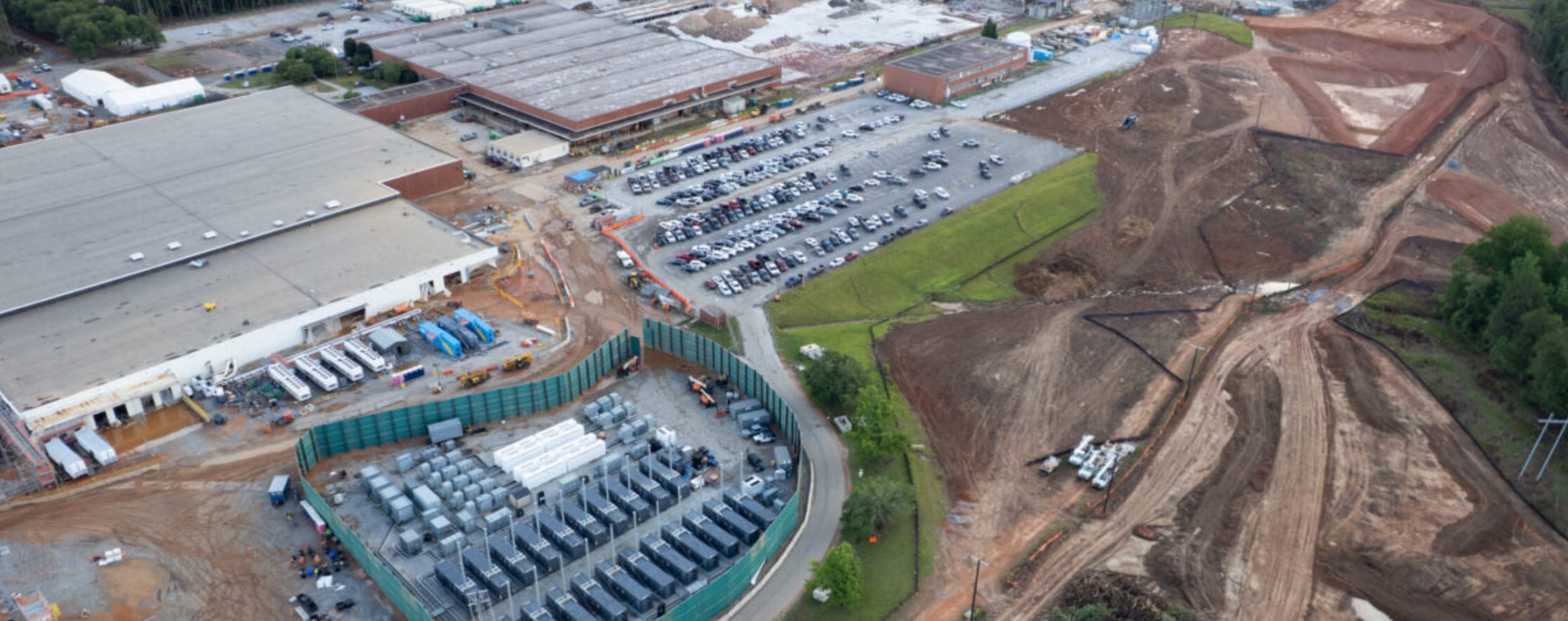
On Thursday (yesterday), attorneys were in a Spartanburg County courtroom arguing over the Valara data center now under construction on South Pine Street. The case is obviously not about endangered bats, and the legal questions are different. Residents organized as Concerned Citizens of Spartanburg County are challenging how the county handled the project’s land-development approval and are asking that Valara be required to go through the county’s major-land-development process, which would bring additional public review. Valara and county officials dispute that account of the permitting process and have defended the project’s approvals.
The judge didn’t immediately make a ruling yesterday. He said he would review the parties’ materials and issue orders later. So, I don’t know how the case will be decided eventually.
What caught my attention was something smaller.
Dust.
The Dust
According to WSPA’s report from the hearing, attorneys for residents raised concerns about dust, light, and noise experienced by people living near the construction site.
Valara’s attorneys reportedly argued that those effects do not amount to the kind of “irreparable harm” that would justify stopping construction. Representatives also said the company has been responding to neighbors’ concerns.
Then Catherine Wannamaker, a senior attorney with the Southern Environmental Law Center representing the residents, asked a wonderfully concrete question.
If there isn’t real harm here, she asked in substance, why are houses being power-washed for free and residents being offered car washes?
I keep thinking about the houses today.
That’s not really because a dusty house resolves a lawsuit or anything of that sort. It obviously doesn’t. Courts have standards for injunctions, land-development ordinances have definitions, and parties disagree about what the county knew, what the developer disclosed, what permits were required, and what remedies are appropriate. Those questions deserve more care than a photograph of construction dust can provide.
But ecology has a habit of becoming concrete before our categories are ready for it. Dust settles somewhere. Noise is heard by somebody. Light crosses a property line, and water runs downhill. Air moves.
A megawatt generated on one side of a fence does not remain conceptually inside the parcel where a turbine sits.
The interesting question, I think, isn’t whether an effect exists. Sometimes everybody agrees that something exists.
The harder, more interesting, question is: What has to happen before what we perceive is allowed to count?
From Seeing to Recognition
I’ve spent much of this year writing about attention here on Carolina Ecology as well as in my own research and work.
My spring work on AI data centers began with a simple claim: the ecological crisis surrounding digital infrastructure is partly a crisis of perception. The language of “the cloud” makes intensely material systems seem immaterial. Electricity, water, natural gas, transmission, minerals, server hardware, roads, tax structures, and land disappear behind a clean interface.
Project Spero made that argument tangible for me. Once people in Spartanburg County began looking closely at the proposed data center near the Tyger River, things that had been background became foreground. Hundreds of people came to meetings. Residents asked about electricity and water. They read tax agreements. They learned the language of megawatts and closed-loop cooling. A project that had initially appeared as another economic-development announcement became visible as a set of relationships. This didn’t only happen on Substack or Reddit... people in pews and at Scouts’ meetings for our kids were asking me about these things.
I came away from that episode with a phrase I still believe:
You can’t protect what you can’t see.
But the Valara hearing makes me think that sentence is incomplete. Because what happens when people do see?
What happens when the light is visible from the porch, when the construction can be heard from the yard, when the dust is on the siding, when residents know that a project first publicly discussed in one set of terms is now associated with plans for power generation on a dramatically larger scale?
Seeing does not automatically produce recognition. But recognition does not automatically produce responsibility, either.
There are institutions between those things.
There are permit categories and evidentiary standards and zoning classifications. There are definitions of nuisance and harm. There are engineering reports and air permits and tax agreements. There are rules about who may speak, when they may speak, what evidence is admissible, and which kinds of effects fall inside the jurisdiction of which agency.
Those structures are necessary. A community really can’t govern itself by treating every perception as proof of something.
But neither are those structures neutral windows onto the world. They are frames. They determine what becomes legible as a fact that can make a claim on a decision.
That is where the ecological question gets interesting.
What Counts?
A few weeks ago I wrote about a Spartanburg County Council meeting where officials and residents were looking at the same data center and, in important ways, seeing different things.
The philosophical word I kept returning to then was doxa: appearance, opinion, what something seems to be. I contrasted it with the Hebrew kavod, weight or heaviness. A project has a public image, but it also has weight. Megawatts have weight. Water withdrawals have weight. Turbines and transmission lines and tax commitments have weight.
Now I think there is another step. Something can appear. Something can have weight.
And still the institutions responsible for making a decision must determine whether that weight counts. That word is doing a lot of work in this framing.
Does construction dust count as inconvenience or harm?
Does noise count if it remains below a regulatory threshold?
Does a foreseeable ecological consequence count if nobody intended it?
Does a 450-megawatt power plan belong inside the frame through which a redevelopment project was originally evaluated?
At what point does an accumulation of individually permissible effects become a different kind of thing?
I’m not supplying the legal answers to those questions or capable of doing so. That’s what the litigation and permitting processes are for.
But I do think ecology gives us reason to keep asking them.
Ecology is full of realities that become consequential through accumulation and relation. A single warm day is weather. A changing distribution of warm days becomes climate. A gallon of runoff is trivial. Acres of impervious surface reorganize a watershed. One light may be an annoyance. An illuminated industrial landscape can change the nighttime world experienced by people, birds, insects, and other creatures.
The categories we use to govern these things necessarily divide the world into manageable pieces. The world itself does not promise to stay divided that way.
The View From Above
There is a philosophical term I will probably be spending a good deal of time with this fall: survol (good read behind the link if you’re into philosophy).
Literally, it suggests an overflight, a view from above (in English we use “survey” but it’s not nearly as glamorous or precise as the French term).
There are good reasons to want such a view. From above, the parcel has boundaries. The project has a permit number. The generating facility has a capacity. The tax agreement has terms. Noise has decibels. Emissions have limits. Dust has particulate measurements.
We need those abstractions because no one can govern a county entirely from a front porch. But, nobody actually lives at 10,000 feet. We live down here on the soil.
Down here, the parcel boundary is where the light crosses, the sounds people hear, with the construction work becoming dust on a car while the electrical capacity becomes turbines, gas supply, emissions, and infrastructure.
The abstract project becomes a neighbor.
A mature ecological politics has to be able to move between those perspectives without allowing either one to erase the other. The view from above can reveal relationships invisible from a single yard. The view from a yard can reveal consequences invisible on a site plan.
The danger begins when one perspective declares itself complete.
On the Bat and the Dust
Which brings me back to yesterday’s bats.
I did not expect an Endangered Species Act memo and a Spartanburg data-center hearing to speak to each other, but they do. They concern different laws, different actors, and very different kinds of harm.
But both have left me thinking about the distance between intention, consequence, perception, recognition, and responsibility.
An actor intends something. The action enters a world already full of relations, and consequences follow. Someone or something experiences them. Those consequences become perceptible. Then a community, agency, court, or law has to decide whether what appeared will be recognized as something that matters.
That last part is easy to overlook and is often relegated to the “oh well” category.
I’ve spent years arguing that attention matters because responsibility begins by allowing more of the world to appear. I still think that’s true.
But perhaps attention is only the first discipline.
The next is recognition: developing forms of public life capable of receiving what attention reveals. Otherwise we can become very good at seeing and remain strangely powerless before what we see.
The black walnut behind my house has taught me something about this too. Sitting with it day after day has not produced mastery over the tree. Quite the opposite. The more closely I attend, the more particular the walnut becomes and the more relations come into view that I had previously missed.
Attention enlarges the field while responsibility begins when I allow what appears in that enlarged field to make a claim on me. Our institutions at the local, state, and federal levels face a similar challenge.
The question is not whether every claim wins. Ecology doesn’t eliminate judgment, but makes judgment harder by not allowing us to pretend that only one thing is happening at a time.
Neighbors need homes in which they can sleep, breathe, sit outside, wash their cars for ordinary reasons, and trust that decisions shaping the places where they live have not rendered them invisible.
All of those things can be true at once.
The work is learning how to build institutions capable of seeing enough of that world to judge among them. Yesterday I wrote that responsibility begins by allowing more of the world to appear.
Today I would add one sentence:
Seeing is not enough if what appears is never allowed to count.