

There is a sentence in a new federal memo that I have not been able to get out of my head this week:
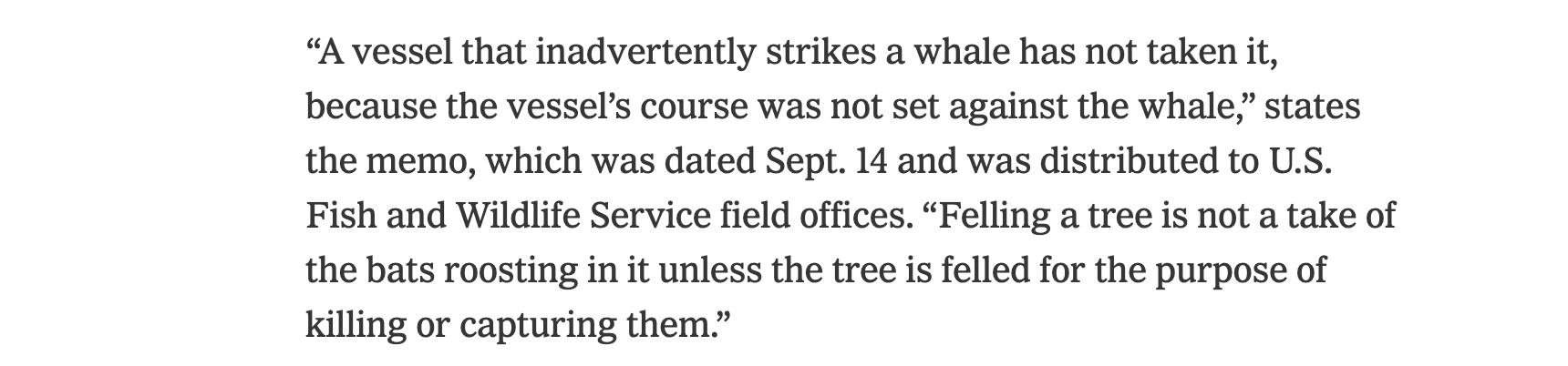
“Felling a tree is not a take of the bats roosting in it unless the tree is felled for the purpose of killing or capturing them.”
The sentence comes from an internal U.S. Fish and Wildlife Service memo reported this week by Catrin Einhorn in The New York Times. It concerns a deceptively small word in the Endangered Species Act: take.
The statute defines “take” to include actions such as harassing, harming, pursuing, wounding, killing, trapping, capturing, or collecting protected wildlife. For decades, the federal regulatory system has also addressed incidental take: harm to a protected animal that occurs as a foreseeable consequence of another activity. A developer may not set out to kill a salamander. A logging operation may not set out to kill a bat. A ship captain may not set out to strike a whale. The point has been that intention does not exhaust responsibility.
That framework has been changing. In July, the Fish and Wildlife Service and National Marine Fisheries Service finalized a rule rescinding the longstanding regulatory definition of “harm,” which had included significant habitat modification or degradation that actually kills or injures wildlife by impairing essential behaviors such as breeding, feeding, or sheltering. The rule took effect September 14. The administration argues that the older definition extended the Endangered Species Act beyond the statute's best reading and imposed unjustified regulatory burdens. Environmental organizations and a coalition of states have challenged that interpretation in court.
The newly reported Fish and Wildlife Service memo appears to push the question further. According to Einhorn’s reporting, the memo interprets “take” so that an action must be directed intentionally against the animal. The tree can be felled, and the bats can die. But if the purpose of cutting the tree was something other than killing the bats, the memo’s logic says that the bats were not “taken.”
I am interested in that sentence not only because of endangered-species law. I am interested in the picture of the world contained inside it.
The Tree and the Bat
A tree is never only a tree.
That should be an unremarkable ecological observation. A tree is habitat, shade, food, water movement, fungal partnership, carbon storage, nesting site, hunting ground, memory, boundary, seed source, temperature regulation, and a participant in relationships extending farther than we can see from where we stand.
Cutting one down therefore does not produce a single action with a single object. The saw may be directed toward the trunk, but the action enters an already existing field of relations.
The bats do not become less dead because they were not what the tree-cutter was thinking about.
This is where the legal question begins to touch something I have been trying to understand in my own work on ecological intentionality. Philosophers use intentionality in a technical sense: consciousness is directed toward something. I look at the tree, hear the bird, notice the creek. Something becomes focal while much else remains at the edge of attention.
But ecology keeps making trouble for the focal point.
The tree I perceive is not simply a bounded object I happen to be looking at. Its roots disappear into soil inhabited by fungi and microbes. Its crown becomes shelter and pathway. Its leaves alter the small climate beneath it. Water moves differently because it is there. Other lives have incorporated its continued existence into their own possibilities.
The ecological problem is that our actions work the same way. They exceed their intended objects.
We grade a parcel for houses and alter the drainage beyond the property line. We widen a road and change where animals can move. We build a warehouse or data center and create new demands for electricity, water, pavement, transmission lines, and stormwater management. We remove a patch of woods and discover afterward that what looked like unused land from one perspective was already being used in hundreds of ways by lives we hadn’t learned to notice.
Obviously, this doesn’t mean that houses shouldn’t be built, roads shouldn’t be improved, trees should never be cut, or economic activity should stop. Here in the Carolinas, those easy binaries are increasingly useless despite the ongoing attempts by social media campaigns to persuade us otherwise. We need housing ordinary families can afford. We certainly need infrastructure. We need jobs and schools and places for communities to grow.
But we also need a vocabulary capable of describing what our actions actually do. And intention alone is too small a vocabulary.
The Ecology Outside the Frame
I keep returning in my Carolina Ecology writing to the problem of frame.
Data centers can be described as buildings on an industrial parcel. Change the frame, and they become part of a watershed, an electrical grid, regional gas buildouts, sets of transmission corridors, tax structures, and landscapes of human and more-than-human neighbors. A subdivision can be described as a collection of houses. Change the frame, and it becomes roads, schools, sewer lines, impervious surface, displaced habitat, altered runoff, longer commutes, and families trying to find somewhere they can afford to live.
Neither description is false. The question is what becomes invisible when one of them is treated as complete.
That’s what makes the tree-and-bats example so revealing to me. The action remains tightly framed around the actor’s purpose: What did you mean to do? The ecological field asks another question: What did your action enter into?
I don’t think those are the same question.
Ecology is, among other things, the study of consequences that refuse to remain inside our categories. Water crosses property lines. Air ignores zoning maps. A bat roosts in a tree without consulting the deed. A salamander does not know that the bulldozer clearing its habitat is aimed at economic development rather than at the salamander.
The world is full of lives for whom our unintended consequences are simply consequences.
This is one reason attention matters so much. Attention can’t guarantee that we will make the right decision. It doesn’t eliminate tradeoffs or tell a growing Carolina city exactly how many houses to build or where to put them. But attention can make the field of relationship harder to erase before the decision is made.
That is a modest claim, but I increasingly think it is an important one: responsibility begins by allowing more of the world to appear.
Before the Saw
Over the last few years, I have spent a great deal of time sitting beneath a black walnut behind our house in Spartanburg. Much of that practice is deliberately uneventful. I sit. I look. I listen. I notice leaves yellowing, squirrels moving through branches, insects landing on bark, shadows changing as the morning moves.
The longer I do it, the harder it becomes to perceive the walnut as an isolated object.
Not because the tree dissolves into some vague cosmic oneness. Quite the opposite. The tree becomes more particular. This leaf. This scar in the bark. This branch where the squirrel stops. This patch of shade where my daughter leaves a chair so she can draw. The walnut becomes more itself as its relations become more visible.
That’s become one of the working intuitions behind ecological intentionality: better attention does not erase difference; it reveals relation without exhausting the beings related.
And perhaps that’s what troubles me about the sentence in the memo.
“Felling a tree is not a take of the bats roosting in it unless the tree is felled for the purpose of killing or capturing them.”
Before the saw starts, there is already more happening than the intention of the person holding it.
There is the tree. There are the bats.
There is the habitat that made their roosting possible. Whatever brought the person and the saw to this particular tree exists. There is whatever will replace it. Water will fall on this ground after the canopy is gone. There is the future forest that may or may not grow here. Human needs, economic pressures, property rights, and laws attempt, imperfectly, to hold these competing claims together.
The difficult work of ecology is not pretending those tensions disappear. That difficult work is refusing to make them disappear by narrowing the frame.
The Endangered Species Act debate will continue in agencies and courts, and people far more qualified than I am will argue the legal meaning of “harm” and “take” to interpret federal wildlife law. But underneath that legal dispute is a question that belongs to all of us who inhabit landscapes undergoing rapid change:
Are we responsible only for the world we intended to make, or also for the world our actions actually make?
Here in the Carolinas, where forests become subdivisions, farms become industrial parks or data centers, rivers become infrastructure, and communities are trying to make room for both human flourishing and the lives already inhabiting these places, that question is not abstract.
It is there before the first tree falls.
Sources / Working Links
Trump Administration Moves to Gut a Core Endangered Species Protection — Catrin Einhorn, The New York Times, September 16, 2026.
U.S. Fish & Wildlife Service, Endangered Species Act §3 definition of “take.”