


The first sign wasn’t a “coming soon” one with a name attached, but a gap in the treeline along South Pine Street, where the pines had stood one week and were gone the next (you can drive by the site and still see the massive collection of pine carcasses), with their root plates turned up red and wet in the June and now July heat. People who drive that road every morning, as I do, have noticed the absence and the large security presence at the entrance. That’s usually how it goes. Land, water, and air tell you something is happening in the only language they have, which is the language of what is suddenly missing, and the paperwork catches up later, if it catches up at all. Before a press release or public discussion, there was a wound, and the wound was legible to those of us with the habit of looking.
Now the story has reached an opinion piece in The Washington Post (archive link), which means the thing many Spartanburg residents have been piecing together from felled trees, public notices, permit applications, county council meetings, rumors, livestreams, and long nights in public rooms has finally become legible to a national audience. Kathleen Parker’s column is useful because it points out what has been true all along... this project arrived through a structure of concealment, euphemism, and delayed public knowledge. The county didn’t receive a data center first. It first received a language system and grammar designed to prevent ordinary people from knowing what they were being asked to accept.
When the name finally did come, it was built to give nothing away. Project MOC-1 was the initial title of the project. A “high-performance computing center,” the county called it, in the flat municipal dialect designed to slide past the ear without leaving a mark. Say it aloud a few times, MOC-1, and notice what the tongue is doing. The name mocks the mouth that tries to hold it. It’s a placeholder wearing the costume of a fact, a set of syllables assembled so that a person reading a council agenda would feel informed but know almost nothing. That was the point, I think. For a good while, the phrase did exactly the work it was hired to do.
“Data center.” We say “data” as though it were the most modern thing in the world, the very substance of the future being poured into a place. But data is a Latin plural, datum in the singular, from dare, to give, and beneath the Latin sits an older Greek word still: δεδομένα (dedomena), the perfect passive participle of δίδωμι (didōmi), to give. Euclid titled a whole book of geometry with it, Δεδομένα, “the given things,” the magnitudes handed to you at the outset so that you could reason your way toward what you did not yet know. We should all read more Euclid. Data means the given, and it means a gift. In this case, the reversal came when the thing named for giving was, in almost every particular that mattered to the public, taken and withheld. Trees were taken while the forty-year tax arrangement was withheld, even though it had already moved through the machinery of approval. The council, we are now told, was bound by nondisclosure and was “not at liberty” to spell the whole thing out loud.[2]
The withholding wasn’t a failure of communication, but was the architecture of the deal. NorthMark Strategies, a New York investment firm, moved through a subsidiary called Valara Holdings and through a county process shaped by... silence. In April 2025, NorthMark and the governor’s office announced a $2.8 billion “high-performance computing center” at the former Kohler facility. The announcement praised innovation, investment, remediation, and minimal strain on the power grid. It also gave the number that should have stopped every celebratory sentence in its tracks... at least twenty-seven full-time jobs. Twenty-seven, against one of the largest single investments in the history of the state.[3]
Kohler’s vitreous works turned clay and fire into white vessels meant to hold water cleanly: sinks, basins, and the ordinary sacramental furniture of a house. The bowl you fill, empty, and fill again. Vitreous, from vitrum (glass), is clay-fired, glassy, and impervious, so it could cradle water without drinking it. Now the vessel-making floor is becoming a machine that does the opposite of holding. It will draw on the county’s water and air to cool rooms full of processors, and it will give back what it is built to give back: heat, exhaust, and a low, continuous mechanical breathing that does not stop.
A Moment of Civic Attention in Spartanburg

Over the last few months, something unusual happened here in Spartanburg. For a brief moment, a large number of people began paying close attention to something that usually remains invisible... the infrastructure that quietly shapes daily life. Water systems, electrical capacity, land use, and industrial development. The complicated negotiations betwee…
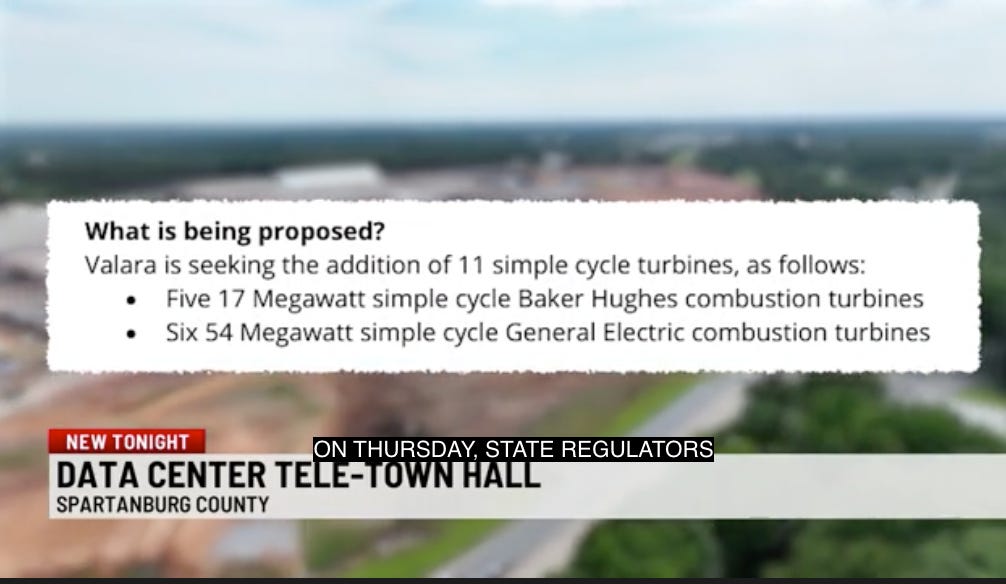
We were told this data center would be different. It would generate its own power off a gas line, would not lean on the Spartanburg County grid, would draw no more than the old plant drew, and would sit “lightly” on the county. To feed the machine, Valara has now asked South Carolina environmental regulators for permission to expand onsite generation with additional natural gas-fired turbines. The draft permit isn’t a minor paperwork adjustment, as the project continues to move toward its end of construction with massive equipment active on the site daily. It’s the document in which the language of quiet promises of “self-generation” becomes stacks, emissions limits, modeling, formal comments, and the public’s belated right to speak.[4]
If approved, the facility would release hundreds of tons of pollutants annually through exhaust stacks rising over Spartanburg County. Parker’s piece points out that more than nine tons of formaldehyde and 158 tons of fine particulate matter would be emitted. Formaldehyde is a carcinogen. Fine particulate matter is small enough to get deep into the lungs and is associated with serious respiratory and cardiovascular harms. These aren’t abstractions. They’re names for what enters breath.[5]
And notice what the permit itself is called here. The document now under review is a Synthetic Minor construction permit, a designation that means the applicant has promised to keep its emissions just below the thresholds that would make it a major source. A minor source is the official word for it. This is a facility the Southern Environmental Law Center says would become one of the county’s largest emitters of formaldehyde and fine particulate, under limits the Center argues are written so loosely as to be, in practice, unenforceable. Rather than being a measurement, minor is one more name doing the work that MOC-1 did, and that high-performance computing center did before it, a large thing dressed in a small word so that it can move through a public process without waking anyone up.[6]
“Self-generation” was a reassurance. The reassurance was the concealment. What it concealed was a decision to spend the breath of a place and to call the spending a gift.
"While We Breathe"

A few months ago, I started writing about data center projects here in Spartanburg after giving them some thought (my background is a strange mix of religion, ecology, business, and marketing). It’s something like the way you notice a word you’ve just learned... suddenly, they were everywhere. NorthMark Strategies is transforming the old Kohler plant on…
This Spring, I wrote the essay “While We Breathe,” in which I argued that our failure in these matters is finally a failure of attention. We cannot defend what we have not learned to notice, and that breath is the most continuous form of noticing there is, the body’s uninterrupted argument that it belongs to an atmosphere it shares with the walnut in my backyard and the wrens in the fence line and the cicadas whose July drone this generator is meant to drown. The ethics come after the perception. Seeing comes first in proper action. A county is a living form before it’s a tax base, and a living form has a shape it’s trying to hold, a way of continuing itself that is legible if you attend to it. The shoal on Lawson’s Fork, the clay that will not drain, the surface water we impound because the crystalline bedrock under us gives no deep aquifer to fall back on. None of that was given a hearing when it mattered most. The council was not at liberty to share. Liberty, it turns out, was the one thing kept off the table.[7]
What Evaporates

There’s a drought here in South Carolina. We had rain this morning, which is helpful, but it’s going to take exceptional spring rainfall in these remaining few weeks before summer to get us back to baseline. You can see it in Lawson’s F…
There’s a wonderful Greek term I’ve mentioned here before, παρρησία, parrhesia. It means frank speech, bold speech, the freedom to say the whole thing out loud. It’s not just the right to make noise after the decision has already hardened (or anything akin to our First Amendment right under the US Constitution). It’s the shared civic air in which a community can see what is coming before the bulldozers arrive, before the tax agreement is signed, and before the trees are gone. In many ways, it’s the opposite of an agreement whose central term is silence. The early Christian congregations knew this word well, as evidenced by our texts. It’s the word for standing in the daylight without hiding. It’s the word for speech that risks something because the truth itself has become a public obligation.[8]
That’s why this story keeps moving, at least for me, between air and speech. A place that cannot speak freely and a place that cannot breathe freely are not separate kinds of harm. They belong to the same wound. Public secrecy is an ecological issue when it prevents people from understanding what will be done to their land, water, air, and future. Pollution is a spiritual issue when it asks a community to inhale the cost of someone else’s abstraction. A nondisclosure agreement is not a smokestack, of course, but it can prepare the way for one. Silence has material consequences.
Nevertheless, the trees came down on South Pine Street, and people noticed. Noticing became calls, posts, and questions. It became a virtual town hall on June 24, then a packed auditorium the next night, then a county that has joined its neighbors in pausing new data-center plans while it remembers how to look. The Southern Environmental Law Center is challenging the adequacy of the air permit process. Residents showed up in the hundreds at the June 25 hearing, and the opposition was all but unanimous, person after person asking the state to deny the permit.[9]
In a culture organized to keep infrastructure invisible (even with our seemingly infinite access to content to entertain us) until resistance becomes inconvenient, public attention is a real form of power. Attention is not sufficient by itself, though. It won’t scrub formaldehyde out of the air around Spartanburg and Pacolet. But it is a condition from which anything better can begin. The given has to be returned to common hands, and the name has to be made speakable. The permit has to be read, and the air has to be counted as more than an externality. The people who live here have to be treated as more than an afterthought in a forty-year deal.
The public comment period remains open through July 31. That’s the window in which parrhesia is still possible, in which a citizen can say the whole thing out loud into the record. Dum spiro spero, the words cut into the state’s own seal: while I breathe, I hope. The breath is shared. The hope depends on what we are still willing to see and on whether we say so openly before the last day of the month.[10]
Kathleen Parker, “A $2.8 billion data center? Oh no, this is Project MOC-1,” The Washington Post, July 3, 2026. The column’s subhead: “The South Carolina development will hurt the environment and create few jobs.”↩︎
On “data” as the given… the English word descends from the neuter plural of Latin datum, “a thing given,” from dare, “to give,” rendering the Greek δεδομένα (dedomena), perfect passive participle of δίδωμι (didōmi), “to give.” Euclid’s geometrical treatise Δεδομένα (Data) concerns the “given” magnitudes from which others may be deduced.↩︎
South Carolina Office of the Governor, “NorthMark Strategies selects Spartanburg County to establish first South Carolina operation,” April 22, 2025; NorthMark Strategies, “NorthMark Strategies Announces Historic $2.8 Billion Investment in Spartanburg, S.C. High-Performance Computing Facility,” April 22, 2025.↩︎
South Carolina Department of Environmental Services, “Valara Holdings High Performance Compute Center” (draft air permit and public notice materials).↩︎
Parker, “A $2.8 billion data center? Oh no, this is Project MOC-1”; National Cancer Institute, “Formaldehyde and Cancer Risk”; U.S. Environmental Protection Agency, “Health and Environmental Effects of Particulate Matter.”↩︎
South Carolina Department of Environmental Services, Draft Air Synthetic Minor Construction Permit, Valara Holdings High Performance Compute Center; Southern Environmental Law Center, on behalf of Sierra Club Upstate, letter to SCDES contending that the draft permit’s pollutant limits are “not practically enforceable” and that the facility would become one of Spartanburg County’s largest emitters of hazardous air pollutants.↩︎
Sam Harrelson, “While We Breathe,” Carolina Ecology, April 3, 2026; Sam Harrelson, “What Evaporates,” Carolina Ecology, May 7, 2026.↩︎
On parrhesia as frank or free speech, see Michel Foucault’s incredible 1983 lectures on the term and its Greek etymology.↩︎
Southern Environmental Law Center, on behalf of Sierra Club Upstate, Concerned Citizens of Spartanburg County, and the Southern Alliance for Clean Energy. ↩︎
SCDES notes that the public comment period for the draft Synthetic Minor Air Construction Permit has been extended to July 31, 2026.↩︎