


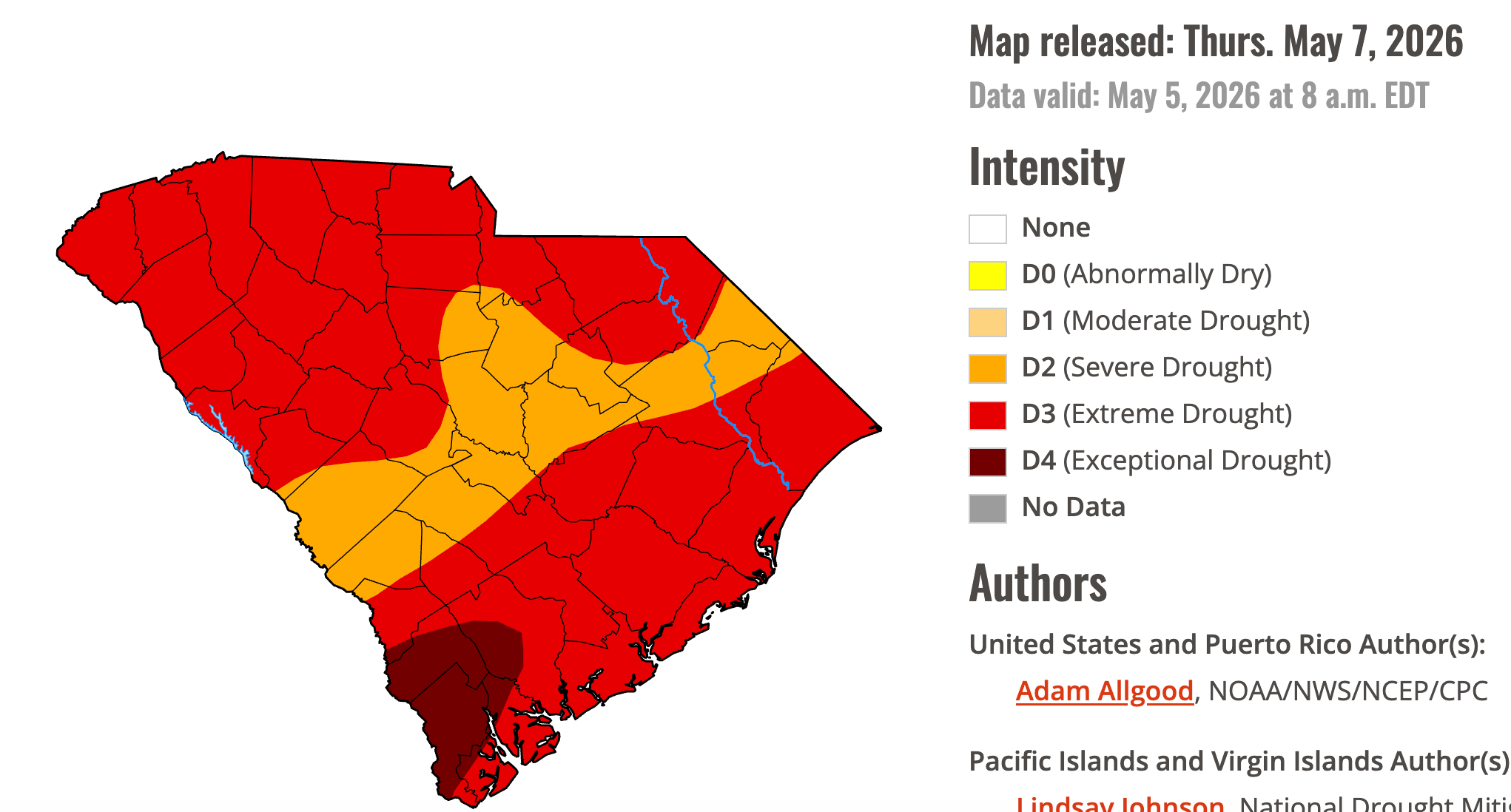
There’s a drought here in South Carolina. We had rain this morning, which is helpful, but it’s going to take exceptional spring rainfall in these remaining few weeks before summer to get us back to baseline. You can see it in Lawson’s Fork if you know where to look... the watermarks on the exposed limestone shelves rising above the current surface, the way the shoals are quieter than they should be in early May, the vegetation at the margins leaning inward toward the diminished channel. Spartanburg Water has already asked customers to conserve in parts of the county served by our watershed (over towards Greenville) rather than our reservoirs and lakes. The language of scarcity is in the air, which is itself drier than it ought to be.
Into this particular spring comes news that the NorthMark data center going up on South Pine Street, the former Kohler site, will use somewhere between 460,000 and 581,000 gallons of water per day, according to reporting from The Post and Courier’s Christian Boschult this morning. That wasn’t a typo. I had to double-check myself. That upper figure, the maximum daily draw, is what you get on the hottest days, when the servers are working hardest, and the cooling towers are cycling fastest... which is to say, the days when the rest of us are also watering gardens and running taps and watching our lawns go brown. Spartanburg Water’s CEO, Guy Boyle, framed it carefully that the average draw represents between 1.8 and 2.3 percent of current daily demand, and since the current system is operating at only about a third of its maximum capacity, the data center’s share works out to roughly 0.6 percent of what the infrastructure could “theoretically” handle. These are the numbers that are meant to be reassuring, after all.
What the reassuring numbers don’t carry is that 86 percent of that water will not return to the watershed. It will evaporate from the cooling towers as vapor and become part of the atmosphere, part of whatever the weather does next, no longer available to the Catawba-Wateree system, to Lawson’s Fork, Pacolet River, or to the small aquifers beneath the Piedmont clay. Only the remaining 14 percent returns as effluent, which is treated and discharged into the municipal wastewater system... 65,800 gallons per day (if the estimates hold). The rest is, in the literal sense, gone.
Yesterday, before Boschult’s article, NorthMark published a statement to their Spartanburg neighbors. It is a careful document, written in the reassuring register that large capital projects tend to adopt when local scrutiny is rising. It mentions that the facility operates under the same municipal water permit as the prior Kohler plant, a sentence designed to anchor the project to something familiar, to something the county already absorbed without crisis and provided jobs for our community. What the sentence cannot tell you is that the Kohler plant, making plumbing fixtures, had a different relationship to water than a server farm does. Kohler used water in manufacturing processes that involved discharge and recovery, while a cooling-tower operation that is 86 percent evaporative is a different kind of draw on the hydrological commons. The permit is the same, but the hydrology is not.
I want to be careful here because I have no interest in pretending the numbers are catastrophic when the utility’s own CEO says they aren’t. Spartanburg Water has substantial capacity. The treatment infrastructure appears adequate. The PFAS testing requirement and third-party discharge monitoring are the kinds of conditions a community should insist on, and they appear to be in place. None of this is the story of a company doing something illegal, or even particularly unusual by industry standards. Cooling towers that evaporate the majority of their draw are standard practice. This is how data centers work.
What I keep returning to is the concept of evaporation itself... the sheer scale of what leaves the watershed and does not return. On its worst day, this single facility will send something approaching the daily water use of 2,000 homes upward into the South Carolina sky. In May. During a severe drought. Under conditions where the state is asking voluntary conservation from every other customer, with the word “voluntary” doing a great deal of work, as it always does in these situations.
The Catawba-Wateree is already one of the most heavily managed river systems in the southeastern United States, a staircase of reservoirs from the North Carolina mountains down through the Piedmont, each one mediating between agricultural demand, municipal demand, industrial demand, recreational use, and the increasingly erratic precipitation patterns that attend a warming climate. Lawson’s Fork feeds into that system, carrying the memory of the Piedmont’s watersheds downstream. The Cherokee and Catawba people understood this creek as part of a living network that required ongoing attention and care... their land management practices along these banks were oriented around long-term reciprocity with the watershed rather than extraction from it. On the contrary, we have mostly organized ourselves differently.
I am not arguing that the data center should not exist, or that Spartanburg should have declined the tax revenue (projected at something like $15 million per year by 2029, which is genuinely significant for a county with real school and roadwork funding needs). These are genuinely complicated tradeoffs, and the people making them are not villains. What I am saying is that 86 percent evaporation during a drought is a kind of relationship with a watershed, whether or not we name it as such.
Water that rises into the atmosphere above South Pine Street was, the day before, rain that fell somewhere upstream... rain that ran off the red clay hills into creeks and tributaries that moved through the shoals and riffles I walk along in the mornings, that was drawn up through the roots of the trees along the bank. It was part of a cycle. After the cooling towers, it is part of a different cycle, or no particular cycle at all if you take the intended metaphor of “the cloud” as data centers are being marketed to heart.
The permit is the same. The water is not.