


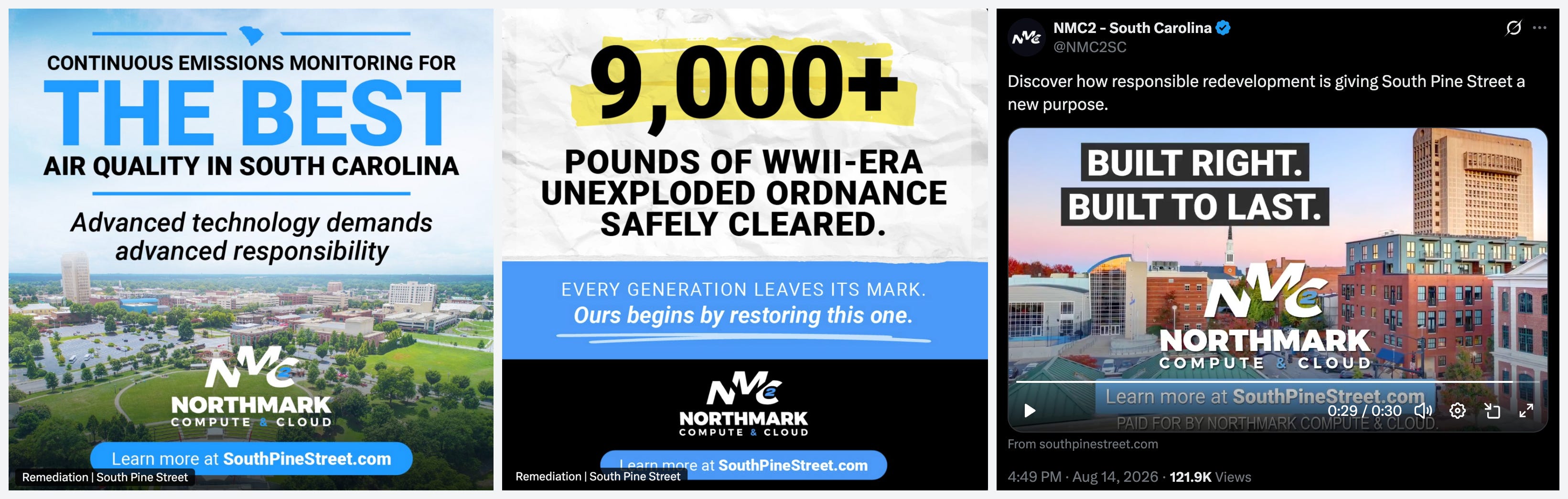
Every time I open a social media app (I’ve deleted most of them over the years, but I still keep Reddit for my Chicago Cubs threads and X for the weather and science folks I follow), I notice these advertisements. This black slab of glass presents all of the world’s information on a screen held a few inches from my body, and I’m thankful for it. It also causes me consternation when an algorithm allows for paid intrusions into my consciousness, as all good advertising does.
Downtown Spartanburg from above, warm in the evening light, with the words BUILT RIGHT. BUILT TO LAST. placed across the skyline. There is another aerial view in daylight, the city green and nearly empty beneath the larger promise: CONTINUOUS EMISSIONS MONITORING FOR THE BEST AIR QUALITY IN SOUTH CAROLINA. A third image offers no skyline at all, only the figure 9,000+ POUNDS and the announcement that unexploded World War II ordnance has been safely cleared from the former Kohler property on South Pine Street. Every generation leaves its mark, the accompanying words say. Ours begins by restoring this one.
All three come from a rather new social media account called NorthMark Compute & Cloud, or NMC². All three direct us to a website with a clever local name url: southpinestreet.com. The videos identify who paid for them if you watch all the way through. The site identifies NorthMark Strategies in its legal pages. There’s no anonymous citizens’ group here, no fictional coalition of concerned neighbors, no effort to hide the immediate sponsor. South Pine Street has become a URL, and the corporation speaking through it has signed its name.
I worked in marketing and as a marketing consultant for decades, so I’m well attuned to this sort of thing. The last few days, I’ve been trying to understand why they trouble me even when much of what they show is true. The former Kohler property carried an industrial history into the present. Asbestos, lead paint, contaminated retention ponds, a landfill, and old munitions all required attention. Those conditions belong to a manufacturing history remembered both for the stable jobs Kohler brought and for the environmental burdens left behind. According to NorthMark’s remediation page, hundreds of tons of asbestos-containing material have been removed, sixty thousand linear feet of lead paint have been abated, and seven tons of material associated with World War II munitions have been recovered and removed. A safer site just a couple of miles from our home is a good thing. I am glad those materials are gone.
The question I have around the advertisements concerns the kind of seeing they ask of us. They offer true things through a field of vision arranged in advance, and the arrangement makes its own argument about South Pine Street. The campaign does something older and more consequential than ordinary advertising, though. It establishes the conditions under which the project will appear. It gives us an image, then a vocabulary, then a corporate name, each offering a kind of nearness while keeping other relationships at a distance.
In “What Was Given,” I wrote about the concealment that allowed Project MOC-1 to move through our county government under an obscure name in the same way that so many data center developments have occurred throughout South Carolina. Now the name has arrived, along with a website, advertisements, tele-town halls, testimonials, fact sheets, and a director of external affairs. Secrecy has given way to managed visibility. The project speaks constantly. The harder question is where it asks us to stand while we listen.
The first thing I notice is that Spartanburg is seen from the air.
The data center itself sits at 4000 South Pine Street, a few miles from the downtown blocks shown in the advertisements. The houses closest to the construction do not appear. The porches where residents have reported dust do not appear. The road where trucks arrive, the missing trees, the bedrooms from which people have heard construction through the night, the proposed turbines and the gas line that will feed them all remain beyond the edge of the image. We are given Spartanburg as a skyline, viewed from an altitude that isn’t occupied by our neighbors.
I’ve written here often about how Edith Stein calls the lived body the zero point of orientation, the Nullpunkt der Orientierung. Every near and far, every left and right, every approach and withdrawal begins from a here that belongs to a body. Perception begins in position. I see the black walnut from beside the black walnut, or through the kitchen window, or from the place in the yard where its roots lift the ground while I’m mowing. Each position opens something and conceals something. The body doing the seeing can grow cold, be startled awake, breathe what is in the air, and become tired of a sound that will not stop. Its vulnerability belongs to its vision.
The drone shot has a point of view without a lived body at that point. Its camera occupies a position, though no one inhabits that position in Stein’s sense. The operator is elsewhere. The eventual viewer is farther away still. The image arrives without the exposure that would ordinarily accompany being there.
This is part of why drone footage has become the natural language of development and real estate. From above, a place becomes shape and extent. Property lines make sense and roads become clean lines while trees become canopy. The particular relations through which a place is lived recede into pattern. The South Pine Street advertisements carry no dust, odor, heat, vibration, exhaust, or interrupted sleep. The city looks whole because the image has moved beyond the range at which its fractures can be felt.
Scripture has a high place that came to my mind while watching these videos. In Matthew’s account of the temptation, the devil takes Jesus to “a very high mountain” and shows him the kingdoms of the world and their splendor. The verb is δείκνυσιν, he shows him. The temptation is staged as an act of vision. The kingdoms are there. Their splendor is there. The height makes it possible to receive them all at once as an object of possession. Scorsese does a good job of making this visible in his film The Last Temptation of Christ.
At ground level, every kingdom resolves into streets, households, a particular body, or a particular creature trying to remain alive. The mountain gathers those lives into a single view and turns relation into extent. It prepares the world for transaction. The power of the offer depends upon the vantage from which it is made.
I highly doubt anyone in a planning meeting about the drone footage or the marketing around the data center on South Pine discussed Matthew 4. A drone was available, Spartanburg is beautiful from above, and beauty was part of the assignment. Yet, traditions last because they teach us to recognize arrangements of perception long after the original stories have passed out of ordinary speech. The high place still does what it has always been able to do by showing a world from far enough away that possession can feel like comprehension.
NorthMark calls the South Pine Street facility a “high-performance technology center” and a “high-performance computing center.” In its June tele-town hall, company representatives also called it a data center when residents and reporters used the familiar term. So, the issue is one of emphasis rather than a forbidden word. Data center places the project inside a national argument about electricity, water, air pollution, tax incentives, and the rapid growth of artificial intelligence infrastructure. High-performance technology center moves it toward engineering, scientific research, innovation, and skilled work. Both names describe something real, but only one carries the whole public history of the thing now being built with or without a county moratorium.
This naming began long before the advertisements. County documents first called this Project MOC-1, just as a proposed data center in Marion County moved under the name Project Liberty as well as our now defeated Project Spero in the western part of Spartanburg County. Nondisclosure agreements and code names have become ordinary instruments of economic development. They allow public officials and private companies to negotiate the conditions of a project before the people who will live with it can perceive enough to form a judgment. By the time the ordinary name arrives, much of the structure has already been decided if not initiated.
This new ad campaign uses a warmer and intentional vocabulary with neighbor, community, welcomed us, earning our place, restoring, leaving it better than we found it. On a dedicated community commitments page, the headline reads, “Built Here. For Here. With You in Mind.” The page promises communication “before, during, and after every major project phase.” It says residents will be “informed, involved, and heard at every step,” and closes by calling South Pine Street “a neighbor you can count on.”
These sentences carry the moral weight of proximity. A neighbor shares weather, roads, schools, sirens, elections, water, and the accumulation of consequences in a place. Neighbor is a relational word. It can also be (or conscripted to be) a geographical one as it has here. It describes what people become through repeated acts of recognition and responsibility. A company can state its intention to become a neighbor. The word reaches its meaning through the life that follows.
The public campaign followed the clearing of trees, the beginning of construction, the discovery by nearby residents of what the scale of the project would be, and months of public concern over permits, water, emissions, and the county’s approval process. The website may now supply useful information. The town halls and county council meetings may answer questions that need answering (if asked in the correct posture). Sarah Knox, the company’s new external-affairs director, has placed her name and South Carolina roots in public view. Those are meaningful changes in posture. They cannot recover the time in which the most consequential decisions were made without the knowledge of the people now being invited into conversation.
The air-quality advertisement shows how managed visibility works within a single sentence: CONTINUOUS EMISSIONS MONITORING FOR THE BEST AIR QUALITY IN SOUTH CAROLINA. The small word for supports almost everything in this perception posturing. It names a purpose without defining a result. Monitoring matters because it gives regulators and operators evidence about what is exhaled through a stack and whether equipment is meeting permitted limits. Monitoring observes emissions. Control equipment reduces them. Ambient-air monitoring tells us what people breathe beyond the property line. These are related practices with different objects.
NorthMark says its real-time monitoring will go beyond what regulators require. The draft SCDES permit also requires continuous monitoring for nitrogen oxides and oxygen or carbon dioxide on each proposed turbine. The public deserves a clear account of what additional pollutants the company will monitor continuously, whether the results will be available outside periodic regulatory reports, and what standard gives meaning to “the best air quality in South Carolina.” As written, the advertisement lets the act of watching stand in for the quality of the air being watched. Here in South Carolina, we are woefully bad at watching from that oversight context.
This facility has already been permitted for twenty-four natural-gas generators. It is seeking permission to add eleven natural-gas turbines with 409 megawatts of combined nameplate capacity, bringing the site’s proposed generation to roughly 459 megawatts. NorthMark says 97 percent of the electricity used during normal operations will be generated on site. That scale belongs in the same field of vision as the monitor. A precise instrument attached to a stack can tell us something true while the larger addition to the airshed disappears behind the fact of measurement.
The third arrangement is harder to photograph because it consists of legal relations. NorthMark’s legal registrations point to New York and Texas, while its company website lists locations in London, Dallas, Houston, Stamford, and Spartanburg.
When the fee-in-lieu-of-tax agreement came before Spartanburg County Council on April 21, 2025, the official minutes identified four company parties: Valara Holdings LLC, a Delaware limited liability company; DC2 Services LLC (Series 2), a Delaware series LLC; BCDC LLC (Series 1), a Marshall Islands series LLC; and HPC Holdco LLC, another Marshall Islands company. After listing them, the minutes record four words: “No one appeared.” The public hearing closed.
Delaware companies and Marshall Islands registries are legal instruments used throughout international finance. Their presence supplies no proof of wrongdoing, obviously. However, it establishes that the company standing behind the tax agreement extends well beyond the local identity now presented to Spartanburg. Two parties were formed in another state. Two were formed in another country. The county record does not explain why two Marshall Islands entities belong in a forty-year Spartanburg tax agreement.
One of those entities points to something more specific. BCDC LLC (Series 1), named in the county minutes, is also the applicant identified in Canadian government trademark records for G-Research Technologies. The listed services include quantitative finance, software used to predict movements in financial markets, investment analysis, financial modeling, and related computing. The applicant is a Marshall Islands company with an address in Bermuda.
That record establishes a formal connection between a party to Spartanburg County’s tax agreement and the intellectual property of G-Research, a London quantitative research and technology firm. It does not establish that G-Research owns Valara Holdings, nor does it identify the ultimate beneficial owner of the South Pine Street project. The connection is substantial enough to ask a question the company has answered only in general terms: whose internal computations will Spartanburg’s air, water, land, and tax structure support?
The trail continues, as I’ve been astonished to find in the rabbit holes I’ve been exploring. In a December 2025 transaction notice, Jones Day described NorthMark Strategies as “previously Dorilton Capital Management”. Dorilton is known publicly as the owner of the Williams Formula One team (as a fan of motorsports and F1... odd for someone who works in ecology, I know, but I’m a Pee Dee Man... this one made me perk up and tune in). Litigation concerning Williams and Dorilton has brought the financier Peter de Putron, founder of G-Research and a resident of Jersey, into the public record. In May, a New York appellate court found substantial evidence that de Putron had been “directly and intimately involved” in the management of the plaintiffs in that dispute, which included Dorilton. The ruling concerns his relevance to that litigation. It leaves the ownership of the Spartanburg project unresolved.
The honest public trail therefore ends here with a gap. It connects Valara to NorthMark; NorthMark to the former Dorilton; a Marshall Islands party in the tax agreement to G-Research trademarks; and the Dorilton and G-Research world to de Putron. It does not disclose Valara's ultimate beneficial ownership or assign the Spartanburg facility to any named individual. This gap can be acknowledged without necessarily being crossed. It can also be recognized as part of the public problem.
Then there is one smaller, almost incidental detail. In the website stylesheet code beneath southpinestreet.com, the website theme identifies itself as “One Degree North - South Pine Street” and credits One Degree North as its author. One Degree North is a digital advertising agency in Leeds, England, offering web development, content, search, and paid-social services. This establishes who built the website. It doesn’t establish who designed the advertisements, bought the media, selected the audience, or determined how often they would appear. The ads name NMC² as their payer, and the site’s terms lead to NorthMark Strategies in New York. The remaining advertising arrangements are outside the public frame.
Put these records together, and the geography becomes... strange. The land is in Spartanburg. The water comes from the Piedmont watershed. Emissions will enter this airshed, affecting Converse Heights and our Duncan Park neighborhood as well as EP Todd Elementary and Pine Street Elementary. The tax agreement belongs to this county, and the construction noise reaches houses on roads many of us know. The legal interests run through Delaware and the Marshall Islands. The parent company points to New York, Dallas, and London. The intellectual-property trail reaches a quantitative trading firm in London. The financier most publicly associated with that corporate world lives in Jersey. The digital architecture through which the project calls itself our neighbor was built many time zones away.
Again, distance by itself is no moral failure. Spartanburg has been shaped by international industry for generations. BMW, Michelin, and Bosch are part of the life of this region, and every phone on which these advertisements appear is already an artifact of mines, factories, designers, programmers, ships, warehouses, and markets scattered across the planet. Despite what assumptions may be held by those outside of our region, we are a very international and diverse community with vibrant communities from Southeast Asia, Ukraine, Western Europe, Africa, and Latin America. The question concerns the direction in which distance works. The company can reach a resident’s phone more easily than the resident can reach the room where the capital decisions are made. Nearness has been engineered for persuasion while distance remains available for accountability.
This is why astroturf is the wrong word, I think. The social media campaign names its immediate sponsor and has a public spokesperson. It has held calls on which residents and reporters have asked unscripted questions. The more interesting form is managed visibility: disclosure arranged as a smooth surface, full of answers, while the relations necessary to interpret those answers remain difficult to see. Sponsorship is visible. Structure requires excavation.
What the Ground Holds
The ordnance advertisement brings the argument back to the ground level.
NorthMark says it recovered and removed thousands of pounds of material associated with unexploded World War II munitions. The work matters, and whatever combination of public requirements, private responsibility, and professional expertise produced the cleanup, material associated with World War II munitions in the ground has been found and removed during redevelopment.
Then the advertisement says something larger: Every generation leaves its mark.
The old munitions make that sentence visible in a literal way. Decisions and their results made during a war remained in the Earth long after the people who made them passed. Their purpose ended, but their material consequences continued. They waited beneath later industries, later ownership, later roads, and later names until another generation disturbed the ground.
The campaign offers their removal as evidence of what comes next. The deeper question in its own sentence points forward. What mark will this generation leave at South Pine Street? There will be buildings, slabs, cooling equipment, gas infrastructure, a landfill under continuing monitoring, a tax agreement lasting decades, and a changed relationship between this place and its air and water. There will also be the less visible result of computation carried out here for purposes elsewhere. We rarely recognize a legacy while we are constructing it. The people responsible usually call it progress, necessity, investment, defense, innovation, or simply work.
That uncertainty is one reason ecological attention begins before the verdict. We look closely enough to ask what is being placed into relation, what will persist, and who will inherit the arrangement after its present purpose has changed.
Ground Level
Near the end of Luke’s well-known story of the Good Samaritan, Jesus changes the lawyer’s question. The lawyer had asked, “And who is my neighbor?” Jesus asks which person had become a neighbor to the man left beside the road. The Greek is γεγονέναι, a form of ginomai: to come to be, to become. Neighborliness emerges as an event, something enacted between vulnerable bodies on the ground.
That is a much heavier word than a social media campaign can convey. A corporation may announce its intention to become a neighbor. The becoming will happen through what it does when the dust reaches a porch, when turbine exhaust enters the air shared with Converse Heights, when a permit allows more than residents expected, when monitoring finds something unwelcome, when a family cannot sleep, when a promise becomes expensive to keep, and when the public asks a question the prepared materials cannot answer.
NorthMark also reported multiple alleged threats against its employees this summer, and law enforcement opened an investigation. Threats are, obviously, wrong. They endanger people whose lives cannot be reduced to the corporation that employs them, and they damage the public work residents have undertaken with persistence and courage. They turn an ecological and civic grievance into a security problem, moving the discussion farther from the ground on which it began. The safety of workers and the accountability of a powerful company belong within the same field of care.
People like us living near South Pine Street have already described the project from a lived zero point. They have spoken about dust gathering where it did not gather before, dump trucks arriving through the night, changes in their breathing and voices, and the loss of trees that once held some of the sound of the heavily used railroad and road. These accounts do not replace emissions models, permits, engineering studies, or economic figures. They disclose dimensions of the place that those abstractions cannot contain. A body awakened in the night knows something about infrastructure.
The black walnut in our backyard has been letting its fruit down for weeks now. Some mornings I go outside with coffee and look up into the canopy; other mornings I notice the tree by what has fallen in the grass or by the squirrels working above me. From a drone, it would appear as a patch of green in a residential grid, perhaps a particularly beautiful one in the late-August light. The image would be true, but it would also be thin.
The tree, as I know it, includes the slope beneath it, the rain moving toward the creek, the fruit underfoot, the shade crossing the yard, and the years of our children growing in relation to it. Its truth gathers at ground level because that is where the relations become perceptible. This is what Stein understood about the zero point, what Matthew understood about the high mountain, and what Luke understood about the road to Jericho. Where we stand alters what the world can ask of us.
The South Pine Street campaign offers Spartanburg a beautiful view from above. It shows the skyline, names remediation, promises monitoring, and speaks the language of neighborliness. We should look at what it shows. We should also notice the position from which we are being asked to see, then come back down through the words and structures to the houses, porches, creeks, corporate records, permit limits, and bodies that remain below the frame.
The high place can show us all the kingdoms at once. South Pine Street can only be known from somewhere. And whatever is built there will eventually have to live on the ground.
Sources and Records
Web sources were last accessed August 22, 2026 (also, my birthday).
NorthMark and South Pine Street materials
NorthMark Compute & Cloud. “Built Right. Built to Last.” X, August 14, 2026.
NorthMark Compute & Cloud. “Continuous Emissions Monitoring for the Best Air Quality in South Carolina.” X, August 11, 2026.
NorthMark Compute & Cloud. “9,000+ Pounds of WWII-Era Unexploded Ordnance Safely Cleared.” X, August 7, 2026.
NorthMark Compute & Cloud. South Pine Street Technology Center.
NorthMark Compute & Cloud. Community Commitments and Project Facts.
NorthMark Compute & Cloud. Remediation: Restoring the South Pine Street Site.
NorthMark Compute & Cloud. Frequently Asked Questions.
NorthMark Compute & Cloud. Terms of Service.
NorthMark Compute & Cloud. “Air Permit Hearing Teleconference.” June 24, 2026; transcript published June 25, 2026.
NorthMark Strategies. “NorthMark Strategies Announces Historic $2.8 Billion Investment in Spartanburg, S.C. High-Performance Computing Facility.” April 22, 2025.
NorthMark Strategies. Company website and listed locations.
South Pine Street website. WordPress theme stylesheet, identifying “One Degree North — South Pine Street” and crediting One Degree North as author.
One Degree North. Agency website and Leeds contact information.
Government records and environmental permits
Spartanburg County Council. Minutes of the April 21, 2025, County Council Meeting. See the public hearing for the Valara Holdings fee-in-lieu-of-tax agreement, including the four company parties and the notation “No one appeared.”
South Carolina Department of Environmental Services. Valara Holdings High Performance Compute Center.
South Carolina Department of Environmental Services. Draft Synthetic Minor Construction Permit CP-50000422.
South Carolina Department of Environmental Services. Draft Statement of Basis for CP-50000422.
South Carolina Department of Commerce. “NorthMark Strategies Selects Spartanburg County to Establish First South Carolina Operation.” April 2025.
Corporate, trademark, and legal records
Canadian Intellectual Property Office. G-Research Technologies, Canadian trademark application no. 2202394, identifying BCDC LLC (Series 1) as applicant.
Jones Day. “NorthMark Strategies Sells Traditions Health.” December 2025. Jones Day identifies NorthMark Strategies as “previously Dorilton Capital Management.”
Dorilton Capital Management LLC v. Stilus LLC, 2026 NY Slip Op 02875, Appellate Division of the Supreme Court of New York, First Department, May 7, 2026.
G-Research. Official company website.
Bogle, Andrew. “Who Really Controls the Williams F1 Team? A Bitter Legal Battle Has Put This Question Centre Stage.” The Guardian, May 28, 2026.
Government of Jersey. “Jersey’s Relationship with the UK and EU.”
Reporting and local context
Erbach, Alexa. “Spartanburg Co. Residents Say They Were Misled About Data Center Project.” FOX Carolina, April 30, 2026; updated May 4, 2026.
Erbach, Alexa. “Spartanburg Residents Say Data Center Construction Is Already Disrupting Their Lives.” FOX Carolina, July 23, 2026.
WSPA 7News. “Alleged Threats Against NorthMark Employees Lead to Investigation in Spartanburg.” Republished by AOL, 2026.
Mahoney, Adam. “A Rural S.C. County Quietly Approved a $2B Data Center During the Winter Storm.” Capital B News, February 4, 2026.
FOX Carolina. “Company Withdraws AI Data Center from Spartanburg County Consideration.” February 27, 2026.
Parker, Kathleen. “A Data Center Was Shrouded in Secrecy. The Neighbors Are Furious.” The Washington Post, July 3, 2026.
Harrelson, Sam. “What Was Given.” Carolina Ecology, 2026.
Scriptural, philosophical, and cinematic sources
The Holy Bible: New Revised Standard Version Updated Edition. Matthew 4:8–10 and Luke 10:25–37. National Council of Churches, 2021.
Holmes, Michael W., ed. The Greek New Testament: SBL Edition. Society of Biblical Literature and Logos Bible Software, 2010. See Matthew 4:8, δείκνυσιν, and Luke 10:36, γεγονέναι.
Stein, Edith. On the Problem of Empathy. Translated by Waltraut Stein. Washington, D.C.: ICS Publications, 1989. See especially the discussion of the lived body as the “zero point of orientation,” p. 43.
Scorsese, Martin, director. The Last Temptation of Christ. Universal Pictures, 1988.
People have also reported trespassing. That doesn't threats, but I think property rights are important.