


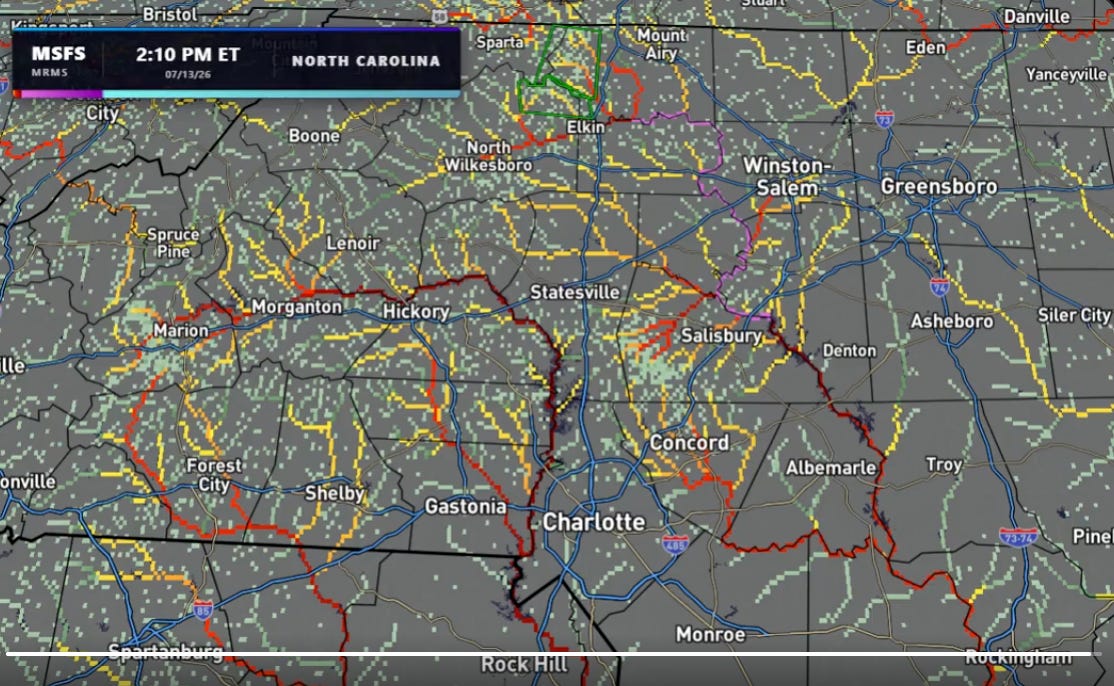
Over the last couple of weeks, the rain has arrived the way it does when the ground has forgotten how to receive it. Rather than the slow soaking of a Piedmont spring, it’s felt more like something impatient, arriving in sheets off the ridgelines and running before it could sink. Lawson’s Fork went from a set of exposed cobbles to a brown, muscular thing overnight, and the Pacolet with it, along with the creek that feeds into Duncan Park Lake in our neighborhood. The red clay, baked to brick through a long dry season, shed the first inches almost entirely and washed down neighborhood roads, the water sliding off toward the creeks as if the land itself had turned its face away. Only later, once the surface had softened, did the ground begin to drink. I like to stand under the black walnut and listen to the rain come down and thinking that this was the sound of a whole country tilting toward its rivers much like the land we live on is tilted towards the creek (which becomes quite apparent when I mow our lawn or we try to find a level place for a backyard inflatable swimming pool for the kids on the hot days).
That tilting is what the map above shows. Brad Panovich, a meteorologist in Charlotte, posted a visualization this week of rainfall gathered across the entire Catawba watershed in 24 hours (before more heavy rains on Monday and Tuesday morning), and to look at it is to see the basin the way water sees it: not as counties and city limits but as one long inclined plane... aiming. The Catawba rises in the Blue Ridge just east of Asheville (near my former home) and runs better than two hundred miles south, yielding along the way to eleven impoundments and dams before it crosses into South Carolina, changes its name to the Wateree, and finally slides through my beloved Congaree National Park (one of the holiest places on the planet) toward what is now the human-created Lake Marion.
The Catawba is named for the people who called themselves the people of the river. What the map makes visible is that every drop falling on Avery, Burke, or McDowell counties in North Carolina is already committed... already bound downhill toward Charlotte’s reservoirs to provide water for its millions of inhabitants, toward the Wateree bottomlands, toward the Atlantic. The watershed is essentially a single intention inscribed in the terrain.
What Evaporates

There’s a drought here in South Carolina. We had rain this morning, which is helpful, but it’s going to take exceptional spring rainfall in these remaining few weeks before summer to get us back to baseline. You can see it in Lawson’s F…
And what makes this week worth writing about is how recently that intention had nothing to carry. In early May, the Catawba-Wateree basin entered Low Inflow Protocol Stage 2, and more than a dozen cities and water districts were placed under mandatory restrictions. Charlotte sat roughly thirteen inches behind on the year, its driest start on record. The reservoirs drew down, the utilities rationed, and reports spoke (in the flat language of modern “water management”) of a system operating below normal. Then the storms of the last two weeks dropped six to nine inches across the headwater counties, flood watches went up across the mountains, and the same basin that had been counting every gallon in May now stood in the road trying to shed the excess. Drought and deluge in a single season, over the same ground, along the same downhill grain.
There’s a great term for what a watershed represents that comes from the third day in the Genesis account of Creation. In the Greek, the Genesis command on that day is Συναχθήτω τὸ ὕδωρ... εἰς συναγωγὴν μίαν (from συνάγω, to gather together): let the water be gathered into one gathering. And in the same breath, ὀφθήτω ἡ ξηρά... let the dry appear. The dry, ἡ ξηρά, shouldn’t be read as a punishment in Genesis. It’s the necessary counterpart of the gathering, the ground that shows itself once the water has found its one place. A watershed is the same: a συναγωγή, a gathering-into-one, the machinery by which scattered rain is collected and given a direction. Drought, then, is something other than the absence of that working. Drought is ἡ ξηρά advancing where it should not, the dry appearing in the reservoir bed and the exposed shoal, the gathering starved of anything to gather. What unsettled me about the drought maps this spring was that the aiming persisted, not that the Catawba had stopped aiming downhill. The basin went on, intending to the sea and had only dust to offer it.
This is a place where ecology and theology stop being two subjects. In the work I have been calling Ecological Intentionality, the wager is that directedness is not something a mind adds to a passive world but something the world is already doing, everywhere, in advance of us. Merleau-Ponty would have us begin with the body’s aiming before the mind’s judging; Aristotle would call the river’s downhill tendency a matter of act and potency (Edith Stein later builds on that), the water in potency to the sea. A watershed is intentionality you can walk. Gravity is its ἐντελέχεια, its being-at-work, and the basin holds its object the way a perception holds what it is a perception of, whether or not the object arrives. The drought didn’t suspend the Catawba’s directedness. It made that directedness legible by frustrating it, the way a covered human eye still turns toward the light it can’t reach. Before we manage a river... before the protocols, regulations, and permits with the arithmetic of storage that has occupied so much of my writing here... there is this prior fact to be perceived... the land is already leaning toward one place, and has been leaning there since the third day and well before humans arrived to consider it.
Which is why this recent deluge in the Blue Ridge and Carolina Piedmont asks a cruciform question rather than a triumphant one. When John’s Gospel reaches for the verb of ultimate gathering, it does not choose συνάγω but ἕλκω: κἀγὼ ἐὰν ὑψωθῶ ἐκ τῆς γῆς, πάντας ἑλκύσω πρὸς ἐμαυτόν... and I, if I be lifted up from the earth, will draw all to myself (John 12:32)1. ἕλκω is also the word for hauling a full net of fish up into a boat or the bank, for the drag of a real weight toward a real point. It’s the verb of gravity. And the geometry it names is the geometry of watersheds: the lowest place is the gathering place.
Water is drawn not to the summit but to the trough in this sin(e) wave of geography, and the whole two hundred miles of the Catawba is one long confession that things arrive by descending. The Ecology of the Cross, as I keep trying to say, reads the created order as already shaped this way before Golgotha’s revelation... the low point, the drained and skull-dry place, made into the point toward which everything is drawn. A watershed is a doctrine you can get your boots wet in. It gathers by descending. It draws all to its lowest ground.
So I am wary of calling this week’s rain simply an answer to the spring’s drought or an answer to a corn farmer’s prayers (though it is also that), as though the Excel sheet had been balanced and the season redeemed. The water that saves the reservoir is the same water that tears out the low-water crossing, and the basin does not distinguish gift from threat... it only gathers, only draws downhill whatever falls. What the map gave me wasn’t necessarily relief but more of a recognition. The Catawba was aiming all along, in the dust of May and June as much as in the flooding of July, toward the one gathering it has always intended. Our work, the perceiving before the managing, is to learn to see that aim... and then to live as people of the river who know which direction the ground is leaning, and toward what, and why the lowest place is the one that gathers.
Written under the black walnut in our backyard, after the rain on Tuesday.
On πάντα (12:32). Most printed texts and translations read the masculine πάντας (πᾶς, accusative plural) here, which the English fills out as something like “all people,” supplying the implied ἀνθρώπους (humans). A line of manuscripts and interpretations (myself included) instead read the neuter πάντα, “all things,” and that single letter is nearly the whole argument of this essay. The neuter opens the ἑλκύσω past the human remnant to the created order entirely... a similar reach Colossians makes when it says that in him τὰ πάντα, the things in the heavens and the things on the Earth, were made and hold together (συνέστηκεν, Col 1:16–17). Worth marking here that the verb carries the συν- of the third day’s gathering... συναγωγή and συνέστηκεν lean on the same prefix, the same instinct toward one place. Editors hold their own preference loosely here... the UBS committee gave πάντας a “D,” its lowest grade of confidence, about as near as an apparatus comes to conceding it cannot say. Of course, I won’t pretend to settle the witnesses from a post here, and I would point you to NA28 or the ECM for the actual lists before anyone leans on it from a pulpit (although I do). But the theological grain runs with the neuter, in my opinion. If the Cross is the low place toward which all things descend, then πάντα is the reading the watershed already prefers as well!