


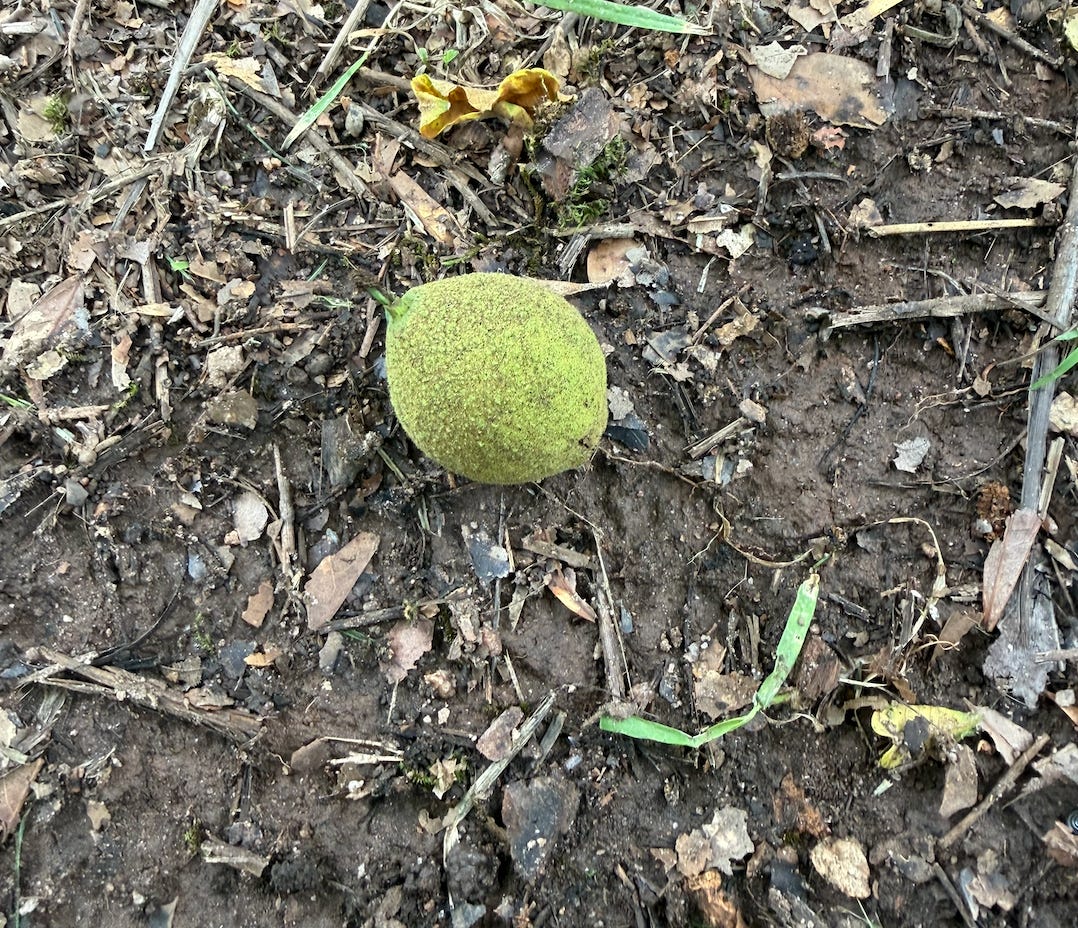
The black walnut started dropping hulls in the last week of July, a good three weeks ahead of any note I’ve kept on it over the last few years. Green husks in the fescue, some of them still hard and undersized, a few with the shell inside barely formed. You don't need instruments to know that's what's happening. You need to be standing under it in August with the hose running and your feet in dry grass. I’m assuming the tree is under drought stress despite our recent rains and makes an informed decision about what it can carry through to October, letting the rest go. In its own way, the black walnut is doing the arithmetic a body does without being asked to, just as we humans do.
I’ve been thinking about that arithmetic since Monday night, when Spartanburg County Council decided to wait at least one more month (GoUpstate) before taking up the third reading of an ordinance that would put a one-year hold on new data center development in the county. Six days earlier, the public safety committee had spent close to five hours on it, hearing from people who study air pollution, water use, noise, and what these facilities do to electric utilities. Five hours is a long time to listen. At the end of it, Councilman Grant DeShields said the county needed one more fact-finding effort before deciding. Paul Abbott agreed that having more beats having less. Monier Abusaft, who chairs the committee, agreed as well. No date has been set for that additional meeting.
The moratorium, if it eventually passes, still won’t touch the project the room was actually there about. The data center by NorthMark Cloud and Compute, also called Valara, is already under development on South Pine Street, and all three committee members have said they’re not inclined to fold it into the ban. DeShields thinks doing so would leave the county exposed to an expensive lawsuit. So the ordinance would pause the data centers that don’t exist yet while the one with a 450-megawatt power plant attached to the Northmark data center moves forward. The South Carolina Department of Environmental Services hasn’t yet ruled on that plant. The Southern Environmental Law Center has asked the state’s Public Service Commission to review the project under the Utility Facility Siting and Environmental Protection Act, and the commissioners are considering the request.
Then the room spoke, as rooms are allowed to speak at such meetings. There were comparisons of the turbines to jet engines running beside neighborhoods. Mary Helen Wade said that even if DES finds the projected emissions inside state air quality standards, the agency’s ongoing oversight of the facility may not amount to much, and she asked the council not to place its faith there.
Councilman Abusaft said he understands the concerns people have raised, including about emissions from the plant, and that he hasn’t seen compelling evidence that the air will make people living near the site sick. He said he’s open to receiving more. “If there are people out there with this knowledge, please come and inform our decision-making,” he said. At one point in the meeting, Abusaft had a law enforcement officer remove a woman from the chamber for speaking without permission.
The next day, in Washington, the National Republican Senatorial Committee circulated a memo titled “Ohio Data Center Risk” (PDF), which Axios published Wednesday morning. Its argument is that Jon Husted’s Senate race is being lost to a perception problem. Sherrod Brown has made data centers his de facto opponent, the memo says, has put three television ads and millions of dollars behind that, and it’s working better than conventional attacks because it brings new information about something people are just beginning to have feelings about. Axios reports that executives and Republicans alike are looking at internal numbers where data centers poll about as well as spent nuclear waste. The memo’s central instruction is that neither campaigns nor party committees can repair what it calls the toxic brand of an entire segment of the economy. Only the companies can. They have to fix how Ohioans see them: “who benefits, who pays, and why a community should want one.” Reminds me of Hamilton’s imperative “Who lives, who dies, who tells your story?” that my 10-year-old son sings constantly. If that isn’t fixed quickly, the memo warns, the campaign against data centers spreads well past Ohio.
I’ve read the NRSC memo four times now, and what holds me isn’t the politics, as I try to stay as independent and objectively distant as possible from party machinery. But it’s the verb. See. The problem, as the memo understands it, is located in the seeing.
Ancient Greek has a great term for this. δόξα (doxa) comes off δοκέω (dokeō), “to seem, to appear, to be thought.” In ancient usage, δόξα is opinion, reputation, the shape a thing takes in the public mind, which is what a poll measures and what six thousand points of television and social media ads are purchased to move.
But when the Septuagint translators of the Hebrew Bible needed a word for כָּבוֹד (kavod), the glory that fills the tabernacle, they reached for δόξα too, and kavod is built on a root meaning weight. Heaviness. What actually presses down. So the same four letters carry both the seeming of a thing and the weight of it, and the history of the word is the story of those two coming apart. The memo here is a document written entirely inside the first meaning. It says nothing about the second. Whether a 450-megawatt turbine hall beside a cluster of Spartanburg neighborhoods is a heavy thing to place there is a question the memo doesn’t raise, because within its frame the heaviness isn’t the asset in play. The seeming is.
And here’s where I have to say the quiet part about my own tradition of looking. Edith Stein’s argument in her 1916 dissertation is that empathy is a species of knowledge, an act with its own structure and its own kind of givenness, through which another’s lived experience comes to me as something I grasp rather than something I invent. She’s careful about the difference between the Leib, the body I live from, and the Körper, the body as an object among other objects in the world. Every act of perception happens from a zero point of orientation, a here that’s mine and no one else’s, and everything I see is given to me as seen from that here.
This is why the phrase fix how they see them should stop us in our tracks. The people who live near South Pine Street, as we do, occupy a here. What’s given to them from that here is noise carried on humid August air at two in the morning, warm exhaust, headlights of trucks, a water table, a power bill. That’s not about brand impression. It’s the report of a Leib about the place it lives in, and the report has standing.
The Gospel of John’s ninth chapter is a great example of what happens when an institution treats such a report as a perception problem. The man born blind is questioned, then questioned again, then his parents are questioned, then he’s brought back for a third round, because the people running the inquiry have a prior commitment about what could and couldn’t be true. He gives them almost nothing they can use. ἓν οἶδα, ὅτι τυφλὸς ὢν ἄρτι βλέπω. One thing I know: I was blind, now I see. οἶδα (oida) is a perfect tense built on the root of ἰδεῖν, “to see,” so that to know, in Greek, is to be in the settled condition of having seen. His knowledge has no credential attached, and he can’t be considered an expert witness by a council. It’s the sheer weight of a body’s experience laid on a table where everyone would prefer a manageable δόξα. And they throw him out of the room for it, as well.
None of which makes the memo stupid, and I don’t want to be cynical. Read its policy list without the framing, and much of it would find friends in that Spartanburg chamber Monday night, including myself: data centers built only where a community approves them by local vote, facilities paying their own way on generation and infrastructure, no cost shifted onto existing ratepayers. Those are the demands the people holding signs at these meetings are making. Nor is the Brown Senate campaign somehow standing outside the market in some sense; millions of dollars of television is a δόξα operation, whoever’s buying it, and it should be described as one. Both parties have read the same polling, and both are moving fast. The question worth putting to all of them is what happens on the day the polling and the bodies agree, and the permit still gets issued.
Which brings me back to Councilman Abusaft’s invitation, which I take to be sincere and which I think ought to be answered rather than resented. He asked for people with knowledge to come inform the decision. That’s the right request. But notice how narrow the channel is: a fact-finding meeting with no date on it, three minutes at a microphone, a woman escorted out for speaking at the wrong moment. Procedure isn’t the enemy here. A council can’t function as a shouting match, and the chair has a room to run.
However, asymmetry is what we should always learn to watch and perceive. On one side, the seeming can be worked at a continental scale, by professionals, with a budget, for as long as it takes. On the other, the weight has to be carried into a chamber by an individual person, on a Monday, after work, and delivered inside a three-minute window in the order the agenda allows. If those two are competing on the same field, we should be clear that the field is tilted. Our yards slope toward Fairforest Creek and Lawson's Fork watersheds because of gravity. This one slopes because it was built to.
So: my recommendation is to go. The additional committee meeting hasn’t been scheduled yet, which means it can still be attended once it is. Third reading comes back to council in September. The DES decision on the plant is still open, and the SELC petition sits with the Public Service Commission. If you live near that South Pine site and you know what the air and the water and the nights are like there, you hold the thing the record can’t manufacture.
The byline on the account of Monday’s meeting in the local paper belongs to Baker Maultsby. In 1999, I was beginning my Senior year at Wofford College with Bingo=Sin in more or less permanent rotation, the record he’d put out the year before with his friend Peter Cooper, with songs (Four Wal-Marts about Spartanburg specifically) about what happens to an Upstate town like ours when the decisions about what gets built in it are made somewhere else and arrive already finished. “Pee Dee Man” was my track, for reasons that won’t require much explanation. I was a Pee Dee man in a Spartanburg dorm room a long way up the road from my hometown (which Maultsby calls “Pride of the Palmetto State”) Mullins, hearing my end of the state come out of speakers in this one.
What Was Called Liberty

Water is never far away in the Pee Dee, and under my home county of Marion, you sense that in the same way that you feel a hardwood floor through a thin rug. The land is low and mostly sandy, laid down by o…
Nearly thirty years on, the man who made that record is taking notes in a county council chamber on what is recognizably the same question, and the question has followed me home in both directions. Project Liberty was going to put a data center in Marion County until it was withdrawn after public protest. The Pee Dee flatwater I learned to pay attention to and Lawson’s Fork are on the same map now, subject to the same arithmetic about who gets the power and who pays for the water.
A Moment of Civic Attention in Spartanburg

Over the last few months, something unusual happened here in Spartanburg. For a brief moment, a large number of people began paying close attention to something that usually remains invisible... the infrastructure that quietly shapes daily life. Water systems, electrical capacity, land use, and industrial development. The complicated negotiations betwee…
The roughly 460,000 gallons a day this facility would move through evaporative cooling and never give back to our watershed here haunts me. Water is the most genuine test case for the difference I’ve been approaching in my own PhD work, because water can’t be persuaded. It goes where the ground tells it, it evaporates at the rate the heat dictates, and the aquifer’s answer to a question is arithmetic. You can shift how a data center seems. You can’t shift what a watershed weighs.
I’ll be at the Unitarian Universalist Church of Spartanburg again this Sunday, the 23rd, at 11 am, giving the second of two meditations in a short series called Home Ground. The first, last Sunday, made the case that the first home any of us has is a watershed. This one’s called “What We Ask of the Water,” and I expect a good deal of the above will be in it, though with more Stein and fewer NRSC memos. Their pastor Scott Neely has made room for this kind of thinking all summer, and the congregation asks good questions afterward. If you’re local and inclined, come.
The walnut will keep dropping its husks through all of it. Sometime in the next few weeks, the hulls will go from green to black in the grass, the squirrels will start their inventory, and the tree will have finished telling me, in the only language it has, what this summer actually weighed.