


Water is never far away in the Pee Dee, and under my home county of Marion, you sense that in the same way that you feel a hardwood floor through a thin rug. The land is low and mostly sandy, laid down by old seas, and the rivers that cross it run dark with the tannins of the swamps they drain, which always made me a little trepidatious skiing and wakeboarding on the Little Pee Dee as a young person when it was high enough for such things. The Great Pee Dee on one edge, the Little Pee Dee and the Lumber (after the ancestral Lumbee People) easing down toward it, Catfish Creek slipping past Mullins. I grew up close enough to that water to know its smell after rain. It was the first landscape I learned to read, before I had words for reading a landscape at all.
This June, the water is far. South Carolina is in drought again, despite recent rains and the inevitability of an El Niño summer and winter that normally bring wetter conditions. Along the coastal plain, farmers are cutting back on what they plant and raising what they charge, because not enough is falling and not enough water is being held in the soil. The rivers the Winyah Rivers Alliance (Hydrologic Unit Code 030402) keeps watch over are running low for this time of year. A county, like Marion, worried about its water isn’t something to be argued about, but is a place where you can walk down to the creek in June and find the pale line on the bank where the water used to be. Now hold that picture, and let’s go back to January.
In the last week of January, while that same coastal plain was bracing for one of the rare winter and snow storms that would close our state down for days, the Marion County Council met and approved a thing it wouldn’t name. On the agenda was Project Liberty. The line item carried no details because the council had signed a nondisclosure agreement and wasn’t free to say what it had voted on. Most of the county was watching the sky, buying rock salt (and bread and milk) from Walmart, bringing in the animals, and doing the small, frightened arithmetic a Carolina town does whenever ice is coming. The meeting was legal, and the notice was posted inside the window as required by law. And almost no one knew it was happening, though.
What had been approved, residents would learn over the following weeks, was a data center. A pretty large one with promises of much-needed tax revenue (eventually). Stream Data Centers, a developer out of Dallas, had its eye on a four-hundred-acre tract in the industrial park off the Highway 501 Bypass between Marion and Mullins that I have driven by too many times to count in my years on this planet and in Marion County. The plan ran through two phases and as many as nine buildings, with a first phase valued near eight hundred million dollars and a full buildout, the county said, of two and a half billion. By the time it surfaced again on a county agenda, even the name had changed. Project Liberty had become Eagle Myra, LLC. A thing approved before it could be spoken, by people who had agreed in writing not to speak it.
Secrecy isn’t incidental to the story. It’s the story’s first fact about how the land is treated. When a county signs away its ability to tell its own residents what is being built among them, it has already decided something about who the place is for. The county’s interim administrator, who also holds a seat in the state legislature, called the nondisclosure agreement ordinary and the usual practice in economic development. As weird as that may sound to those of us not in the day-to-day of governing, he’s not wrong about how common it has become. That’s the trouble, though. The practice is so normal now that a county can trade away the public’s knowledge of its own water and its own air and file the trade under routine.
Each building, the county said, would use something like seven thousand gallons of water a day, the whole campus amounting, by that arithmetic, to no more than a modest neighborhood’s draw in the county. The tax arrangement, a fee paid in lieu of ordinary property taxes, would spare the developer tens of millions while promising the county, at full buildout, more in a year than its entire annual budget. The jobs, when the buildings were humming, would number about sixty at full capacity by the county’s own count, though the developer itself had earlier put the figure nearer twenty (in a county of less than 30,000 humans where the poverty rate runs at twice the national figure and barely two in three households have steady access to the internet, the center would help to serve).
Set the water figure down on the table and look at it in good light. 7,000 gallons a day per building is a modest number, the sort a person can hear and feel reassured by. It is also far below what comparable facilities elsewhere are known to draw, low enough that anyone who has followed these projects would want to ask what kind of cooling produces it and what it costs in electricity instead, and whether the number describes the whole operation or one early, hopeful slice of it. Under a nondisclosure agreement, those questions have no place to land. That’s the deeper problem with a number delivered from behind a signed silence. It’s not a fact you can check. It’s a figure you are asked to accept from people who have promised someone else not to tell you the rest.
I have watched this same logic arrive at the other end of South Carolina in my other hometown. In Spartanburg, here in the Piedmont where I live now, I spent a long while tracing what the NorthMark project meant for our water, and the figures there weren’t modest at all. Hundreds of thousands of gallons a day, the great majority of it lost to the air as vapor, gone from the watershed entirely. Two ends of one state, two different geologies of water. Here in the Piedmont, the rock is hard, and the creeks run fast off it, so what you take you take from the surface, from Lawson’s Fork and the Pacolet. Down in the Pee Dee, the sand is deep, and the water table sits close beneath your feet, and what you take you draw up from an aquifer that the U.S. Geological Survey has already flagged for long-term decline across the Atlantic Coastal Plain. Different water, drawn differently, asked for by the same appetite. The machine doesn’t care which part of Carolina it is standing in… it only cares that the water is there and that the asking can be done quietly.
The reporting that brought Project Liberty into the light set it within a pattern that runs the length of the country: developers using nondisclosure agreements to push these projects into rural, often majority-Black counties with less organized power to push back, sometimes after a wealthier or whiter community nearby has already organized and said no. Marion County is a majority-Black county. It fits the pattern the way a key fits a lock that was cut for it. None of this happens against the grain of policy, either. It runs with the current of a federal push to fast-track data centers in the name of winning an artificial-intelligence race, a push that asks agencies to thin out the very environmental reviews that might otherwise slow things down long enough for a county to read them.
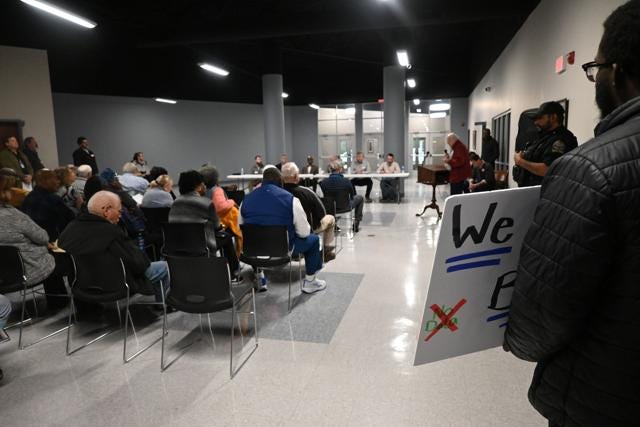
What broke the quiet in Marion was not the policy and not the developer. It was people. They packed the county administration building when the two public sessions finally came, in late February, a month after the vote. The faces sent to answer them belonged to the company and to state agencies, Commerce and Environmental Services. The elected officials who had signed the thing into being were not in the room. The people asked the plain questions, a hidden vote had denied them anyway… what will this do to the water, where is our money going, why were we the last to know? One council member, Joel Rogers, had already said aloud that he received the important documents only a day or two before he was asked to vote on them, and that the county would do well to slow down. Residents organized, not to win a single fight but to make sure the next Project Liberty could not slip in under the cover of an ice storm.
Two days ago, Stream announced (from Dallas) that it would not be moving forward with the data center project. The reason it gave was neither the water nor the people of Marion County. It was utility timing. The power could not be brought to the site fast enough to meet the company’s schedule, and so the project, citing the constraint, withdrew. The language around the leaving was warm. The company said what mattered most to it was the community itself, that it meant to be a good neighbor and a responsible developer, and that the funds it had already pledged would still arrive, routed to after-school programs and library shelves and other good local things, though which ones have not yet been named. It is hard to feel the warmth in the silence that opened the whole affair. A good neighbor, in the Pee Dee or anywhere, is one you have met before they are standing in your yard.
I understand the relief, and I share some of it. The residents who fought this are right to be glad. But I would ask my home county to notice the grammar of the ending as carefully as it noticed the silence at the beginning. The center did not leave because Marion County’s water was judged too precious, or because its people had not been told. It left because a wire could not be run on time. Change the wiring, change the schedule, and the same project, or its cousin, comes back to the same sandy ground, the same shallow aquifer, the same drought-thinned rivers, with the same agreement to say nothing. The thing that produced Project Liberty is still fully intact. Only this particular instance is dissolved, for reasons unrelated to the questions people were asking.
The people who organized against it understand this better than anyone. The groups that formed in the Spring greeted the news with relief and, in the same breath, with a warning to one another… don’t let it be quietly shelved now that it is dead. Push for the kind of ordinance that would keep the next one from ever arriving in the dark. A withdrawal isn’t a protection. It’s a reprieve, and reprieves expire.
There’s a term in the Greek of the New Testament, παρρησία, parrhēsia, that the early church used for a particular kind of courage: speech that is plain, public, and unafraid, the freedom to say the true thing out loud in the open assembly. It is the exact opposite of a nondisclosure agreement. I’ve been teaching a Sunday School class this spring on what it means to be free (thanks, Epictetus), and I keep coming back to how thin our usual sense of the word has become. The developer named its project Liberty. Marion County wasn’t free to say what Liberty was. The residents were free only after the fact, free to be angry, free to demand an accounting of a decision already made. That’s not the freedom worth the name. The freedom worth the name is the one that lets a people know, in time, what is being asked of the water that their children and their farms and their churches all draw from the same low ground.
So I’ll keep doing the only thing I know to do with a place I love, which is to pay it the attention that secrecy is designed to prevent. I’ll keep walking down to the creek with my children behind my home here in Spartanburg and the Little Pee Dee near my family home in Mullins when I’m able to visit. I will keep watching the line on the bank rise and fall. When the next quiet vote comes, and it will come, in Marion or in Colleton or Allendale or in some county whose name I do not yet know, the work will be the same as it has always been. Look first. Name what you see. Say it out loud, in the open, while there is still time to be heard.
The ice storm passed, but the drought hasn’t. And the water under my home county is still there, close beneath the sand, waiting to be either tended or taken.
Sam, what an essay! Thank you for speaking up about what went on very close to home. Definitely restacking this.👍🏽