


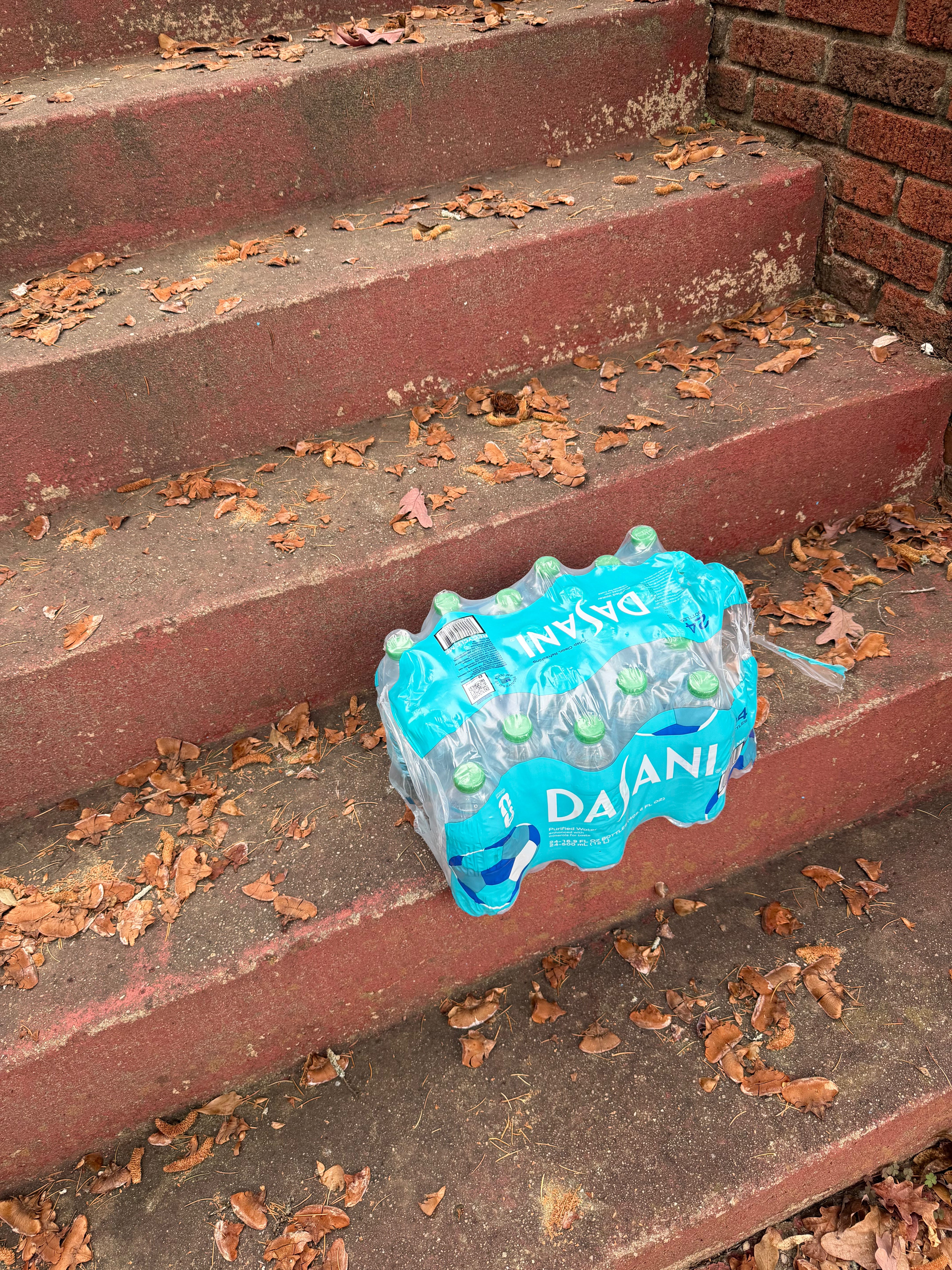
This week I carried water to some family members who needed it. School schedules changed, a church dinner had to be rethought, and the ordinary assumptions of a household... that the tap will run, that the dishes can be washed, that there’ll be coffee in the morning... turned out to rest on a 42-inch pipe most of us had never had a reason to think about.
Two days before the pressure dropped, County Council had taken its final votes on three data center development agreements and its first votes on three more. By Wednesday morning, the week had a second subject, and it’s worth asking how the two relate.
It helps to begin with what they don’t have to do with each other. Spartanburg Water traced the outage to a brief power interruption (or “power blip,” which rightly entered into the local meme vocabulary) early Wednesday that sent a surge through the system and damaged both the main distribution line and its backup. The source of that interruption is still under investigation. Nobody has connected the failure to a data center, and I won’t either (even though many people have reached out to me with certainty that this is the culprit). Monday’s vote and Wednesday’s outage raise a shared question: what do we expect our public systems to carry, and who gets a say? Both concern the systems we share, and both ask what we expect those systems to carry.
A phrase ran through both halves of the week, too. NorthMark has said for more than a year that it wants to be a good neighbor on South Pine Street. On Thursday, the company put fifteen trucks of drinking water at the Fairgrounds behind the phrase. So this seems like the right week to take the word seriously, and to ask what a neighbor is for.
What Monday decided
On November 16, council gave third and final reading to three development agreements: the Valara project, which is NorthMark’s campus on South Pine Street I’ve written so much about here; AIB’s replacement of its cryptocurrency operation at Tyger River Industrial Park; and a project on Jones Road. Valara passed 3-2. Paul Abbott, Jessica Coker, and Jack Mabry voted yes, Monier Abusaft and Grant DeShields voted no, and Chairman Manning Lynch was absent for the votes. The other two passed unanimously. Three more AIB proposals at Tyger River passed first reading, and each still needs two more readings and its own public hearing.
Some of what was said Monday deserves to be kept. Abusaft, who voted no, told the room he believes in this industry, and he credited his colleagues for pressing NorthMark until much of what the company had first promised was back in the agreement. County Administrator Cole Alverson said the final terms require efforts on noise, glare, and air pollution beyond the county and state minimums. The Post and Courier reports that the agreement also holds back a certificate of occupancy for one data hall until the county is satisfied with the noise mitigation plan. Residents spoke on both sides, and some of them see in these projects the reuse of idle industrial land or a technology that might help a father who’s lost his sight get around on his own. I take those hopes seriously, as well. They belong to my neighbors too.
Two things discourage me, though. The first is transparency, which concerns access to documents, studies, negotiations, and reasons. I’ve written about drafts that arrived late and exhibits that arrived later, and those concerns didn’t close on Monday.
The second is responsiveness, which concerns how officials answer the public, including during a transition. WSPA reports that the Valara agreement locks in its terms for ten years. It passed with three votes, and two came from members who lost their primary runoffs in June and leave office in January. The Chairman, who’s also leaving, was absent for the votes. Residents asked council to wait until the four members voters chose on November 3 take their seats. The outgoing members still held office, and the vote was theirs to cast. The election results prove nothing about transparency on their own. They do make the second question more concrete, though. When a ten-year commitment is decided by a council the voters have already begun to replace, while questions about the record behind it remain open, people are left to supply the missing account themselves. That’s where many residents are this weekend, and I’d be less than truthful if I said I weren’t there with them.
Near-dwellers
On Thursday, NorthMark brought fifteen trucks of bottled water from North Carolina and Georgia to the Piedmont Interstate Fairgrounds here in Spartanburg. FOX Carolina reported that the line wrapped around the grounds, that people came by car, bike, and on foot, and that each left with two cases. Sarah Knox, the company’s director of external affairs, explained it this way: “I know that when your neighbor needs help, if you can, you step up.”
I agree, and I’m grateful for the gesture and action. Water handed through a car window to someone whose tap has been dry since Wednesday is a real good, and it deserves to be received as one. Walmart sent truckloads as well. SJWD, the water district next door whose system wasn’t affected, opened refill stations with the county. Many people were neighbors this week. Residents can take the water, thank the people loading it, and keep their own judgment about the project. Gratitude and scrutiny can live in the same person.
The word itself is well worth slowing down for in my own word-nerd mindset. Our English neighbor is an old compound, the nēahgebūr, or the near-dweller. The Greek in the Gospel of Luke ch. 10 is πλησίον (plēsion), rooted in an adverb meaning “near,” that came to stand for the person who is near. In its plainest sense, a neighbor is whoever lives close by, and on that definition, NorthMark already is one, three hundred acres’ worth (whether we like it or not). Nearness here is a fact before it’s a virtue.
The company’s Good Neighbor Program describes neighborliness as “listening, staying connected and offering practical support,” and it offers house washing, car-wash memberships, and replacement HVAC filters to households beside the site that are living with construction dust. AIB’s spokesperson says that the company is drafting what it calls a “good neighbor agreement” with residents on Griffin Road and has hired a firm to take sound readings there. The phrase is becoming part of how this industry introduces itself to us. Good marketing.
I’d like to accept the phrase, but I also want to ask what it commits a company to. Practical support belongs in it. So does the first word on NorthMark’s own list. Listening has consequences when the person being heard can affect what happens next. A resident’s experience of dust, noise at two in the morning, or learning in September that the daily water usage figure had more than doubled needs a route into decisions about construction practices, operating conditions, monitoring, and public information. A dust filter is a kindness. A way for the person breathing the dust to change how the dust gets made is the beginning of a relationship.
What the water showed
The smaller backup line to Spartanburg line was back in service overnight Wednesday, and the 42-inch main was back by Thursday morning. After that came the slow work of refilling about 1,600 miles of pipe and the storage tanks in a system that serves roughly 240,000 people. By early Saturday, the utility reports that plant and distribution operations are back to normal, with the boil-water advisory still in place as of its 10 a.m. update on November 21 (as I’m writing this), pending final tests. The crews who worked those nights were doing the work the rest of our routines depend on, and I’m thankful for them.
The outage doesn’t show that the system lacks capacity for new customers, and I’d be misusing it if I said so. It shows what dependable means when you’re the one standing at the sink. A utility spokesperson told WYFF that both lines had never gone down together before, and that a study and a capital plan are already in place. Capacity is one question; resilience is another, and it’s the one this week's story asked.
On Thursday, the utility warned customers about AI-generated social media posts carrying inaccurate information about the outage. The Post and Courier described fabricated images of exchanges between Spartanburg Water and Duke Energy that never happened. In a week like this one, that irony needs no help from me. The utility kept posting dated updates through the worst of it, and people could check rumors against them if we trust public utilities (as we should be able to). However, public information behaves like infrastructure. We notice how much rests on it when the pressure drops.
We’ve already had reason to look closely at how water demand gets described. In September, NorthMark corrected the widely circulated figure of 459,000 gallons a day to a full-buildout average of 1.2 million and a maximum of 1.6 million gallons a day, and said Spartanburg Water had assured the company that the demand remained within the utility’s capacity. Both the correction and the assurance belong in the account and history of this process, which will be remembered and studied long after the current County Council is no longer seated.
After this week, I’d also like a public explanation of how large new demands fit the system’s plans for drought, equipment failure, and recovery. What can a large industrial customer reduce or suspend during an emergency? Who’s first in line when the tanks refill? Who pays for the capital plan? Those questions deserve answers people can easily read and trust.
An ecological account also follows the water past the treatment plant. The black walnut behind our house came through the week without an advisory, though it’s no more independent of water than we are. Its dependence runs by other paths... rain, soil, the fungi at its roots, a water table none of us can see. The South Pacolet that fills our reservoirs, the creeks below them, and the people and creatures downstream belong to the same system we spent the week missing. Their needs don’t end where a development agreement’s boundaries do.
The week elsewhere
On Tuesday, Intercontinental Exchange, the company behind the New York Stock Exchange, launched a tool that estimates, county by county, the probability that a data center project will be delayed or disrupted within two years. The announcement lists utility costs, environmental concerns, and community opposition among the reasons projects stall, and one executive put the problem in a sentence: “Data center capital is moving faster than local permitting and community consensus.” The release prices a twelve-month delay on a median project at $162 million to $270 million.
From a trading desk, a community’s questions show up as disruption risk. For the people who live near these sites, the same questions are called participation. Still, the announcement concedes something residents have been saying. The time it takes a place to understand a project is one of the conditions of building there, and the industry’s own financiers now count it.
In Texas, environmental regulators resumed reviewing data center permits after a pause ordered while grid officials audited the projects’ power, water, and neighborhood effects. The full findings aren’t due until December 10, and the watchdog group Public Citizen objected that permitting restarted before the results had been shared with the public. Information can exist inside a process while the people affected still can’t examine it. Transparency has a timing as well as an availability.
North Carolina spent the week writing terms. Its Utilities Commission approved a separate rate schedule for Duke Energy data center customers above 50 megawatts, with minimum contracts of ten to fifteen years and a charge meant to guard against stranded costs. One commissioner dissented, arguing the protections don’t go far enough. Whatever one makes of the details, the terms and the disagreement are both on the public record.
Closer to home, a Thursday night forum in Orangeburg, hosted by Rep. Gilda Cobb-Hunter, invited residents to submit questions in advance. Warren Harley, who manages the city’s public utility, told them the system can’t serve hyperscale projects in the 100-to-500-megawatt range and that something between 25 and 50 megawatts fits the community better. He said the utility has rewritten its contracts so a developer pays the “full freight” of being connected and the utility isn’t left with costs for a project that never arrives, while ongoing upkeep is still recovered through the rates every customer pays. I find that useful. A place can investigate an opportunity, say what it can support, and ask a developer to work within that. Limits spoken aloud give people something firm to build a decision on.
What we can ask for now
If Monday’s Council vote left you discouraged, I’m with you. Reading long packets, showing up at meetings, quoting a water figure from a pulpit and learning later it was out of date, and standing at a microphone for three minutes all take something out of a person. I’d only say that, at this point, losing a vote and losing your place in the conversation are different things. Much like the talks I’d give my golfers and baseball players in the previous decade as a coach and teacher. An agreement is where obligations start to become checkable, and most of the relationship this one governs hasn’t happened yet.
So, here’s where I’d put our energy
One public record. Residents should be able to find, in one place, the signed agreements, the studies behind them, and a plain account of what changed between drafts. That record should say which commitments are enforceable and which are voluntary, who’s responsible for each, and when the public can expect a report. The South Pine Street agreement reportedly ties one data hall’s certificate of occupancy to a noise plan the county accepts. Tell us how the county will judge that plan, and what its other tools are.
A December meeting worth attending. NorthMark has committed to a yearly public, in-person meeting and plans the first for next month. I’d like the company to circulate its light, noise, and landscaping studies beforehand, take questions in advance the way Orangeburg and Greenville did, and publish the answers afterward, including its reasons when it declines a request. I hope a lot of us will be in the room.
Three decisions still open. AIB’s three new proposals each need two more readings and a public hearing, and the company’s own representative told reporters that “nothing gets approved as a group.” Let’s hold everyone to that. Watch the county’s agendas and public hearing notices closely, and take each proposal on its own terms. In January, William Crawford takes the chair and Jason Seay, Betty Montgomery, and Alex Turner take their seats alongside Abbott, Abusaft, and DeShields. Write to the members serving now and those arriving (rather than being passive-aggressive in the comments on a social media post). The county moratorium has about ten months left, and the standards that replace it will shape our county far longer than any single agreement.
A map of the whole. A household doesn’t experience six separate projects. It experiences the sound reaching a bedroom, the traffic on its road, and the reliability of its tap water and ability to flush toilets. A public map of approved and proposed facilities, with their power, water, and noise footprints stated in comparable terms, would let residents see the decisions as they accumulate. I asked about cumulative review before the vote, and the question gets heavier with each first reading.
Shared work. Someone has time to read an agreement. Someone else understands decibels, or lives on Griffin Road, or remembers what was promised in 2025. Churches, neighborhood groups, and civic clubs can help people compare what they know and keep unanswered questions in circulation. Nobody has to carry the whole endeavor alone, and people who are already carrying plenty can still carry a piece.
Becoming a neighbor
The lawyer in Luke 10 asks Jesus, τίς ἐστίν μου πλησίον; “Who is my neighbor?” It’s a question about where obligation stops. Jesus tells the story and hands back a different question: which of the three δοκεῖ σοι γεγονέναι, “seems to you to have become,” a neighbor to the man who fell among the robbers (Luke 10:36)? The verb is γίνομαι, here in the perfect infinitive γεγονέναι. To become, or to prove to be. The priest and the Levite were already near. They were close enough to see him and pass by on the other side. Nearness was true of all three. One of them became what the other two already were by location.
The judgment is also made from a particular place. The Samaritan is neighbor τοῦ ἐμπεσόντος, “to the one who fell,” so the word gets measured from the ditch. And the lawyer’s answer names him by what he did: ὁ ποιήσας τὸ ἔλεος μετ᾽ αὐτοῦ, “the one who showed him mercy,” or more woodenly, “the one who did the mercy.” In this story, neighbor is something other people say about you afterward. A company can’t declare it of itself. Neither can a County Council, or a minister with a newsletter.
I keep returning to what happens after the roadside. The Samaritan takes the man to an inn, asks the innkeeper to care for him, and promises to repay whatever more it costs ἐν τῷ ἐπανέρχεσθαί με, “when I come back” (Luke 10:35, from ἐπανέρχομαι). He signs for a cost he can’t yet know, and he promises to return. I’d rather leave the parts in this story unassigned. What it offers all of us... a company, a county government, a church, a household... is a standard of continuing care. Emergency help matters. So does remaining answerable for what comes after.
My own work on ecological intentionality starts from the observation that we rarely arrive anywhere with our purposes fully formed. People, other living things (I’d include rivers and creeks), and the conditions of a place help shape what we come to care about and what we’re able to notice, and then they keep giving us reasons to revise it. That bears on development. Residents have a part in examining a project’s impacts and holding it to its commitments. They also have a part in shaping what responsible development here is trying to accomplish... whose needs count, and what success would mean. I want the people making plans for Spartanburg to stay open to what its residents and its watershed can teach them, and I want public questions to be able to change a decision.
The water’s running again, and as of Spartanburg Water’s Saturday morning update, we still need to boil it if we intend to use it from the tap for drinking or cooking. I notice it now when I turn the handle to brush my teeth out of habit or tell my children to brush theirs after a meal, and I’d like to keep noticing after the routines close back over. This week, being a neighbor meant carrying water to someone who needed it. In the months ahead it’ll also mean making information available, keeping commitments, answering for harm, and changing course when the evidence asks for it. That work is still open to all of us near-dwellers, old and new. We still belong in the decisions about the place we’re becoming.
Sources
Greek text of Luke 10 follows the standard critical editions. Translations are my own.
Spartanburg Water. “1 PM Update: Spartanburg Water Customers Can Expect Widespread Water Service Interruptions.” November 18, 2026. See also the utility’s running outage information page, including the 10 a.m. update of November 21.
Post and Courier. “Spartanburg County Council paves the way for 3 more data centers, an $8 billion investment.” November 2026.
Baker Maultsby. “Spartanburg County Council Gives Green Light to Valara Agreement.” Spartanburg Herald-Journal, November 17, 2026, via AOL.
WSPA. “Spartanburg Co. council approves six data center agreements.” November 16, 2026, via Yahoo.
Alexa Erbach. “Spartanburg Co. Council Gives Final Approval to 3 Data Center Agreements, Advances 3 More.” FOX Carolina, November 18, 2026.
Jada Washington. “Data Centers Clear Spartanburg County Council, with More in the Pipeline.” South Carolina Public Radio, November 17, 2026.
Post and Courier. “Republicans sweep Spartanburg County Council races.” November 4, 2026.
Ashley Listrom. “Data Center Developer Provides Free Water during Boil Water Advisory.” FOX Carolina, November 19, 2026.
Post and Courier. “Where to find free drinking water in Spartanburg amid boil water advisory.” November 2026.
NorthMark Compute & Cloud. “NMC² Good Neighbor Program.” Accessed November 21, 2026.
FOX Carolina. “Everything we know about the Spartanburg Water outage.” November 18, 2026, updated.
WYFF. “Saturday update: Spartanburg Water situation.” November 21, 2026.
Post and Courier. “As Spartanburg Water works to restore service, fake images and misinformation circulate social media.” November 2026.
WSPA. “Spartanburg Water CEO, councilman respond to data center water concerns.” September 2026.
Intercontinental Exchange. “ICE Launches New Tool to Quantify Data Center Construction Risk.” November 17, 2026.
Emily Foxhall. “Texas Regulators Are Resuming Environmental Permits for Data Centers.” Texas Tribune, November 17, 2026.
WFAE. “Duke Energy rates are going up next year, as NC Utilities Commission approves increase,” November 17, 2026; Zachary Turner, “NC Regulators Approve New Rates for Data Centers in Rate Hike Plan,” November 18, 2026, via WFDD.
Jada Washington. “Orangeburg Community Forum Tackles Data Center Questions.” South Carolina Public Radio, November 20, 2026.
Sam Harrelson. “What the Number Lets Us See,” September 22, 2026; “What We’re Being Asked to Trust,” November 6, 2026; “What the New Documents Let Us Ask,” November 10, 2026. Carolina Ecology.

I’m surprised and disappointed that it took a private company’s largesse to make bottled water available to city residents.
While overall communication from the water department was good, a definitive (as much as possible) timeline as to when the boil advisory would end and what it covered (drinking, bathing, cooking, laundry, hand-washing, teeth-brushing) would have been helpful. The timeline seem to get extended every time I checked the department’s website.
A December meeting on data centers is not optimal. January would be much better. The incoming council members will be present, and holiday event conflicts will be minimal.
A final thought: if the county emergency department could send an alert Wednesday night about the water outage, why not send one Wednesday morning to give residents and customers more time to prepare?