


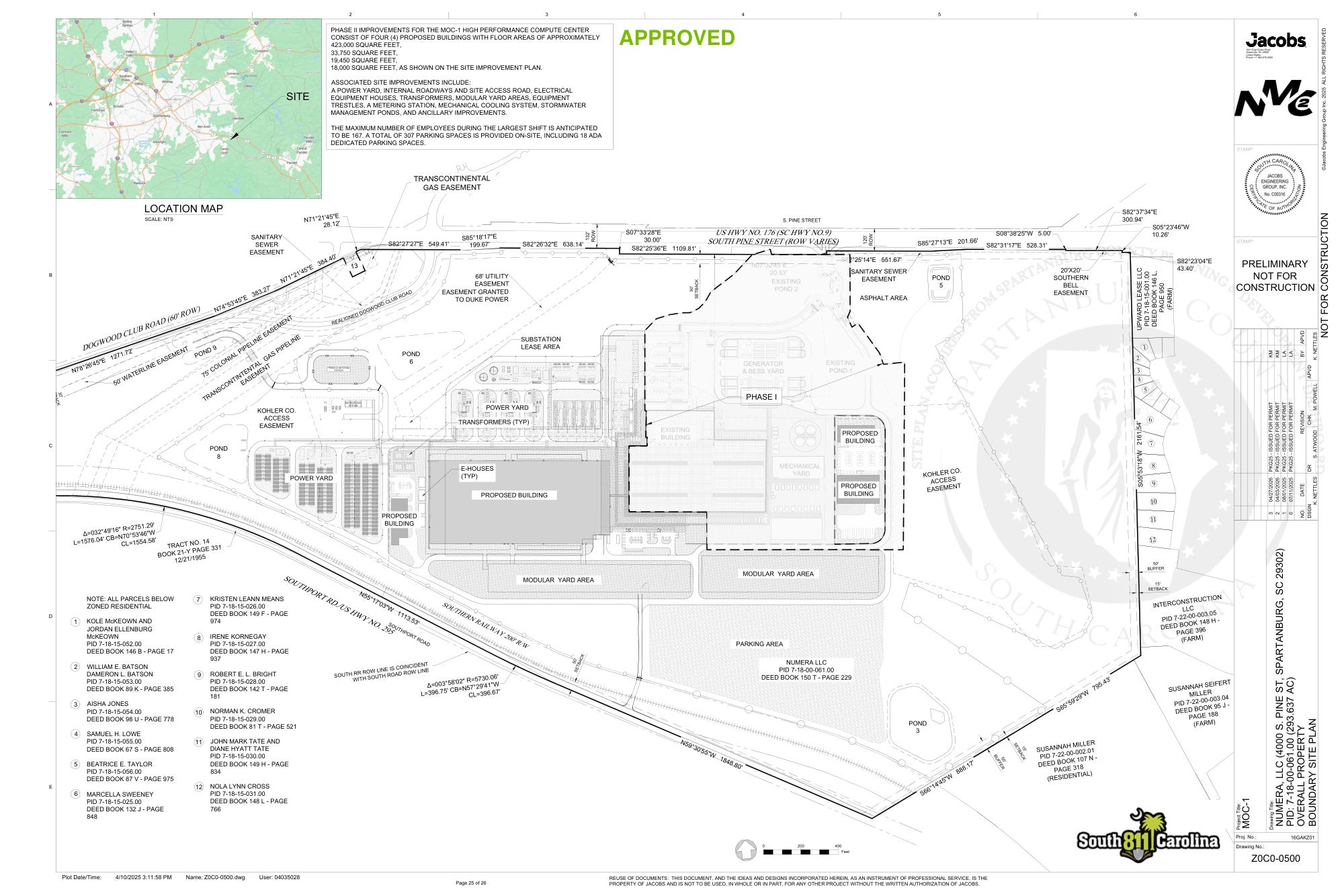
A few hours after I published What We’re Being Asked to Trust on Friday, Spartanburg County posted the tentative packet for its November 16 meeting. The 556-page packet includes revised development agreements for the South Pine Street project, AIB at Tyger River Industrial Drive, and Jones Road. The South Pine Street project I’ve been calling NorthMark appears in its agreement under two legal entities: Numara LLC, the property owner, and Valara Holdings LLC, the ground lessee. I’ll use Valara here when discussing that agreement.
Some of what I asked for is there now. In my last essay, I noted County Administrator Cole Alverson’s commitment, reported by Christian Boschult, to make the missing exhibits available before the regular November meeting. Valara’s site plan and development schedule are attached, and AIB and Jones Road have written design standards where their drafts had placeholders. Those exhibits have been supplied, and residents now have more to examine before the vote.
Reading the documents together, though, a pattern comes into view. Councilman Monier Abusaft’s October 19 report states that “Clustering is good policy.” The separation paragraph in the September moratorium disappeared from its October readoption, and similar commitments have now disappeared from the proposed AIB and Jones Road agreements. The new design standards also anticipate data centers sharing property lines.
I read those changes as movement toward concentration: fewer restrictions on proximity, alongside proposed standards written for shared boundaries. That makes the question of combined effects more urgent. The county is making room for developments to sit near one another, and residents need to understand how it will assess what those developments mean together for the surrounding place.
What the county has supplied
Valara’s agreement now dates the lighting plans, noise plan, and noise study to October 28. The landscaping plan is dated October 16, with a resubmission on October 28. The attached schedule projects substantial completion of the first two data halls in January and June 2027, followed by two more in June and December 2028, with operations beginning upon completion.
The underlying noise study still isn’t attached to the agreement. The text describes a study that measured existing noise and modeled postconstruction operating levels, with an increase of no more than ten decibels “at determined locations.” The agreement doesn’t identify those locations, and its wording doesn’t establish that the model addresses every neighboring property line.
That brings me back to last week’s questions. Where were the baseline measurements taken, and why were those locations selected? What operating conditions were modeled? How does the study address low-frequency sound, later data halls, and other nearby sources? With the first hall’s projected completion only a few months away, residents should be able to examine those assumptions before the equipment begins testing them in daily life.
Another difference among the agreements remains. Valara still has no comparable schedule of community-benefit payments or requirement to obtain and publish annual findings from an environmental monitoring firm. It does require annual reporting to the county and other ongoing obligations, including maintenance of noise-mitigation equipment. But the specific payment and public monitoring commitments in the AIB and Jones Road agreements haven’t been added to Valara’s.
Following the separation language
The separation provision is easiest to follow with the documents side by side. Its removal from an adopted ordinance and its later omission from proposed contracts are distinct steps in the same chronology.
September 21 signed moratorium: Section 4 bars a new data center permitted under the relevant exception from sharing a parcel or industrial park with another data center, or locating within one mile of one.
October 19 signed readoption: The separation paragraph is absent.
November 3 AIB and Jones Road drafts: Both contain proposed commitments against sharing a parcel or industrial park with another data center, or locating within one mile of one.
New drafts prepared for November 16: Both agreements omit those commitments.
The provision concerns distance between data centers, rather than a one-mile setback from homes. The November agreements are still drafts, so this latest revision removes proposed commitments. It doesn’t cancel signed contracts or establish that other land-use requirements have disappeared.
The sequence still calls for an explanation. Why did language removed from the moratorium remain in the agreements through second reading, and why has it now been removed there too? What does the county expect the change to accomplish?
What a household can hear
Imagine a bedroom above a back porch on a November night. Even with the window shut, the question remains: what would someone in that room hear if two nearby facilities were operating at once? A review of either project needs some way to account for the conditions where their effects meet, including low-frequency sound indoors.
Stein’s account of the lived body helps explain why that location matters. The world is experienced from somewhere. A noise model has to choose the locations it represents, while a resident already lives in one. Asking how several projects will sound from that place brings the review into contact with the life it’s supposed to protect.
The same need to consider relationships extends to water demand, road work, substations, and transmission lines. A facility’s individual requirements tell us part of what a place will be asked to accommodate. The question grows when other facilities use the same systems, when later phases come online, or when infrastructure changes the land between the projects and the people they affect.
There are reasons to consider grouping industrial uses. The planning department’s October 20 presentation discusses an overlay district as an option for directing larger data centers toward industrial parks or corridors, where infrastructure might be coordinated and development separated from residential uses. It also leaves decisions about location, size, and development standards open.
The new AIB and Jones Road design standards make the direction more concrete. Both generally call for Type 5 bufferyards along side and rear boundaries, with adjustments for certain neighboring uses. Both also provide that no bufferyard is required along a boundary adjoining a cryptocurrency or data-center facility. The exception concerns those shared boundaries; requirements for boundaries next to homes remain part of the standards.
So the proposed agreements accommodate adjoining data centers, while removing a commitment that would have kept them apart. Abusaft’s report favors clustering and also calls for evaluating projects individually. How will the county connect those individual reviews so that someone living nearby can understand the conditions they’ll experience?
Residents need the county to identify the framework it will use, the area each assessment will cover, and how it will account for existing facilities, approved projects, and anticipated expansions. They also need to know who will compare operating conditions with the studies, publish the results, and require a response if the predictions prove inadequate.
Where did the 65 IT MW exemption come from?
The capacity exemption raises a related question about how the county arrived at its present approach. The moratorium defines a covered data center using a combined connected electrical load of one megawatt or more. Both the September and October versions retain that definition, alongside a separate exemption allowing qualifying facilities of up to 65 IT megawatts to proceed subject to location and other conditions.
The draft in the final packet circulated before the September 21 meeting contains no 65 IT MW exemption. Its Section 4 addresses prior conditional approvals and previously issued development permits. The signed ordinance contains the additional exemption, and contemporaneous reporting describes amendments adopted before the final vote.
The comparison establishes a change between the circulated draft and the signed ordinance. The county should make the exemption’s drafting history available, along with the analysis used to choose 65 IT MW and the conditions attached.
The agreements make the units consequential. AIB’s draft distinguishes a limit of 50 IT MW from a maximum facility cap of 65 MW. Jones Road’s permits up to 65 IT MW. Those are different descriptions of capacity, and they don’t establish identical demands on surrounding infrastructure.
A cap on each qualifying project also leaves open the question of several projects together. How did the county account for that possibility when it selected the exemption, and how will it evaluate it now that the separation language is gone? An explanation of the number should include the circumstances under which it will be used.
What else changed?
Some revisions strengthen the county’s position. AIB’s earlier draft placed a $100,000 cap on aggregate liability under its indemnification section. The new wording applies that cap specifically to attorneys’ fees under the section and broadens the injury and property-damage language to cover negligence by additional company-related parties and their contractors, agents, or employees.
Jones Road’s draft loses another sentence alongside the separation commitment. That sentence protected the project from later regulations that materially impaired it, subject to listed legal exceptions. Other vested-rights provisions remain, but the proposed agreement removes this additional protection.
AIB and Jones Road also retain their scheduled community-benefit payments, totaling $12.6 million and $9 million respectively during their initial terms, along with their annual environmental-monitoring publication requirements. Their new design standards put specific requirements into the proposed agreements where there had been placeholders. These are obligations residents can follow through approval and, if the agreements are executed, into operation.
Before November 16
The tentative agenda schedules public hearings and third readings for all three agreements on Monday, November 16. The main meeting begins at 5:15 p.m. in the County Council Chambers at 366 North Church Street, with a five-minute limit per public-hearing speaker.
Before those votes, the county can provide documents and explanations that residents can examine for themselves. These are the questions I’d put before it:
Why were the separation provisions removed from the moratorium and then from these proposed agreements, and what standards now address the concentration of data centers? Identify the framework for assessing the combined effects of nearby facilities, including how reviews will account for existing operations and future phases.
Will the county publish Valara’s October 28 noise study, associated mitigation plans, and review findings before final reading? Include the measurement locations, modeled operating conditions, and the basis for determining that the requirements have been satisfied.
How does the new design standards’ treatment of adjoining data-center boundaries fit the county’s broader land-use objectives? Explain how the shared-boundary exception relates to protection of households and other uses around a group of facilities.
Who proposed the 65 IT MW exemption, why was that threshold chosen, and what analysis supported it and its conditions? Provide the amendment’s drafting history and supporting analysis, including how capacity is defined and how the County considered multiple qualifying facilities.
Can the county provide a comparison showing the substantive revisions between readings, with explanations for those changes? Residents should be able to follow the terms under consideration without reconstructing a negotiation from successive packets.
In August, writing about Stein, I returned to the two verbs Paul uses for creation in Romans 8:22: συστενάζει and συνωδίνει, groaning together and suffering birth pains together. Their shared prefix, συν-, means together. I hear in that prefix a demand to attend to lives in relation, including consequences that cross the boundaries of our individual decisions.
I live here with my family, and these questions concern the place where we’re raising our children. The creek, the substation, the yard, and the walnut behind our house belong to a landscape whose relationships continue beyond the boundaries we administer. I want the county’s decisions to be answerable to the people and other living beings already there, and to what we will learn as the place changes.
The council will consider these agreements one at a time. Their consequences will unfold together in the places around them, and the county’s account of its responsibilities needs to reach that far.
Sources
Spartanburg County documents (page numbers are physical PDF pages)
November 16, 2026, tentative agenda packet, 556 pages, posted 7:02 p.m. on November 6. Numara and Valara: p. 462. Valara Article V: pp. 467-468. Valara Article VII: pp. 470-471. Valara site plan and schedule: pp. 484-486. AIB capacity, separation, and monitoring: pp. 496-498; indemnification, pp. 504-505; payments, p. 516; design standards, pp. 517-520. Jones Road capacity, separation, and monitoring: pp. 530-532; payments, p. 552; design standards, pp. 553-556. Meeting time and hearing rules: p. 2; hearings and third readings: pp. 6 and 12.
November 3, 2026, agenda packet, 155 pages. Valara: pp. 78-79, 95-96. AIB separation: p. 106; indemnification: pp. 114-115. Jones Road separation and future-regulation language: p. 137.
September 21, 2026, final agenda packet, proposed moratorium at pp. 82-84 (Section 4, p. 83).
Ordinance O-26-26, signed September 21, 2026, Section 1(b), p. 2; Section 4, p. 3.
Ordinance O-26-26, signed October 19, 2026, readoption, Section 1(b), p. 2; Section 4, p. 3.
Monier Abusaft, “What Spartanburg Learned,” presented October 19, 2026, pp. 35 and 38.
Spartanburg County Planning and Development Department, “Land Use Committee: Data Center Ordinance,” October 20, 2026, pp. 31, 34-35.
Reporting
Christian Boschult, “Spartanburg County Council approves NorthMark data center agreement, amid alleged legal threat,” The Post and Courier, November 5, 2026. Fascinating reporting from Boschult here. Really well done, and I hope he keeps it up!
Ashley Listrom, “Spartanburg County Council passes data center moratorium with several amendments,” FOX Carolina, September 21, 2026. Reports four amendments before final passage; the 5-1 tally concerns the final ordinance.
Other
Edith Stein, On the Problem of Empathy, trans. Waltraut Stein, 3rd rev. ed. (Washington, DC: ICS Publications, 1989), 42-43.
The Greek New Testament: SBL Edition, ed. Michael W. Holmes (Society of Biblical Literature and Logos Bible Software, 2010), Romans 8:22: συστενάζει (συστενάζω) and συνωδίνει (συνωδίνω).
Sam Harrelson, “What We’re Being Asked to Trust,” Carolina Ecology, November 6, 2026.
Sam Harrelson, “What Empathy Is For,” Carolina Ecology, August 9, 2026.