


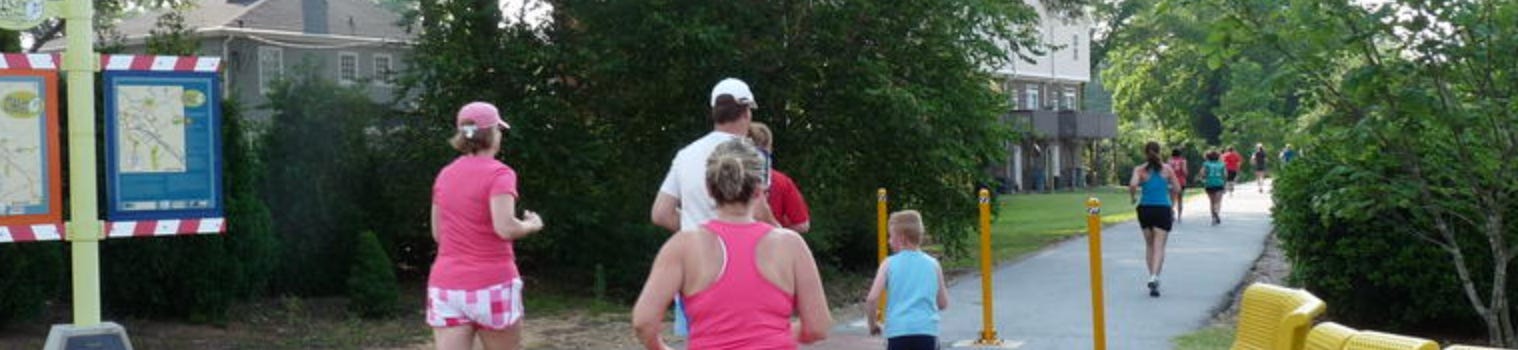
I love that Spartanburg downtown is a walkable, bike-friendly city. Sure, we have some things to improve, but the momentum is in a positive direction here. Liv does a wonderful job writing about some of this over on The Walking Spartan. Having lived in Asheville, NC (also with positive momentum and a vibrant walking town), Columbia, SC (not so much a walkable city despite the planned grid layout downtown that serves USC and the government functionaries well), Sumter, SC (walking seems to be a punishable offense), and my hometown of Mullins, SC (small town feel and if you can avoid the main highway it’s walkable), I’m glad to say Spartanburg with its Rail Trail, The Dan, incredible team at PAL, and a number of local-led initiatives, is becoming more pedestrian friendly with road diets and more thoughtful road intersections.
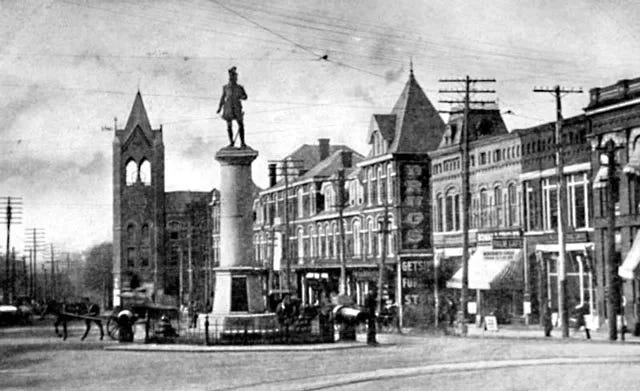
I obviously enjoy my walks here, both solo and with our children. Despite recent construction and road reconfiguration, Morgan Square downtown is a good reminder, as light stays sideways along Main Street even on warm summer afternoons. The square is a made thing, and on a quiet morning, you can almost watch it being made again. The curbs run along the sides of streets, and crosswalks where traffic picks back up after the pedestrian-only section lie at right angles to the buildings as designed (and now re-designed). The brick storefronts hold their cornices at a common height, and the whole arrangement gathers itself around the figure of Daniel Morgan on his pedestal, a center fixed a hundred years ago by people with chains and a transit, who looked through a small glass at a distant rod and wrote the town down in numbers as Spartanburg became a town. We are the Hub City because of the ubiquitous railroad tracks that were laid across the area (some of which are now reassembled into our Rail Trail). The streets remember the drawings and surveys, even if they aren’t necessarily straight now, and more metaphorical than resembling a hub with clear spokes (no remark here on our Spartanburg minor league’s team name… ok, I like it). To stand in the square in the morning or afternoon hours is to stand inside a survey... a thing laid out from a point of view, measured from somewhere, held together by a plan that lives in a courthouse drawer and in the habits of everyone who keeps the lines. That’s especially true now, as evidenced by the ongoing construction of a new hotel and center abutting our recently constructed baseball stadium. I won’t touch the thorny Clock Tower issue here.
But sometimes, as we’re in Morgan Square, I’ll kneel down to tie one of our children’s shoes or help confirm their latest sighting of a cool bug near the edge of a planting bed, or at the lip of a storm grate, and I find the other kind of thing entirely.
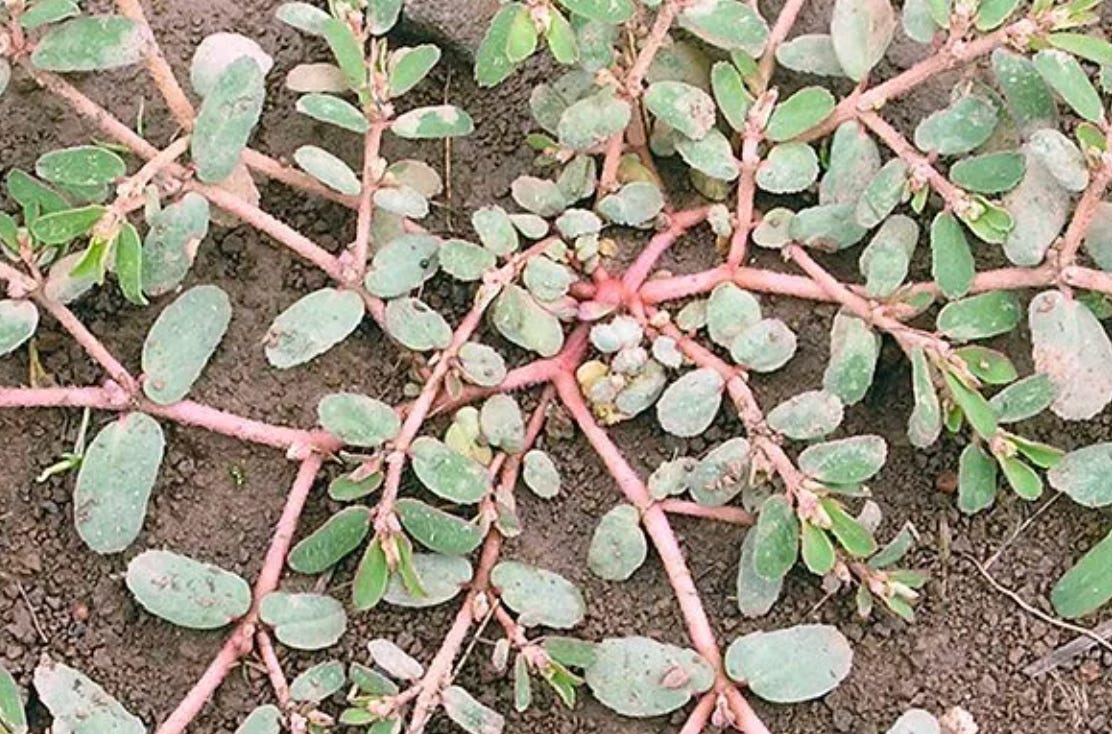
There’s spotted spurge (Euphorbia maculata) flattened against the warm concrete, its small leaves laddered along red stems, bleeding white when you break them. There is broadleaf plantain in the seam where the sidewalk meets the building, its ribbed leaves fanned out in a rosette that no one drew. There’s a mulberry seedling, or a hackberry, no taller than my hand, holding two true leaves up out of a crack that collects just enough grit and rain to be a soil.
A human didn’t survey these, nor was any transit or construction equipment used to fix them. They weren’t assigned a height to match the cornices. But each one holds a form, keeps a form, presses a form up out of itself into the morning, with an exactness the square doesn’t teach and doesn’t own. The spurge is more itself than the crosswalk is itself in that way. The “made” Daniel Morgan Square is held together from the outside by us. The “weed” (I don’t prefer that term, but will employ it here) in the crack is held together from the inside by nothing I can point to.
I have been heavily reading a French philosopher this summer who spent his life on exactly this difference, and reading him for a particular reason, so let me say who he was and why I am down here on the sidewalk with him.
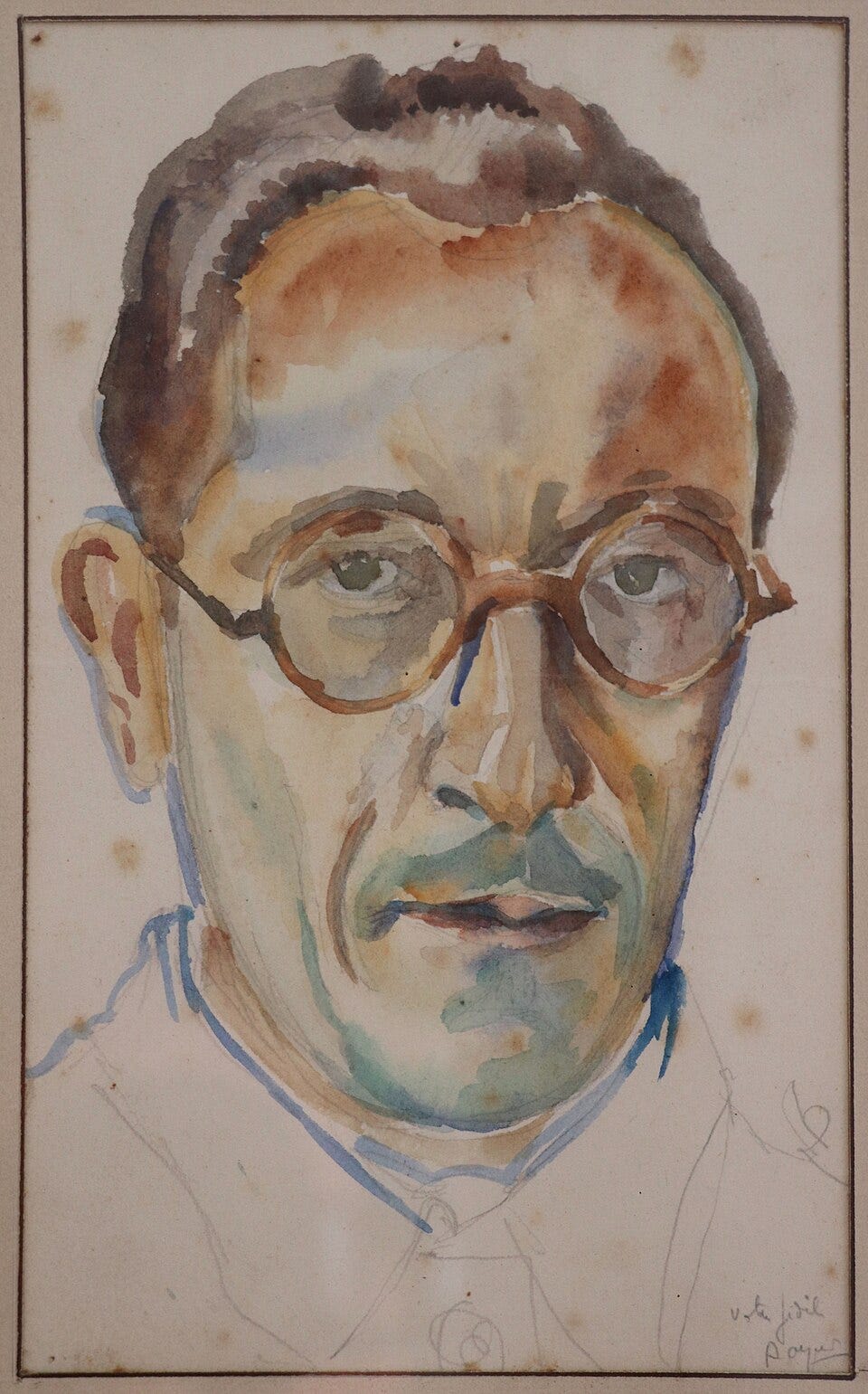
Raymond Ruyer (1902–1987) taught philosophy at the Université de Nancy and wrote more than twenty books, most of which have never been translated into other languages, on the strange seam where biology meets metaphysics. He is little known in English, partly because his major work, Néo-finalisme, remained in French from 1952 until an English translation finally appeared in 2016. He was not a vitalist of the old romantic kind, and he wasn’t content with the machine-talk that was overtaking biology in his lifetime. He wanted to know how a living form holds itself together, how an embryo builds a body, and how a melody stays a melody. Most fascinating to me was that he was willing to follow that question past the edge of what the science of his day could say. The philosophers who read him carefully tended to be the ones who could not be ignored. Deleuze called him the latest disciple of Leibniz.
I’m reading Ruyer and Deleuze now as I’m preparing for comprehensive examinations this summer and fall… that long threshold a doctoral student crosses after coursework and before the dissertation itself begins, as we try to realize how much we still don’t know despite all that we’ve learned (or “to build even more expertise!” as a Mentor optimistically put it). Ruyer sits near the center of the framework I am trying to build there, which I have been calling ecological intentionality. The sidewalk is one place where I test whether the ecological intentionality framework can work (see?).
Ruyer’s central word is survol. It means, literally, a flight over. You “survol” a landscape when you fly across it. In one of Deleuze and Guattari’s books I’ve been working on, the word gets rendered into English as survey, in another as overview, and one careful translator chose overflight to keep the wings in it. I found that translation point to be interesting for my own notes this summer and my own work. I like having all three in the air at once, because Ruyer is after something the ordinary words almost hide.
When a surveyor surveys the square, they stand at a fixed point, sight across a distance, and build the whole out of measured parts seen from where they happen to be standing. Their survey has a center and a circumference, a here and a there, an eye and an object. Ruyer’s survol absolu, his “absolute survey,” doesn’t follow that practice or methodology. The living form, he says, surveys itself all at once, with no distance inside it, from no particular point, with nothing standing outside it to do the seeing. The spurge does not assemble itself, leaf by leaf, according to a plan filed elsewhere and kept in the county courthouse down the street from Morgan Square. The plant is present to itself, whole, in the act of being spurge. There is no surveyor inside the seedling looking at the seedling. There’s only the form, flying over itself without leaving the ground, holding every part in a single self-possession that has no point of view because it needs none.
This is why Ruyer can say the unsettling thing he says, that an embryo is a kind of primary organic consciousness... not because it thinks, necessarily, but because the way it holds its own developing form together is already the deep form of what consciousness will later become. Mind does not arrive later, bolted onto matter from outside. The self-survey is there at the bottom, in the simplest living shape that keeps itself. Matter, in this view, isn’t a heap of parts waiting to be organized by an external hand. The forms in it are oriented, gathered toward an ideal of themselves, working. Ruyer ties three words together tightly here to help make his point: existence, freedom, and work. To exist as a true form is to be at work actualizing a form one is not yet finished being, and that labor, judged against the form it reaches for, is what freedom actually means. The spurge is free in Ruyer’s sense. It’s at work being spurge, and it can succeed or fail.
I find I can’t unsee the difference now when I walk Morgan Square or Spartanburg’s Rail Trails and sidewalks. The city is the great aggregate, the masterpiece of assembly from outside. Every straight line in it is a decision held somewhere other than the thing itself as a code, a permit, a drawing, a maintenance schedule, the muscle memory of the crew that repaints the crosswalks around town. Take away the people who hold the plan, and the painted lines begin to fade, and the grout fails on building facades.
The square doesn’t survey itself. Rather, it is surveyed, and it stays square only as long as the surveying continues. But the spurge in the crack would go right on being spurge with no one watching at all, because the plan of it is not in a drawer. The plan of it is in the act of it. This is the old Aristotelian word (reading lots of Aristotle as well this summer) that I keep returning to in my exam work, ἐντελέχεια, entelecheia, or “being-at-an-end.” Something like form held in act rather than waiting in potency.
Aristotle distinguished a first actuality from a second, the having of a form from the active use of it, and Ruyer’s self-survey lives there as well, in the form that is not a blueprint but an actuality keeping itself actual. The Greek for the working itself, ἐνέργεια, energeia, is the same root we have flattened into a utility bill. Downtown, on a summer sidewalk, the distinction isn’t as academic as that comparison, though. The “grid” (also an interesting metaphor of abstraction we’ve settled on for some reason) runs on ἐνέργεια in the metered sense, fed from elsewhere, and it would die the moment the feed stopped, as it tends to do during major afternoon thunderstorms and hurricanes here. The weed runs on ἐνέργεια in the older sense, the work of a form keeping its own form, and doesn’t ask the city for anything beyond a few spare photons.
I could write this into a sermon against cities and try to take Ruyer in the direction of Le Guin’s fantastic work Always Coming Home as a post-dystopian anti-utopia of Carrier Bag sentiment (maybe I should do that soon!), but that isn’t what the sidewalk is teaching me through this phenomenological exercise of attention and intentionality.
Morgan Square isn’t diminished by being assembled and reassembled. It’s a remarkable thing, a cooperation across two centuries, and the planted willow oaks and crape myrtles along the street are real organisms that someone chose to make room for at some point in all of this assembly work and thought. What the sidewalk teaches here is finer than a verdict or condemnation of urban life for humans and more-than-humans. The sidewalk teaches a way of seeing that holds two kinds of order at once and doesn’t confuse them… the order we impose and must keep imposing, and the order a living form keeps for itself, whether we attend to it or not.
Most of our public arguments about land, about water, about what we are allowed to build and where, run aground precisely because we cannot tell these two apart. From data centers to mono-crop agriculture to Amazon warehouses to ubiquitous carwashes and dollar stores, we treat a living watershed as though it were a grid we surveyed, a set of measured parts we may re-survey at will, and we are surprised, every time, when it does not behave like a drawing. A creek is a survol. It surveys itself. You can route it, culvert it, and write it down, and it will go on being what it is beneath your numbers, and it will hold you to account for the difference (eventually).
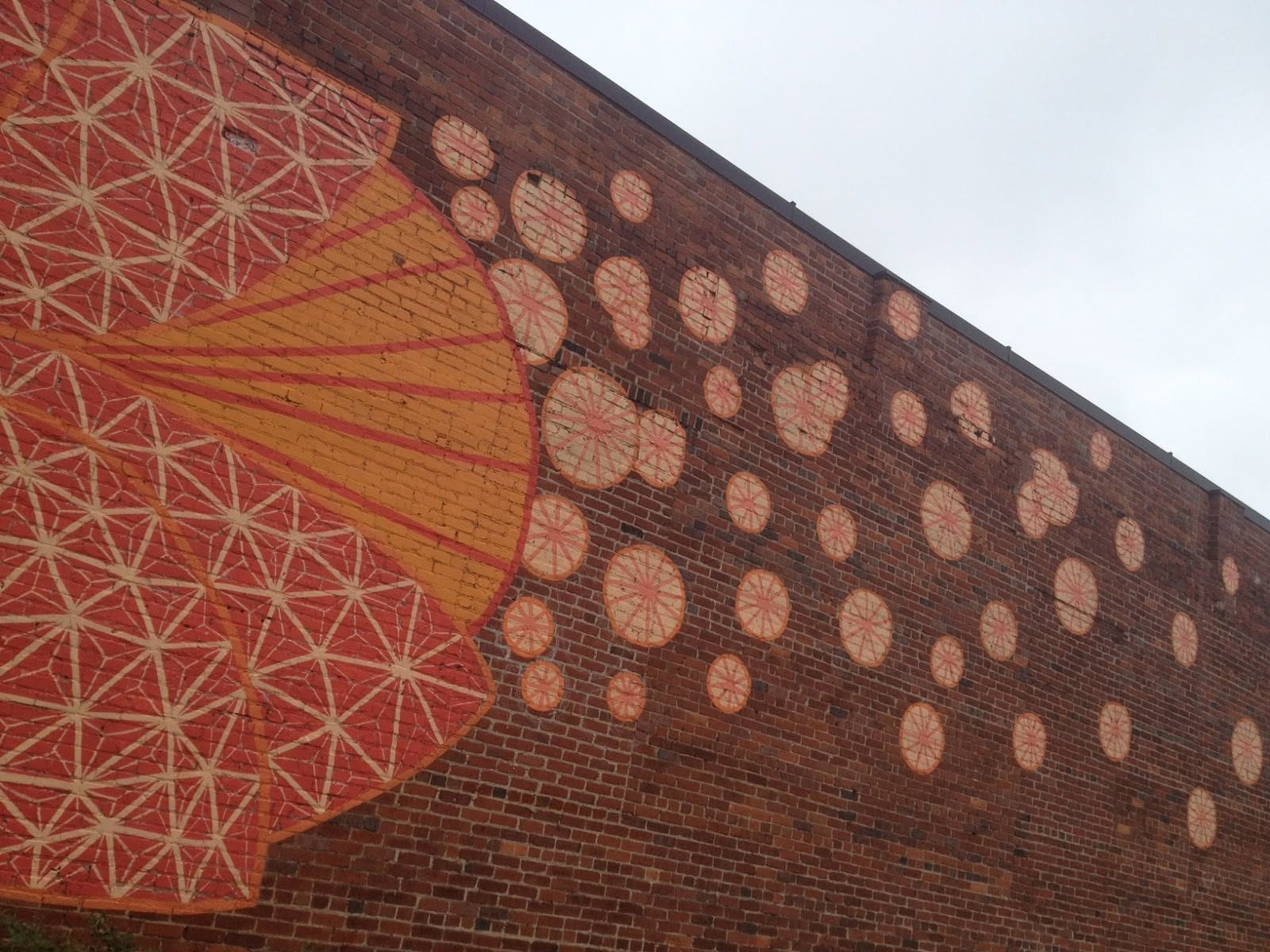
So, I have taken to doing a small thing downtown or on the Rail Trail as we make our way to the oasis that is Fretwell on a sunny afternoon: on each walk, find one form that surveys itself and one that is surveyed, and attend each long enough to “feel” or be attended by the difference in my own attention. The lichen on the stone near the Masonic Lodge, grey-green and slow, a single living surface that is somehow two organisms at once, holding a shape across years while the building it grows on is repainted and re-leased and re-permitted around it. The chimney swifts at dusk over the old mills and granaries in the Grain District, a flock that is a single moving form, a melody written in birds, surveying itself across the evening without a conductor and a score. The plantain in the seam. The mulberry in the grate. And then, by contrast, the beautiful surveyed things: the true curb, the square corner, the painted line. I’m trying not to choose between them. But I am trying to keep them distinct, because the day we forget which is which is the day we start treating the living forms as though they were ours to re-draw, and they aren’t. They were keeping themselves long before we arrived with the transit, and they are keeping themselves still, down in the cracks of the survey, flying over their own small shapes without ever leaving the ground.
Back home, under the black walnut where I keep my sitting spot, the same lesson waits in a larger body. The walnut surveys itself. It has been at the work of being a walnut for longer than I have owned the ground it stands on (or have been an embryo-turned-human), and it will go on at that work, free in Ruyer’s exact sense, succeeding or failing at a form it carries whole inside the act of carrying it. The fence around it is surveyed. The tree is a survey. I am slowly learning to tell the difference and to let that change how I live beside both.
References
Aristotle. De Anima (On the Soul). Translated by Hugh Lawson-Tancred. London: Penguin, 1986.
Bogue, Ronald. “The Force that Is but Does Not Act: Ruyer, Leibniz and Deleuze.” Deleuze Studies 11, no. 4 (2017): 518–537.
Bogue, Ronald. “Raymond Ruyer.” In Deleuze’s Philosophical Lineage, edited by Graham Jones and Jon Roffe. Edinburgh: Edinburgh University Press, 2009.
Ruyer, Raymond. Neofinalism. Translated by Alyosha Edlebi. Minneapolis: University of Minnesota Press, 2016. Originally published as Néo-finalisme (Paris: Presses Universitaires de France, 1952).
Ruyer, Raymond. The Genesis of Living Forms. Translated by Jon Roffe and Nicholas B. De Weydenthal. London: Rowman & Littlefield International, 2020. Originally published as La genèse des formes vivantes (Paris: Flammarion, 1958).
Smith, Daniel W. “Raymond Ruyer and the Metaphysics of Absolute Forms.” Parrhesia 27 (2017): 116–128.