



Editorial note: This essay develops the proposal I made in Consciousness in a World We Cannot Possess on October 24. It’s an argument in progress, written alongside the Black Walnut Field Notes, not the announcement of a finished theory of consciousness. I’m preparing this working account for publication, so that its claims, objections, and later revisions can be examined. If the stronger philosophical proposal fails, I want that failure to remain part of the record rather than disappear behind a rewritten conclusion.
The swing and the question it left behind
On October 31, I took a swing down from a limb of the black walnut in our backyard. My children had played on it. It belonged to our family life, and removing it wasn’t especially dramatic. But by then I’d been sitting beneath this tree almost daily for weeks, and I had begun wondering whether leaving the straps around the branch was appropriate for the walnut.
Earlier in October, I had considered taking the swing down and noticed a spider’s web attached to one of its straps. I decided to wait rather than disturb it. Later, when I no longer saw the web, I took down the swing and put it in the basement.
The next morning, I saw smoother, indented places on the bark where the straps had hung. Those marks weren’t evidence I possessed when I made the decision. I didn’t know whether the straps had injured living tissue, and I couldn’t tell whether removing them had helped the tree. I still can’t make those conclusions from the appearance of the bark alone.
What I could see was a question about intention.
Taking down a swing to clear space and taking down a swing because I hope to benefit a tree can involve exactly the same bodily movements. Yet I wouldn’t call them the same achievement. In the first case, the swing’s absence might satisfy my purpose. In the second, the walnut’s continuing life matters to whether the action fulfilled what I meant to do.
I can sincerely intend to care for something and be mistaken about what that care requires.
For me, that’s where the philosophical question becomes interesting. What gives an intention its content when it is undertaken for another living being? And what happens when that being’s condition challenges the account of care I brought to the encounter? What about the roles of church congregations?
The end, and the one for whose sake
Aristotle offers an older account for part of this problem. In De Anima II.4, he distinguishes two senses of “that for the sake of which”: the end being pursued, and the being for whose sake an action is undertaken. The passage occurs in his discussion of living things, generation, nourishment, and final causality. It isn’t a ready-made theory of ecological intentionality. But it helps me articulate a distinction the swing made difficult to ignore.
What am I trying to accomplish? And whose good would make that accomplishment worthwhile?
The two questions don’t necessarily have the same answer. I might succeed in removing a swing and fail to benefit the tree I intended to care for. I might postpone a practical task because another creature’s activity becomes relevant to what I think I should do. I might later discover that my reasons were mistaken.
Aristotle also reminds me that the idea of a being’s own good has a much longer philosophical history than this field journal. I’m not inventing creaturely teleology by watching a walnut. What I’m trying to construct is an account of how the good of another life becomes consequential to the formation and continued adequacy of my own practical purposes.
Why an artificial tree could still matter
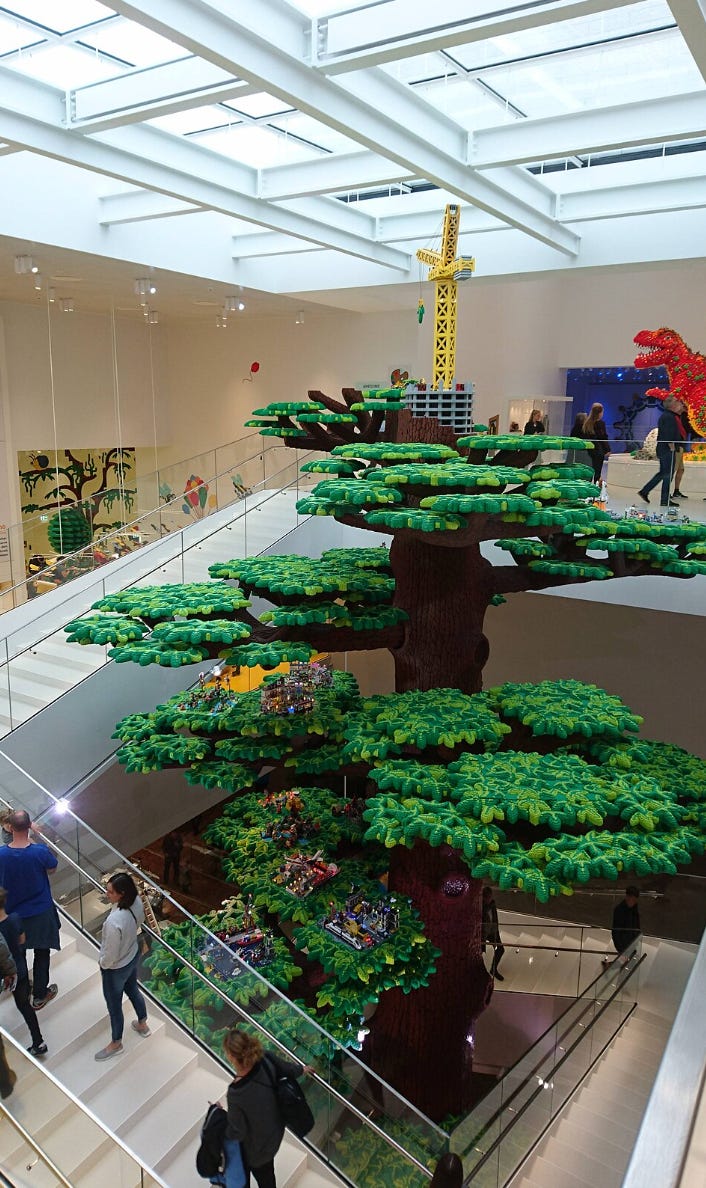
On November 3, the question became more demanding when I imagined a LEGO version of the walnut my soon-to-be 11-year-old son made (he’s an avid LEGO fan and builder, and we spent a good deal of time this weekend cleaning his room where he endlessly creates and deconstructs and creates his creations with thousands of bricks and minifigs).
Suppose I knew from the beginning that it was artificial. I would still care about it. I’d want to preserve his work, remember why he made it, and perhaps keep it somewhere meaningful in our home. That attachment wouldn't be irrational. The model could matter profoundly because of its maker and our shared history, even though it couldn’t grow, be nourished, or flourish as a tree.
That means the distinction I need isn’t between living things that matter and artificial things that don’t.
Edmund Husserl already gives me good reasons to take the model seriously. In Ideas II, particularly §50, he describes a personal surrounding world in which objects are encountered through use, value, and the work of others. A handmade object isn’t exhausted by the material from which it was assembled. Edith Stein also attends to the cultural world of humanly made things in On the Problem of Empathy.
The difference is what an act of care is directed toward protecting or sustaining.
For the LEGO walnut, I might be caring for a work, a memory, or a relationship with its maker. For the living walnut, I might intend its good as an organism. The tree’s well-being isn’t equivalent to the meaning it has acquired in my life. Its growth, material dependencies, vulnerability, and continuing development belong to a life I neither initiated nor direct.
And this distinction also exposes a weakness in my understanding. I may know that the walnut is alive without knowing what will benefit it. Taking its good seriously doesn’t make my ecological judgment correct.
When the practice itself comes into question
The fallen foliage beneath the walnut gives me a different kind of case.
For years, I’ve often left leaves and other fallen material beneath the tree because I understood that as a form of care. It felt right to let the material return to the soil rather than remove everything from the yard. During the recent sits, however, I began asking what that practice actually does for the walnut, the plants growing beneath it, and the other organisms sharing this place.
I remember a violet colony thriving near the base of the tree earlier in the year. I can now see fallen yellow leaflets and living groundcover. But I haven’t identified every plant under the canopy or established how black walnut litter affects each one.
Even university extension guidance gives me reason to avoid easy conclusions. Iowa State University Extension emphasizes the limited field evidence for consistent injury caused by walnut-derived mulch and litter. Penn State Extension offers more cautious advice about plants susceptible to walnut compounds. Neither account tells me exactly what is happening in this yard, and neither establishes that the walnut’s interests and the violets’ interests are actually in conflict.
That’s the point of investigating.
Unlike the swing’s removal, leaving the foliage is an ongoing practice. I can learn more and reconsider it while it is still being carried out. The question isn’t whether I should immediately clear the ground. It’s whether my intention to care can remain answerable to the different lives affected by that practice, including when new knowledge complicates what I had thought was obviously beneficial.
Perhaps the practice is appropriate. Perhaps some adjustment would help. Perhaps what benefits one organism would hinder another. I don’t yet know.
What matters philosophically is that the intended good isn’t established by the sincerity of my intention. And an ecology composed of different living beings can’t be presumed to have one perfectly harmonious set of interests.
The positive structure I’m proposing
I want to call the account I’m developing ecological intentionality, but I also want to give that name something definite to explain.
My working proposal is this:
Ecological intentionality concerns the possibility that conscious purposes become specific and remain corrigible through relationships with independently living beings whose own goods cannot be defined or fulfilled by the intending subject alone.
I can describe how this might happen.
I come to a situation with an established purpose. I encounter living beings whose activities and possible goods aren’t organized around mine. Through attention, knowledge, memory, and judgment, I begin to specify what my purpose means in relation to them. I act, wait, refuse, or reconsider. What happens next, and what I learn about the lives affected, can change my interpretation of what counted as good care. Sometimes that means altering the means or timing of an unchanged end. Sometimes it may require changing the end itself.
This is a positive account of practical directedness, not a claim that the walnut and I intend together. The spider didn’t agree to my decision to wait. The walnut didn’t authorize my decision to remove the swing. Its continuing life doesn’t become mine because I describe it philosophically.
But the tree and spider also aren’t just decorations surrounding an intention that I formed in isolation.
They are different beings whose conditions can matter to what I intend, why I undertake it, and whether I have done what I thought I was doing.
I want to make three questions explicit rather than slide between them. How did the intention develop? What constitutes the particular act of intending? And what would make the resulting action adequate to the being for whose sake it was undertaken?
The walnut’s actual condition can test the third question. The history of my encounters with it helps explain the first. Neither, by itself, proves that the tree’s ongoing activity constitutes the conscious episode described in the second.
That’s where the stronger philosophical work begins.
What Husserl, Stein, and Merleau-Ponty already explain
I don’t want to develop this account by diminishing the philosophers who brought me here.
Husserl’s phenomenology has resources for much more than isolated acts of a spectator consciousness. Embodiment, horizonality, passive synthesis, motivation, habit, valuation, and the personalistic attitude already explain how an encountered world becomes relevant to attention and practical action. A caring intention toward the walnut may be describable through those layered structures without inventing another category.
Stein is equally important. In On the Problem of Empathy, her discussion of vegetal life and the gardener already connects recognition of a plant’s condition with inquiry and intervention. Hal King develops that possibility in his recent essay “Propagating Plant Empathy with Edith Stein”. Moving from the perception of life to practical care can’t, on its own, establish the novelty of my proposal.
In Finite and Eternal Being, Stein offers another resource. Her account of creaturely goodness, particularly chapter V, §§15–17, distinguishes a being’s own good from the good other beings may mediate to it. That helps me describe the walnut as having a life and possible flourishing not reducible to its usefulness for me.
It also raises a harder metaphysical question: can the goods of creatures genuinely conflict within an encompassing order of being? I can’t resolve that tension through this backyard case, but I shouldn’t erase it with the attractive language of ecological harmony.
Maurice Merleau-Ponty gives the argument a different burden. His later account of flesh, reversibility, and écart asks how perceiver and perceived belong to a sensible world without ever fully coinciding.
That isn’t equivalent to an ethics of good care. Nor can the fact that I perceive the walnut’s branches prove that I experience the walnut’s inner life. His account may explain the possibility of embodied belonging while leaving open the separate question of how one living being’s good specifies another being’s purposes.
Raymond Ruyer also presses me to take the tree’s own organization seriously rather than treating its branching form as an arrangement for my view. And Gregory Bateson’s accounts of learning and ecological circuits challenge any assumption that I invented distributed or relational responsiveness.
These aren’t names I need to defeat to make a contribution, or to prove wrong, or to show what's missing in their own arguments. They’re the intellectual resources through which the contribution has to become intelligible.
The stronger question I’m not abandoning
On October 24 I proposed a stronger formulation: co-constitution without co-intention. Another being’s activity might participate in the formation or ongoing realization of conscious directedness without sharing the human subject’s intention.
I haven’t withdrawn that proposal.
But the account of care developed here doesn’t yet establish it. Another organism can motivate my decision or supply the conditions under which my action succeeds without its ongoing activity being constitutive of a particular conscious act.
So I need a better test.
I want to compare an encounter with a living walnut, an artificial counterpart I initially mistake for life, and a known handmade object whose value through its maker is already acknowledged. I also want a documented case in which learning more about an affected life changes the practical end I pursue rather than just how or when I pursue it.
Those comparisons won’t, by themselves, settle the whole phenomenological question. But they could make the claim answerable to differences rather than protect it behind an appealing phrase.
If Husserl, Stein, Merleau-Ponty, Ruyer, and existing ecological accounts explain the process completely, ecological intentionality might name a distinctive configuration of established capacities rather than a new fundamental structure.
I wouldn’t hide that outcome. The task is to explain the process carefully enough that another reader can tell where it adds something and where it doesn’t.
The theological question beside it
There’s another constructive argument I want to develop, though it needs its own foundation.
In my eventual dissertation, the Ecology of the Cross, I’m asking whether participation in God’s reconciling life in Christ transforms not only how a community pursues its purposes, but what that community comes to understand its purposes to be.
That claim can’t be proved by an indented branch or a pile of fallen leaves. It has to answer to scripture, theology, the experiences of actual communities, and evidence about the places they inhabit.
Philippians 2, Colossians 1, Romans 8, and 1 Corinthians 15 offer different lines of inquiry into self-giving, cosmic reconciliation, creation’s suffering, and embodied resurrection. They aren’t interchangeable illustrations of the same ecological lesson.
But the practical question is worth asking of congregations too. A church might consider how to accomplish an existing project with less ecological harm. Sometimes the more difficult question is whether its mission requires a different understanding of what the project is for, whom it serves, and whose lives it has left out of consideration.
I think about our own church, First Presbyterian Spartanburg, and how beautiful our campus is. We’ve got such an incredible landscape, greenery, a community of trees, and more-than-humans that function as part of our congregation in many ways beyond being backdrops. I wonder how often those are actually given voices in session votes, or thought of when we think about the goods and ends of our mission work or our community-related work.
That’s a theological possibility about participation and community, not a conclusion I’ve extracted from the walnut.
What I’m carrying ahead
The walnut has changed since I began these sits. Leaves have yellowed and fallen, and the upper branching has become more visible. My own attention has changed as well. I now look toward familiar limbs and ask questions I didn’t know to ask in September.
That change in my attention is an experience I can describe. It doesn’t establish every metaphysical claim I hope to make eventually. But it shows how the inquiry keeps producing questions answerable by something outside the argument.
I keep returning to a sentence that emerged from this work:
Care becomes philosophically interesting not only when it changes what I do, but when another life can change what I understand care to require.
I don’t want that to remain a memorable sentence without an explanation.
I want to develop an account of how different living beings help determine the content, timing, and revisability of our purposes. I want to make the strongest version of that account, examine the best explanations that already exist, and preserve the record of where it changes.
The walnut doesn’t need my theory to keep living. That’s part of why it remains such a good companion for the work.
Sources and paths
Obviously, this is a working essay rather than a citation-final academic paper. The references below identify the texts and dated field observations behind the argument.
Aristotle, De Anima, II.4, 415b2–3, on the different senses of what something is done for.
Edmund Husserl, Ideas II, especially §50, on values, uses, and human works. See Husserl.
Edith Stein, On the Problem of Empathy, especially III.5(i), and Finite and Eternal Being, chapter V, §§15–17. See Edith Stein.
Hal King, “Propagating Plant Empathy with Edith Stein”, Plant Perspectives (2026).
Maurice Merleau-Ponty, The Visible and the Invisible, “The Intertwining: The Chiasm.” Raymond Ruyer, Neofinalism. See the Sources & Reading bibliography.
Field record: October 24: A Purpose the Tree Does Not Share, November 1: After the Swing, November 2: What Care Becomes, and November 3: A Purpose Answerable to Life.
Questions I’m inviting readers to challenge: Does this account explain anything beyond Husserl’s layered intentionality? How can the different goods of organisms be determined without assuming harmony or inventing conflict? What evidence would show that another being’s ongoing activity participates in the realization of an intention, rather than its motivation or subsequent success?
For the evolving argument and its public revisions, see Where the Inquiry Stands, How the Inquiry Developed, and the open research roadmap.