


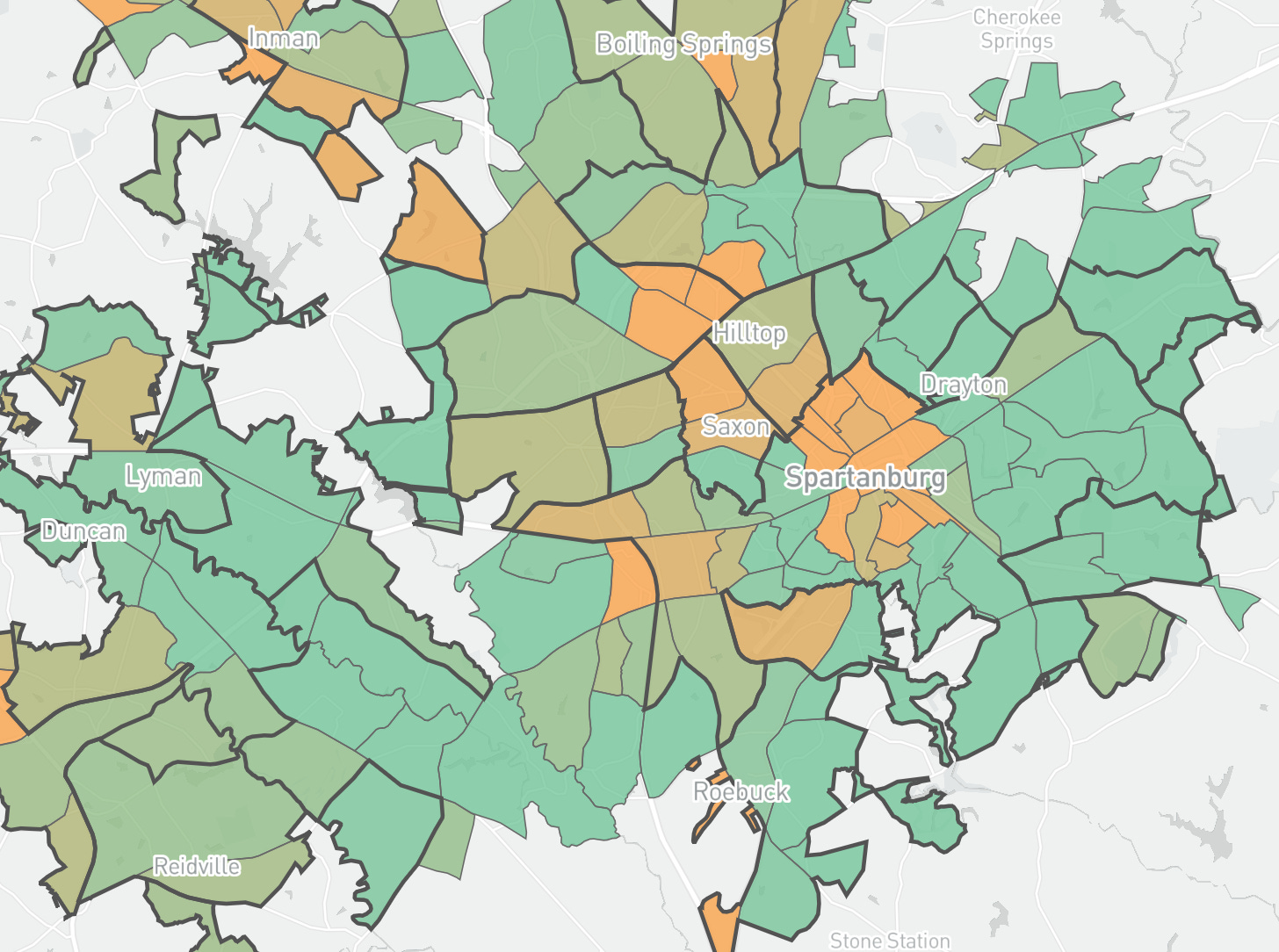
June in South Carolina is a month of contradictions in many ways. This morning, we’re in the 70’s with off-and-on rain showers. We’ll be back in the 90’s with rising humidity soon enough. July is a different story if the past is any indication of our current weather, climate, and mosquito count.
By four o’clock in June here in Spartanburg, the black walnut has carried its shade most of the way across the back of our yard, and the chair (where I usually sit to meditate, pray, laugh, read, cry, talk Star Wars with my son or Harry Potter with my daughter while she’s on the tire swing), under it has gone from a place I avoid to a place I keep. The shade moves the way a tide moves, slow enough that you cannot watch it and sure enough that you can set your afternoon by it. There is a line on the grass, soft at its edge, where the light stops, and the cool begins, and crossing that line is one of the plainest pleasures I know. The air does not change much. What changes is the radiation falling on my skin and my head, the long press of the sun lifted off in a single step. The walnut does this without effort and without my asking, all summer, for free.
I’ve been keeping this sitting spot beside this tree long enough now (since August of 2024) that I notice the small things ... the way the shade is thinner in early leaf and thickens through July, and the way a breeze through the canopy carries a coolness the still air under it doesn’t have. A body knows shade before a mind has any words for it. You feel the difference at the back of the neck and across the forearms first, and only later does it occur to you to call it relief. This is the order I trust. Perception arrives ahead of judgment, and most of what I have come to think about trees began as something felt under one before it was anything I could argue.
I grew up in a place where that feeling was rarer than it should have been. Mullins sits in the Pee Dee, in the coastal plain, in a country that was made flat and made for tobacco, and the heat there is a different experience from the heat of the Piedmont. It’s a low, wet, standing heat, the kind that settles into open fields and does not move, and in the part of the world I came up in there were long stretches with nowhere to put your body that the sun didn’t reach. A field of tobacco offers a child no mercy at midday as I learned very early (and I’m old enough to remember other young kids selling ice shaving from huge blocks of ice placed on burlap sacks outside of the non-air conditioned tobacco barns when the auctions would start for that year’s harvest in August and September). The shade you found was the shade you went looking for... the north side of a barn, the dark under a porch, a lone live oak left standing at the corner of a field because someone two generations back had the sense or the sentiment to leave it. I wish we’d been able to leave more chestnuts but globalization took care of those here. I learned early that shade was not evenly given. Some places had it and some places had been stripped of it, and a child working in the second kind of place understood the difference in his shoulders by ten in the morning.
The Piedmont where I live now is a more forgiving land for a body in summer, rolling and wooded, its hardwoods closing over the older streets so that you can walk some blocks of Spartanburg in a green tunnel and others in bare glare and open hot asphalt. The contrast between the two regions is more than memory. It’s the first fact I reach for when I try to think honestly about what trees are for when it comes to human perception not their more immediate roles in ecology. We talk about canopy in the language of carbon and stormwater and property value, all of it true, but the older and simpler truth is the one a field hand and a tired walker share. A tree is also a place to stand that the sun can’t punish in a South Carolina summer. The question of who gets to stand there isn’t a small one, either.
What the body senses as relief, our data and instruments also confirm. A surface in the shade of a tree can run twenty to forty-five degrees Fahrenheit cooler than the same surface in full sun at the peak of the day, because a tree’s leaves and branches let only about ten to thirty percent of solar radiation pass through the canopy, with the rest absorbed or reflected back. Temperatures under the canopy of a tree can be as much as twenty-five degrees cooler than in full sun. The cooling isn’t only a matter of the patch of ground directly beneath. Across the built environment of the country, the shading effect of urban trees lowers near-surface air temperature by about three degrees Celsius on a daily average, chiefly by reducing the energy that reaches the pavement and walls that would otherwise store and re-radiate it as heat. A recent synthesis of studies (see below for links and further reading) from cities around the world found that urban trees can lower air temperature at the height a person walks by as much as twelve degrees Celsius, depending on climate, the shape of the streets, and the traits of the tree itself.
The number that comes closest to the felt thing is the one that measures the felt thing. What our bodies actually experience isn’t air temperature alone but a blend of air, humidity, wind, and radiation. Shade works hardest on that radiation. The shade of trees can lower the physiologically equivalent temperature, which is to say how warm we actually feel our surroundings to be, by somewhere between seven and fifteen degrees Celsius depending on latitude. That’s a gap between bearable and dangerous on a July afternoon. It is also, indoors, a matter of money and exposure, since shade from trees has been shown to cut the air conditioning costs of detached houses by twenty to thirty percent. The household that cannot afford the cooling bill is often the same household the trees were never planted near.
There’s an old word underneath all of this. The Greek of the Psalms and the Gospels reaches for shade when it wants to say shelter. σκιά (skiá) is shadow and shade at once, the cool thrown by a thing that stands between you and what would otherwise fall on you. To dwell ἐν σκιᾷ, in the shade, is in that older tongue to be kept, to be covered, to be guarded by something larger than yourself. The Epistle to the Hebrews (not one of Paul’s, btw) uses the same word for a foreshadowing, σκιὰ τῶν μελλόντων, a shade cast backward from things still to come. I don’t think this is only metaphor borrowed from agriculture or an agrarian mindset. I think the writer(s) knew, as a field knows, that to stand in shade is to stand inside a kind of mercy, and that the absence of it is a real exposure and not a figure of speech.
When you widen the lens from the single tree to the neighborhood, the mercy turns out to be distributed the way most mercies are in this country, which is to say unevenly and along old lines. American Forests (again, see below for all the links and citations), mapping canopy against income and race across the United States, found that neighborhoods where most residents are people of color have on average 33% less tree canopy than majority-white neighborhoods, and neighborhoods where 90% or more of residents live in poverty have 41% less canopy than the wealthiest ones.
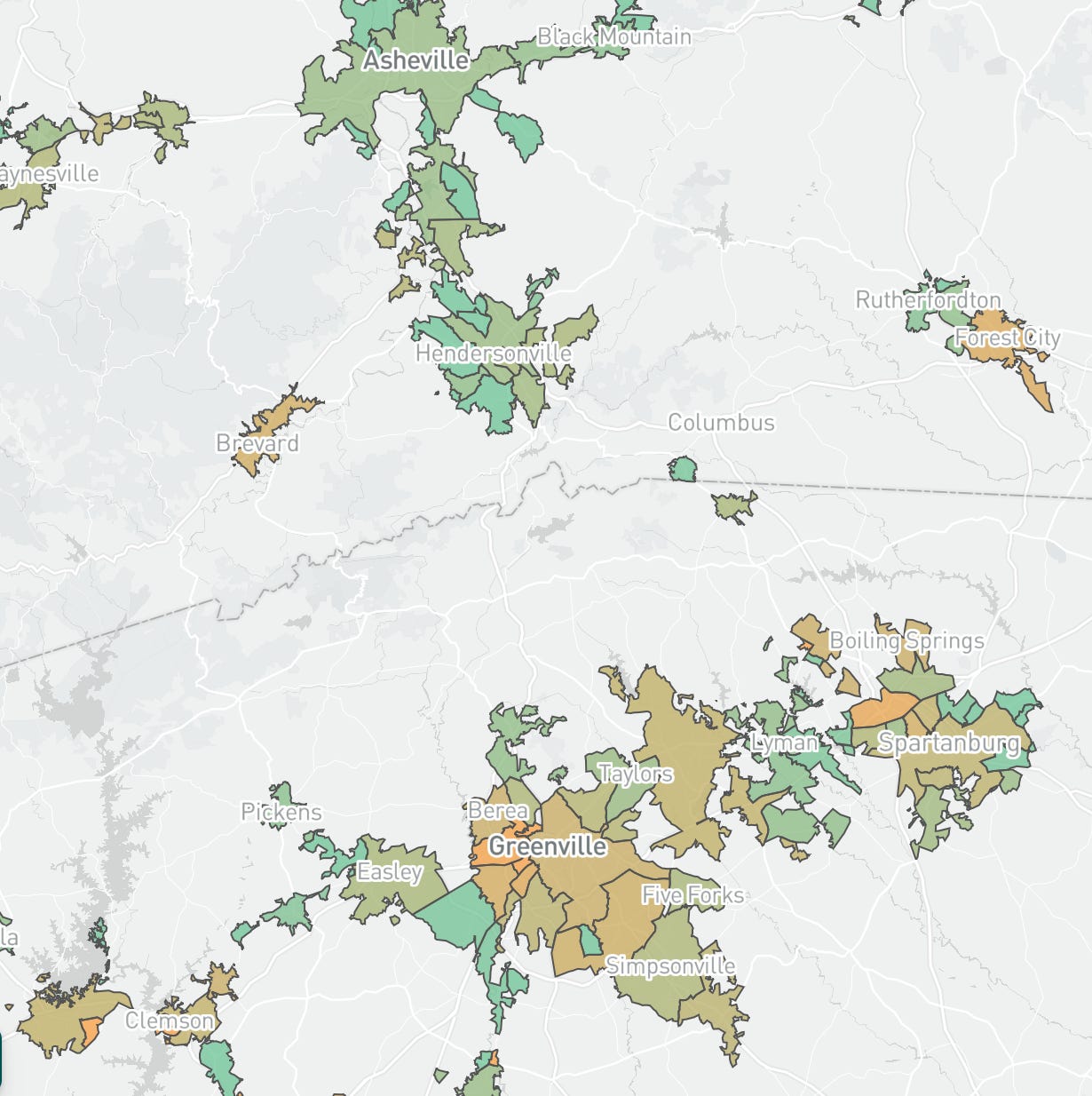
A map of tree cover in an American city is too often a map of race and income. The shade I cross into in my own backyard is, at the scale of a city, a thing some people own a great deal of and others have been left without.
This was drawn on purpose, generations ago, and it has held in our current broken system of housing, especially here in the US Southeast. Studying more than a hundred urban areas, researchers found that land surface temperatures in formerly redlined neighborhoods run about 4.7 degrees Fahrenheit warmer in summer than in neighborhoods that were never redlined. Across those areas the pattern was nearly universal ... ninety-four percent of the cities studied showed higher land surface temperatures in the formerly redlined districts, by as much as 7 degrees Celsius, with those areas averaging about 2.6 degrees Celsius warmer than their non-redlined neighbors, owing in part to more pavement and less canopy.
And the disparity is worst where I am from. The largest within-city temperature gaps appeared in southern and western cities, with the smallest in the Midwest. The South built its heat inequities deliberately and then let the trees (or the lack of them) keep the books as we still do with the mega-quick “starter” home developments popping up across counties such as Spartanburg with our lenient laws and ordinances for such things.
What’s at stake in this accounting is not comfort alone. It is years of life. A health assessment of Philadelphia estimated that raising tree canopy toward a 30% target in every neighborhood could prevent on the order of four hundred premature deaths a year, with even modest increases in canopy yielding measurable reductions in mortality, and with the lowest existing canopy found in the lower-income neighborhoods that stand to gain the most. Because heat and its harms fall hardest where the trees are fewest, a given number of trees planted in neighborhoods of color tends to return a greater reduction in mortality than the same trees planted in majority-white neighborhoods. The relationship between greenness and survival is by now well attested. A meta-analysis pooling studies of more than eight million adults across several countries found that more green space in a neighborhood is significantly associated with a lower risk of death from any cause. Closer to the bark, neighborhood tree cover near the home has been linked to better self-reported health overall, working partly through lower rates of overweight and obesity and stronger social cohesion, and to a lesser degree through less diabetes, high blood pressure, and asthma. That’s true in school-aged young people and children as well.
If there is a simple shape to aim for, the foresters have offered one. The rule some of them now propose is called three-thirty-three-hundred, and it sets three plain thresholds ... at least three well-established trees in view from every home, school, and workplace; no less than thirty percent canopy in every neighborhood; and no more than three hundred meters, about a five-minute walk, to the nearest real green space. It is a low bar, written as a floor and not a ceiling, and most American neighborhoods do not clear it. I think of the streets in our beautiful neighborhood that certainly do (one of the main reasons we chose to live where we do and had the privilege to do so), their old oaks and the green tunnel they make, and the streets just a mile away that do not, and I understand that the difference between them was a choice made by people who are mostly dead now, a choice still cooling some bodies and still cooking others.
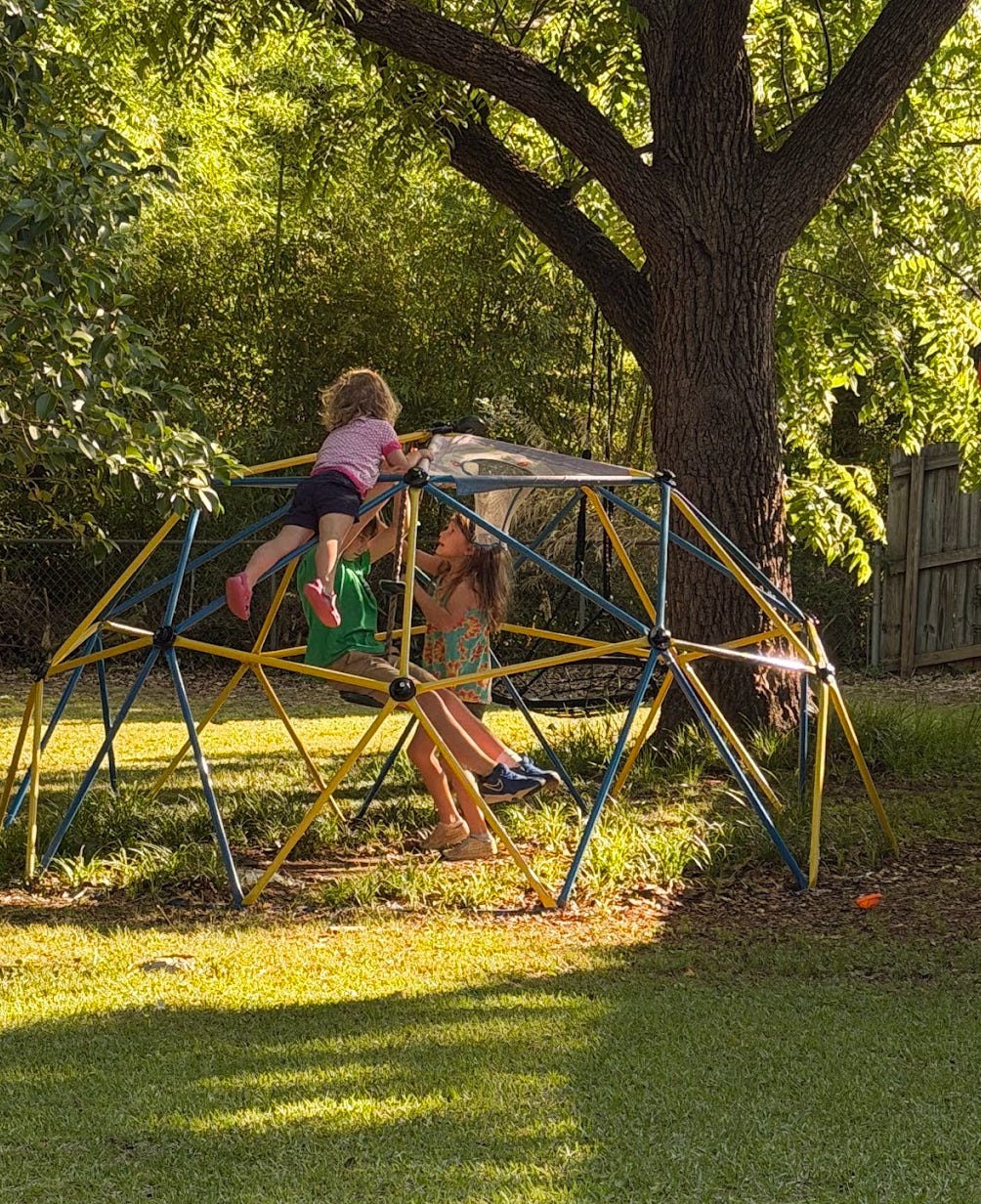
The walnut over my chair was planted, or allowed to stand, by someone I never met decades and decades ago. Same with the oaks, maples, and cedars that provide an amazing canopy over most of our yard in June and July. I sit in shade I did not earn and did not make, the way most of us do, and the only fitting response I can find to that is to plant for someone I will not meet.
A “shade” tree is the rare gift whose whole point is that the giver will be gone before it is fully given. You put a small thing in the ground knowing the deep shade belongs to a stranger forty years out, a child not yet born who will one day cross a soft line on the grass and feel the sun lift off the back of his neck and call it, without thinking, relief. That’s the work. We arrived at the ethics by way of the body (which is the only way I trust to arrive at it) and the body’s verdict isn’t complicated. Everyone deserves a place to stand that the sun cannot punish. The shade should fall on all of us, and where it does not yet fall, we know how to make it.
Further Reading
A short shelf for anyone who wants to follow the research or general suggestions from my piece here…
Shade and cooling
Roland Ennos, “Can trees really cool our cities down?” The Conversation (2015). The most accessible account of the felt difference. Ennos explains that what we register as relief is mostly a matter of radiation, and that tree shade can lower the physiologically equivalent temperature, how warm we actually feel, by something on the order of 7 to 15 degrees Celsius (depending on latitude). He also notes the indoor implications, like shade can cut a detached house’s air conditioning costs by twenty to thirty percent!
Zhi-Hua Wang et al., “Cooling Effect of Urban Trees on the Built Environment of Contiguous United States,” Earth’s Future 6 (2018). The continental view. Modeling across the country's built environment, the authors find that the shading effect of urban trees lowers near-surface air temperature by about 3 degrees Celsius on a daily average, chiefly by keeping solar energy off pavement and walls that would otherwise store and re-radiate it.
Haiwei Li, Yongling Zhao, Chenghao Wang, Diana Ürge-Vorsatz, Jan Carmeliet & Ronita Bardhan, “Cooling efficacy of trees across cities is determined by background climate, urban morphology, and tree trait,” Communications Earth & Environment 5:754 (2024). A global synthesis of 182 studies across 110 cities. Urban trees can lower air temperature at the height a person walks by by as much as 12 degrees Celsius, with the effect depending on climate, street layout, and species. Useful if you want to know the texture of why some shades cool more than others.
Who has trees, and why
Jeremy S. Hoffman, Vivek Shandas & Nicholas Pendleton, “The Effects of Historical Housing Policies on Resident Exposure to Intra-Urban Heat: A Study of 108 US Urban Areas,” Climate 8(1):12 (2020). The redlining-and-heat paper. Formerly redlined neighborhoods are roughly 4.7 degrees Fahrenheit warmer in summer than neighborhoods that were never redlined, a pattern that held in 94% of the cities studied and reached as high as 7 degrees Celsius. The largest gaps were in southern and western cities, which is the part that should spur a Carolina reader’s attention.
American Forests, Tree Equity Score (2021, ongoing). treeequityscore.org Both the argument and the tool are interesting. American Forests found that majority-people-of-color neighborhoods have, on average, 33% less tree canopy than majority-white ones, and that the poorest neighborhoods have 41% less than the wealthiest. Their plainest line is the one I borrowed above, with a map of tree cover in an American city, which is too often a map of race and income. The site gives block-level scores, so you can look up your own street, even.
Kirsten Schwarz et al., “Trees Grow on Money: Urban Tree Canopy Cover and Environmental Justice,” PLoS ONE 10(4):e0122051 (2015). An earlier, foundational treatment of the same disparity, naming the so-called luxury effect by which canopy tracks wealth. Worth reading to see how long this has been documented.
What canopy does to a life
Michelle C. Kondo et al., “Health impact assessment of Philadelphia’s 2025 tree canopy cover goals,” The Lancet Planetary Health 4(4):e149 (2020). A mortality study. Raising canopy toward a 30% target in every neighborhood could prevent on the order of 400 premature deaths a year in Philadelphia, with even modest increases yielding measurable reductions, and the lowest existing canopy is in the lower-income neighborhoods that stand to gain most.
“Current inequality and future potential of US urban tree cover for reducing heat-related health impacts,” npj Urban Sustainability (2024). Carries the equity point into the arithmetic of planting. Because heat falls hardest where trees are fewest, a given number of trees planted in neighborhoods of color tends to return a greater reduction in mortality than the same trees planted in whiter, wealthier ones.
David Rojas-Rueda et al., “Green spaces and mortality: a systematic review and meta-analysis of cohort studies,” The Lancet Planetary Health 3(11):e469 (2019). The pooled evidence draws on data from more than 8 million adults across several countries. More green space near home is significantly associated with a lower risk of death from any cause. The single best citation if you want one number to stand for the whole field and need to make a point in a conversation (or local planning commission or city council meeting).
Standards and possibilities
Cecil C. Konijnendijk, “Evidence-based guidelines for greener, healthier, more resilient neighbourhoods: Introducing the 3-30-300 rule,” Journal of Forestry Research 34 (2023). The rule the essay ends on is stated as a floor. Three well-established trees in view from every home, school, and workplace, at least thirty percent canopy in every neighborhood, and no more than three hundred meters to real green space. Most urban American neighborhoods obviously do not clear it.
More widely
J. Drew Lanham, The Home Place: Memoirs of a Colored Man’s Love Affair with Nature (Milkweed Editions, 2016). A South Carolina book, and the one I would hand a reader before any of the studies above. Lanham writes the land and the inheritance of who gets to belong to it from inside our own state, and he holds race and place together without letting go of either.
Jill Jonnes, Urban Forests: A Natural History of Trees and People in the American Cityscape (Viking, 2016). The long story of how American cities came to have, and to lose, their trees. Good companion for understanding canopy as infrastructure that was built, neglected, and can be built again.
Wendell Berry, The Gift of Good Land (1981), and the essays around it. I love Berry, and he is, in many ways, my Patron Saint along with Edith Stein. Berry on what it means to put something in the ground for a stranger you will not meet is the ground the essay’s last paragraph stands on.