


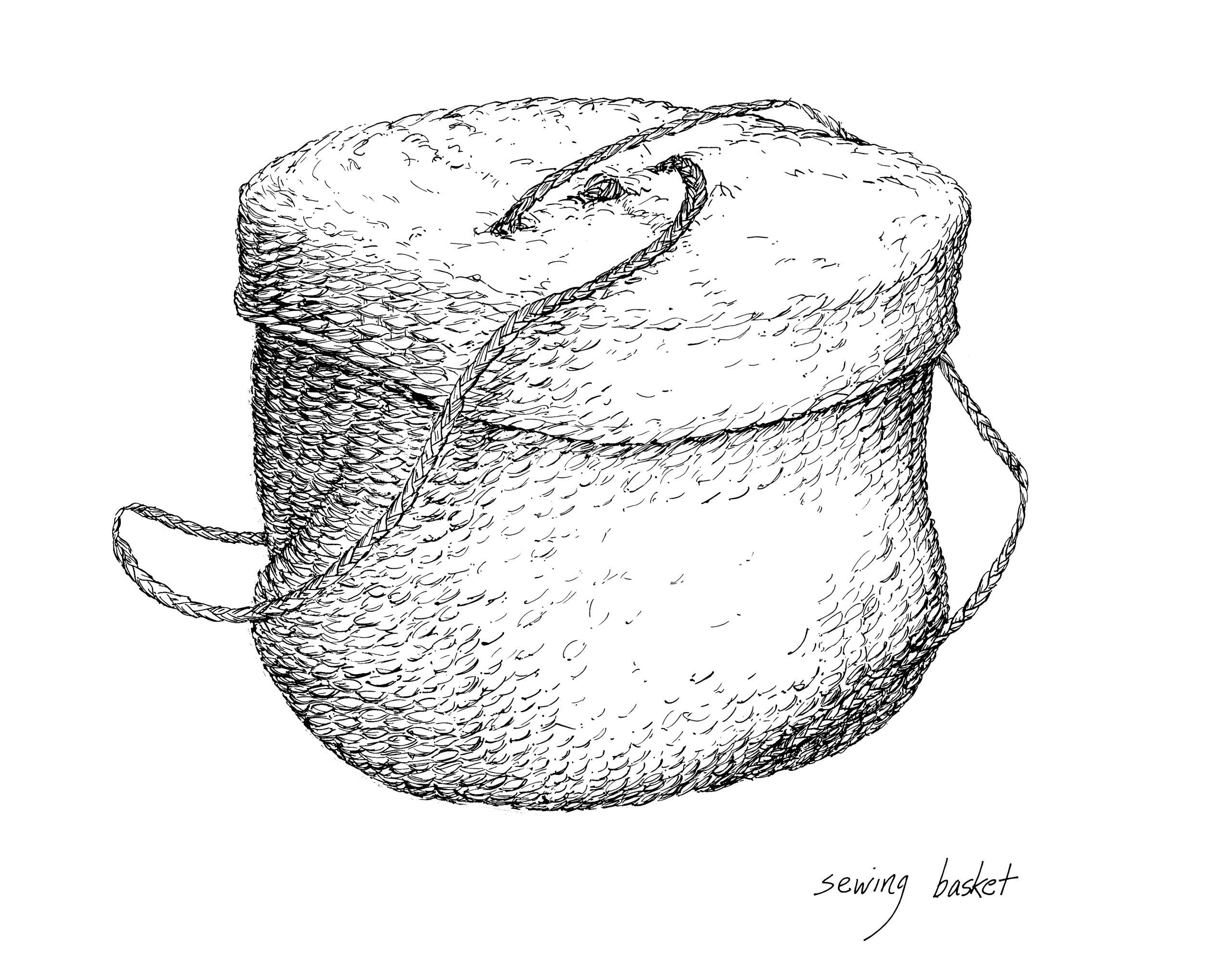
There is a word the Kesh people speak before taking any life. Before hunting, before felling a tree, before squashing a mosquito in the heat of a Carolina summer. The word is arrariv... “my word[s]”... and it is spoken not as prayer exactly, but as acknowledgment. As a way of saying: I see you, I need you, I am implicated in this. Ursula Le Guin invented the Kesh for her novel Always Coming Home, set in a far-future California valley, and I encountered the word last summer in a course on transformation and ecology. I have been reaching for it ever since in places where it is conspicuously absent.
The Piedmont does not lack for such absences. The announcement language of development and extraction here tends toward gift vocabulary... opportunity, investment, growth, the future arriving like a favor. Nobody speaks arrariv before zoning meetings or the groundbreakings. Nobody names what will be taken from the particular watershed, the particular stretch of second-growth forest, the particular quality of a place that has been slowly composting its own history for longer than any press release acknowledges. The formula is omitted as a matter of course. And Le Guin, writing forty years ago about a fictional future people in a California valley not entirely unlike this one, understood exactly what that omission means and where it leads.
I have been reading Naomi Klein’s This Changes Everything alongside Le Guin recently, which is not a pairing Klein would have anticipated but which feels increasingly necessary. Klein’s argument is structural and urgent: the period in which climate science became undeniable was precisely the period in which neoliberal ideology consolidated its grip on global governance, and this was no coincidence. The liberalization of trade regimes, the dismantling of public capacity, the shift toward financialized extraction... all of it happened in roughly the same two decades that would have been our best window for a managed transition. Her concept of extractivism as a logic rather than a practice is clarified in a way that I agree with. Sacrifice zones are not anomalies or accidents. They are the predictable outcome of a framework that requires some places and some people to absorb costs on behalf of the rest of the world. The Piedmont has been absorbing those costs for a long time, in ways that predate the current climate conversation by several centuries.
What Klein diagnoses with precision, though, she struggles to prescribe. Her “People’s Shock”... a bottom-up rupture that reorganizes political possibility the way elite shocks have reorganized it from above... is more wager than blueprint. The critical political economy tradition is, by design, better at naming the problem than at articulating what comes after. I have come to think this is not a failure of imagination so much as a structural limit of the genre... that the tools adequate to diagnosing extractive capitalism are not quite the same tools adequate to imagining its alternatives. The spear is good at identifying other spears. It is less useful for imagining the carrier bag.
Which is Le Guin’s term, drawn partly from Elizabeth Fisher’s work on human origins. The carrier bag theory of civilization holds that the first human technology was not the weapon but the container... the bag, the basket, the gourd, the vessel for carrying gathered food back to a shared place. Civilization, on this account, begins not with conquest but with a different kind of accumulation: tending, gathering, storing, bringing home. We have told ourselves for centuries the other story, that history moves like a spear, that change arrives through rupture and force, that the arc of development bends toward more power, more speed, more extraction. Klein’s extractivism is the logical endpoint of that story told long enough and believed hard enough. Le Guin’s Kesh are what happens when a people decides, across generations, to tell a different one.
Le Guin develops this idea most directly in a short 1986 essay, "The Carrier Bag Theory of Fiction," where she argues that the dominant narrative of civilization... the spear, the hero, the conquest... is not just a story about the past but a story about story, a way of insisting that only certain kinds of action count as significant. The carrier bag, by contrast, holds many things at once, in no particular hierarchy. It does not have a climax. It does not resolve. It accumulates. The essay is worth reading alongside Always Coming Home because it makes explicit what the novel enacts obliquely... that the alternative to extractive logic is not a counter-heroism but a different relationship to time, to significance, to what counts as mattering at all.
The Kesh don’t practice the carrier bag as an ideology. They practice it as a habit, embedded in language and daily gestures. The arrariv formula spoken before every act of taking. The pottery work that slows thought “to the gait of things and lets it be subject to accident and time.” The deliberate pace of a culture that has decided accumulation means something different than extraction... that what you carry home matters more than how fast you move or how much you take. These are not policies. They are perceptual orientations, ways of inhabiting a place that make the sacrifice zone logic not merely unethical but grammatically impossible within the language the community has built around itself.
I think about this in relation to the Piedmont specifically because this landscape is itself a kind of carrier bag... a middle ground, literally, between the mountains and the coast, neither dramatic enough to be iconic nor degraded enough to be cautionary, just persistently, quietly here. The red clay holds what falls into it. The creek systems remember their own courses even when we redirect them. The second-growth forest is carrying something forward from the longleaf and chestnut ecosystem it replaced, incompletely but stubbornly. There is a kind of ecological memory at work in this landscape that operates exactly the way Le Guin’s carrier bag operates... not as conquest or rupture but as patient accumulation, tending what can be tended, carrying forward what can be carried.
The question Klein’s book leaves open, and that Le Guin’s valley quietly answers, is what it would mean to organize a human community around that logic rather than against it. Not a utopia, exactly... Le Guin is careful about that word, and her Kesh are not perfect. But a reorientation of what counts as practical. The carrier bag, it turns out, is an extremely practical technology. It is how most of what matters has actually been transmitted across time... not through rupture but through the daily practice of picking something up, putting it somewhere safe, and bringing it home.
Le Guin opens Always Coming Home with an image I have not been able to shake. She describes the only practical archaeology of the future people she is imagining: “You take your child or grandchild in your arms, a young baby, not a year old yet, and go down into the wild oats in the field below the barn. Stand under the oak on the last slope of the hill, facing the creek. Stand quietly. Perhaps the baby will see something, or hear a voice, or speak to somebody there, somebody from home.”
There is no policy platform in that image. There is no rupture event, no binding agreement, no People’s Shock. There is a person standing under an oak, facing a creek, holding a baby, being quiet. The baby might perceive something the adult has already been trained not to. That is the whole of it... and I find, the longer I live in this Piedmont landscape, the more it sounds less like fiction and more like the most practical instruction I have encountered for how to begin.
Further Reading
Le Guin, Ursula K. Always Coming Home: Author’s Expanded Edition. Library of America, 2019. loa.org
Le Guin, Ursula K. “The Carrier Bag Theory of Fiction.” In Dancing at the Edge of the World: Thoughts on Words, Women, Places. Grove Press, 1989. Full text via Monoskop — also on her official site
Klein, Naomi. This Changes Everything: Capitalism vs. the Climate. Simon & Schuster, 2014. Bookshop.org
Fisher, Elizabeth. Woman’s Creation: Sexual Evolution and the Shaping of Society. Anchor Press, 1979. WorldCat