


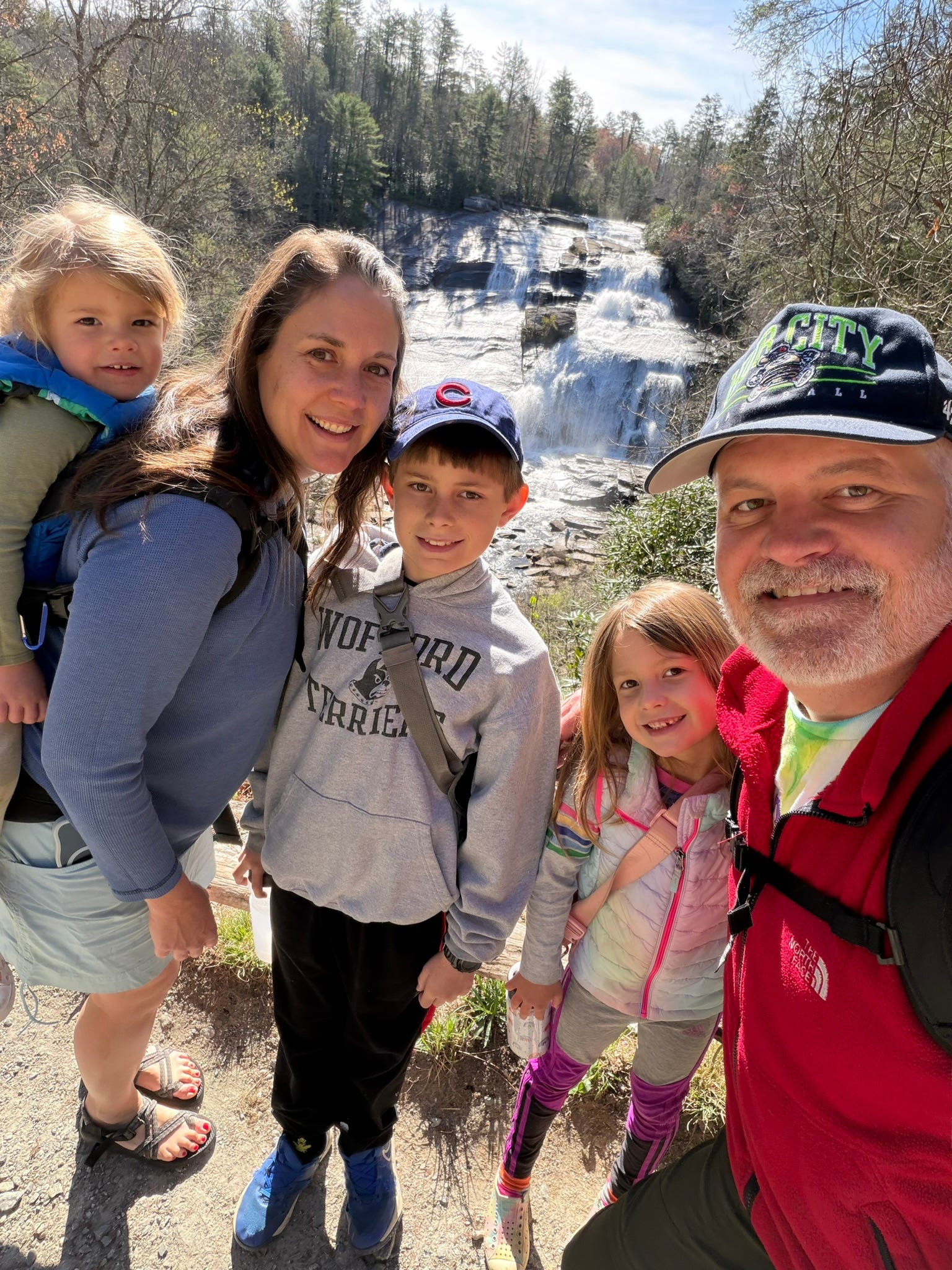
We pulled into the High Falls Access parking lot on Tuesday morning, the kids already unbuckled before the engine quit. Emmylou had her small pink backpack. Ben had a water bottle clipped to his green-gray one. Merianna carried Lily in the carrier on her back, Lily’s shoes dangling at hip level, her eyes already scanning the treeline. I had my Hub City Spartanburger’s hat and, embarrassingly, no plan beyond the trailhead map bolted to the wooden post near the restrooms.
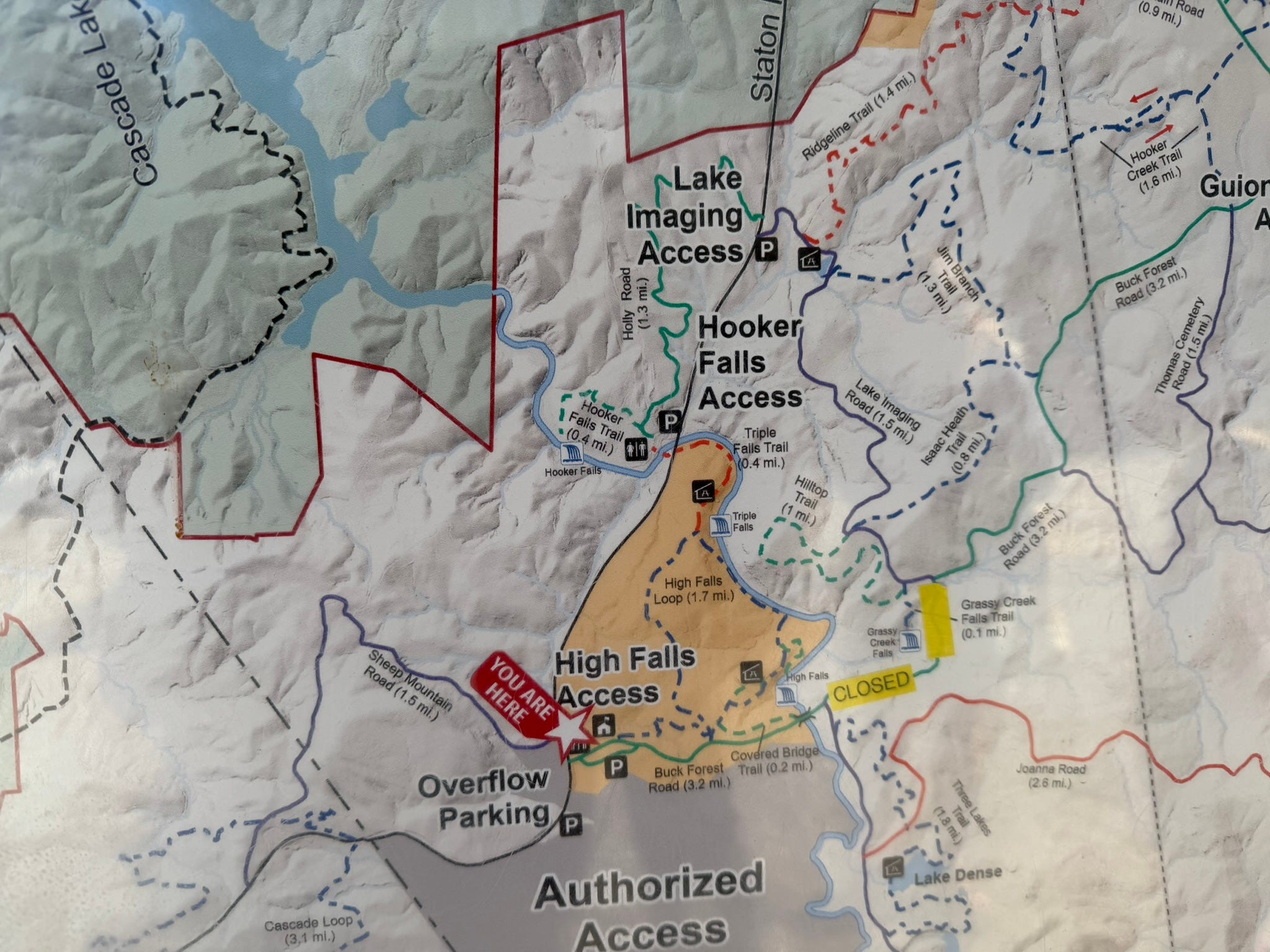
The map showed us where we were, a red arrow, YOU ARE HERE, pressed into the shaded topography just below the High Falls Loop. Triple Falls to the north. Hooker Falls beyond that. The Little River threads through all of it, dropping in stages down through the granite shelves of the Blue Ridge escarpment. We were, in the language of the watershed, standing at the bottom of a sentence that had been composing itself for a very long time.
DuPont State Recreational Forest sits in Transylvania County, just south of Brevard, NC, in a part of the Southern Appalachians where the mountains begin their long unraveling toward the Piedmont (and one of my favorite places on our spaceship planet). The forest covers roughly 10,000 acres and holds within it one of the densest concentrations of significant waterfalls in the eastern United States, including High Falls, Triple Falls, Hooker Falls, Grassy Creek Falls, and more. The Little River, which drains a significant portion of this highland basin, is responsible for all of them, cutting and polishing the exposed granite faces over many thousands of years of patient work.
The land has passed through many hands. It was farmed and timbered, and for a period in the mid-twentieth century, it hosted a DuPont Corporation facility that produced a compound used in the Manhattan Project (which is obviously tied to the development of nuclear weapons, which we still bargain and gamble with this week). That history sits beneath the forest trails now, largely unmarked. What you notice instead is the way the hardwoods open onto exposed rock, the way rhododendron crowds the creek margins, the way water sound precedes the water itself by a hundred yards or more. The forest has had time to grow over its own past.
We were on spring break, which in Spartanburg means the Blue Ridge is within reach if you’re willing to drive an hour and a half or so.
I have been thinking a good deal lately, in the context of my dissertation work, about what Merleau-Ponty calls the lived body, or the body not as object but as the very medium through which a world becomes available to perception, as all being is relational. His argument, worked out across the Phenomenology of Perception and the late notes gathered in The Visible and the Invisible, is that we do not first have sensations and then assemble them into a world. We are always already in the middle of a field (be it gravity or consciousness), oriented, attuned, reaching. Perception is participation before it is analysis.
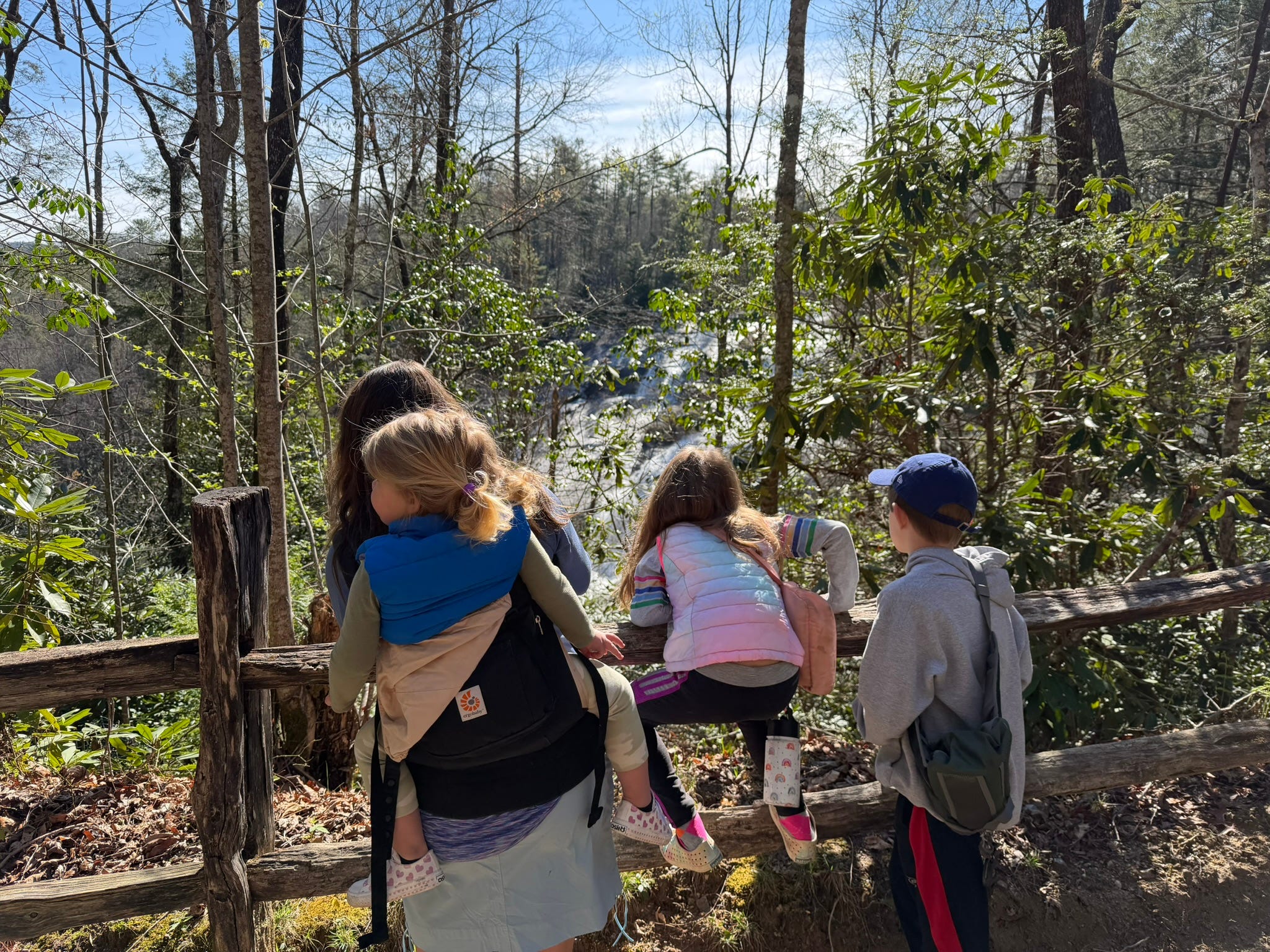
What strikes me, walking a trail with three children under eleven, is how thoroughly this describes what they are doing and how poorly it describes what I am trying to do. Ben moved ahead at his own rhythm even as he didn’t feel well, stopping to examine a fungal shelf on a fallen log, then rejoining the trail without ceremony. Emmylou crouched at every stream crossing as though the water needed her attention in order to continue flowing. Lily, still on Merianna’s back, stretched out both arms at intervals toward things I couldn’t always identify, be they a patch of moss, a shaft of light, a bird moving through brush.
They were not observing nature. They were in it, as it. Their bodies had not yet learned the slight withdrawal that adult attention often requires… the stepping-back that converts experience into data, the modest self-consciousness that comes with knowing one is supposed to appreciate something. They were, in Merleau-Ponty’s sense, living at full contact with the perceptual field. And the perceptual field was, in this case, composed almost entirely of moving water.
Bergson, who thought about time with the same patience Merleau-Ponty brought to space, argued that duration, durée, is what we actually live in, even when our concepts insist otherwise. Clock time slices experience into measurable units and presents those units as equivalent, interchangeable, and mappable. But the time of a waterfall is no more clock time than the far side of the Moon. It is continuous, indivisible, always in the act of becoming something it has not yet been. You cannot step outside it to measure it without falsifying what it is.
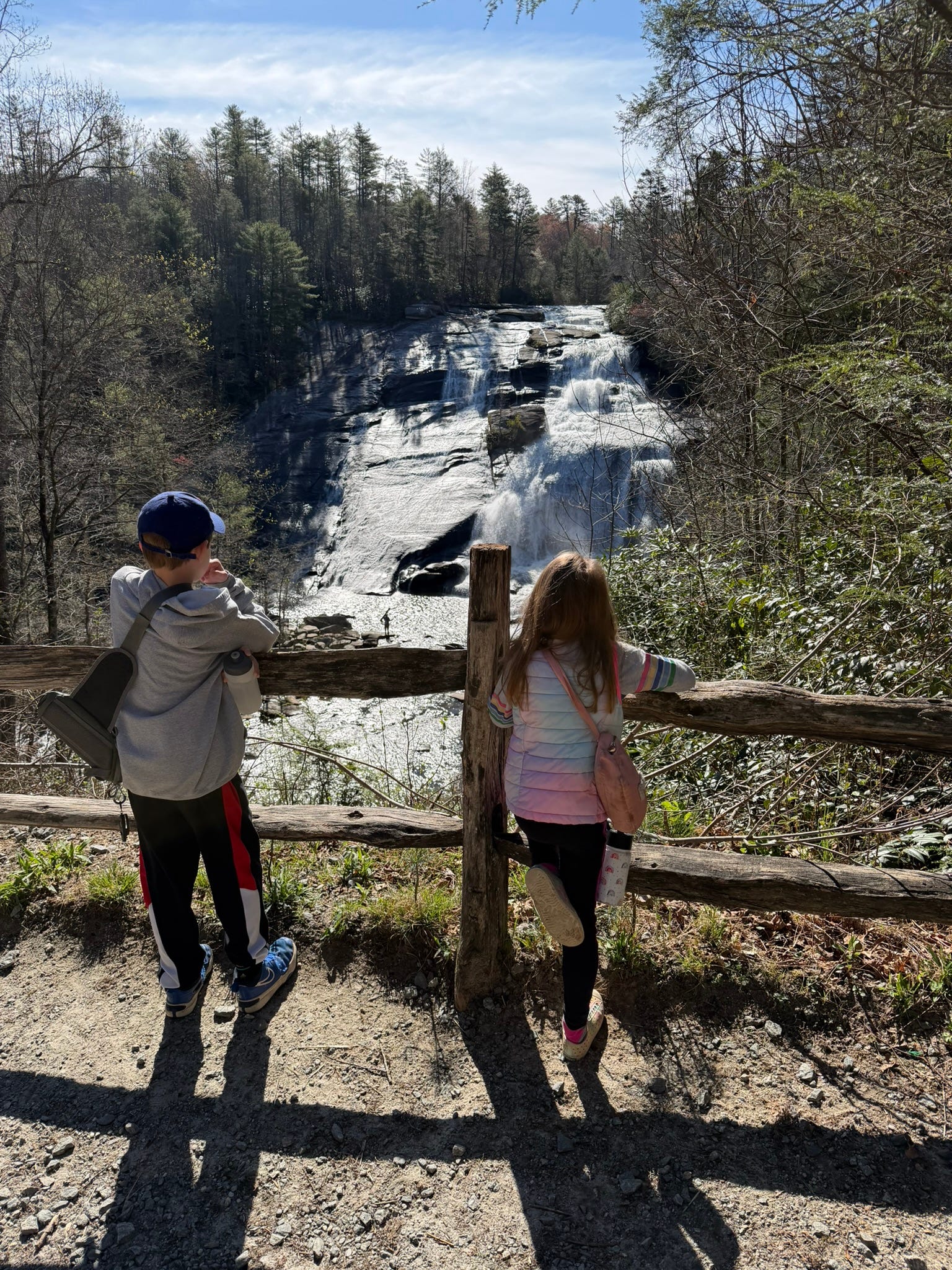
High Falls comes into view from the overlook trail as a wide sheet of white water spreading across a face of exposed granite that must be sixty or seventy feet high (the exact measure is less important than the sheer breadth of it), the way it fills the visual field before you have any framework for understanding what you’re seeing. The water does not fall in a single coherent stream. It fans out across the rock face, braiding and separating, finding the subtle channels and imperfections in the granite, always arriving at the base in a form it could not have predicted from above.
This is duration made visible. The falls are not the same from one moment to the next. The pattern is stable enough that we recognize it, name it, and return to it. But the water enacting that pattern has passed through and is already gone. What we call High Falls is not a thing but an event… a continuous present that, from a sufficient distance, looks like a permanent feature of the landscape.
Ben and Emmylou stood at the wooden fence rail of the upper overlook, just watching. I watched them watching. Lily, from the carrier, made a sound I can only describe as recognition with a low, sustained vowel, directed at nothing in particular and everything at once.
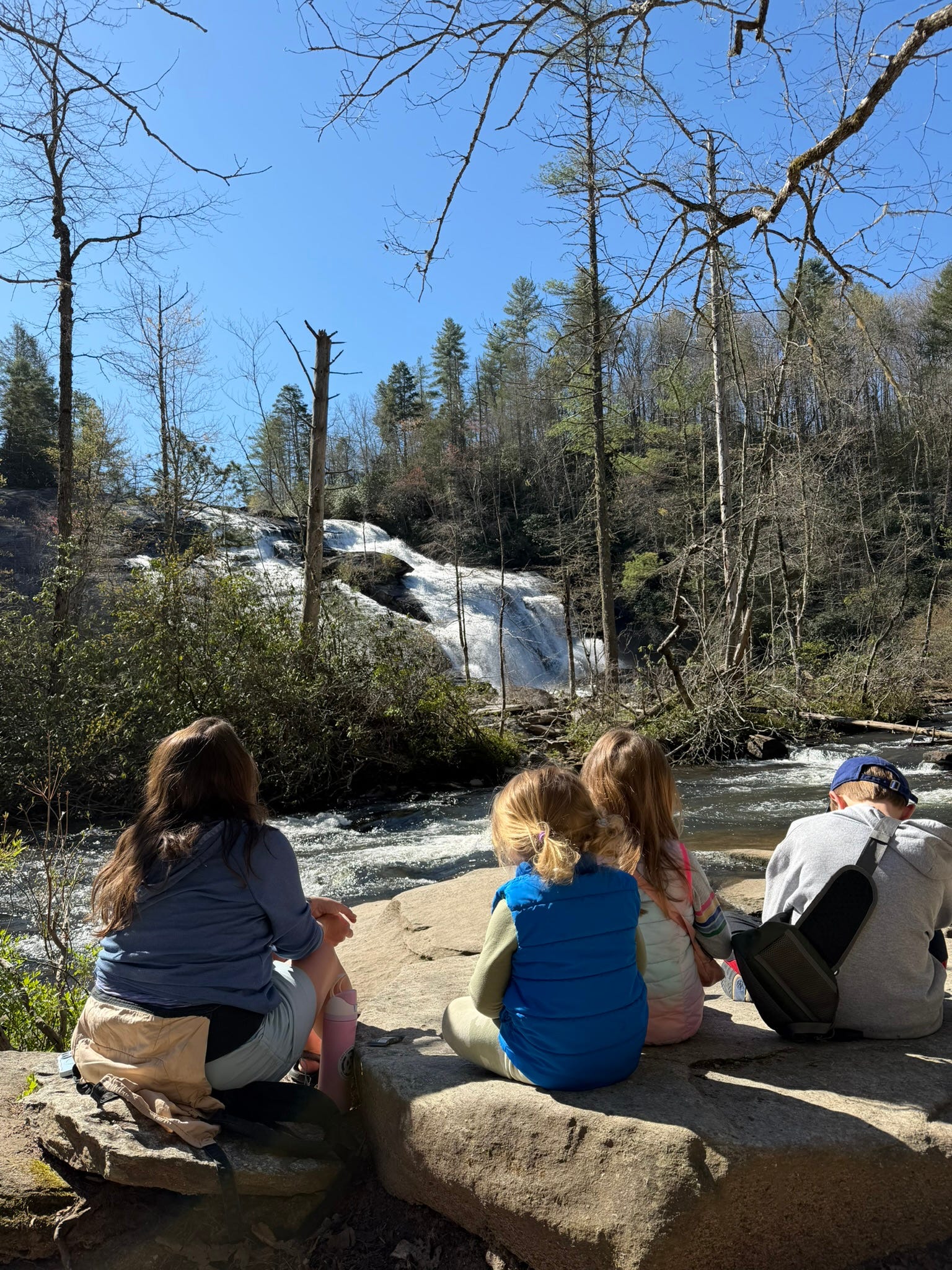
We ate our snack on the flat granite slabs below the falls, where the Little River runs fast and shallow over a broad stone shelf before channeling back into the forest. The rock was warm from the morning sun. Lily took off her shoes.
What I kept coming back to, sitting there, is a phrase I’ve been circling in my dissertation work… ecological intentionality. The term is my own coinage, but the ground it stands on is shared between Husserl’s intentionality, the always-already directedness of consciousness toward a world with Merleau-Ponty’s insistence that this directedness is bodily before it is cognitive, and the further suggestion (which I owe in part to process thought and in part to the plain evidence of watching children at a waterfall) that the directedness runs in both directions. The world reaches back. The falls pull the attention of anyone who comes within earshot. The current shapes the intention of anyone who steps into it.
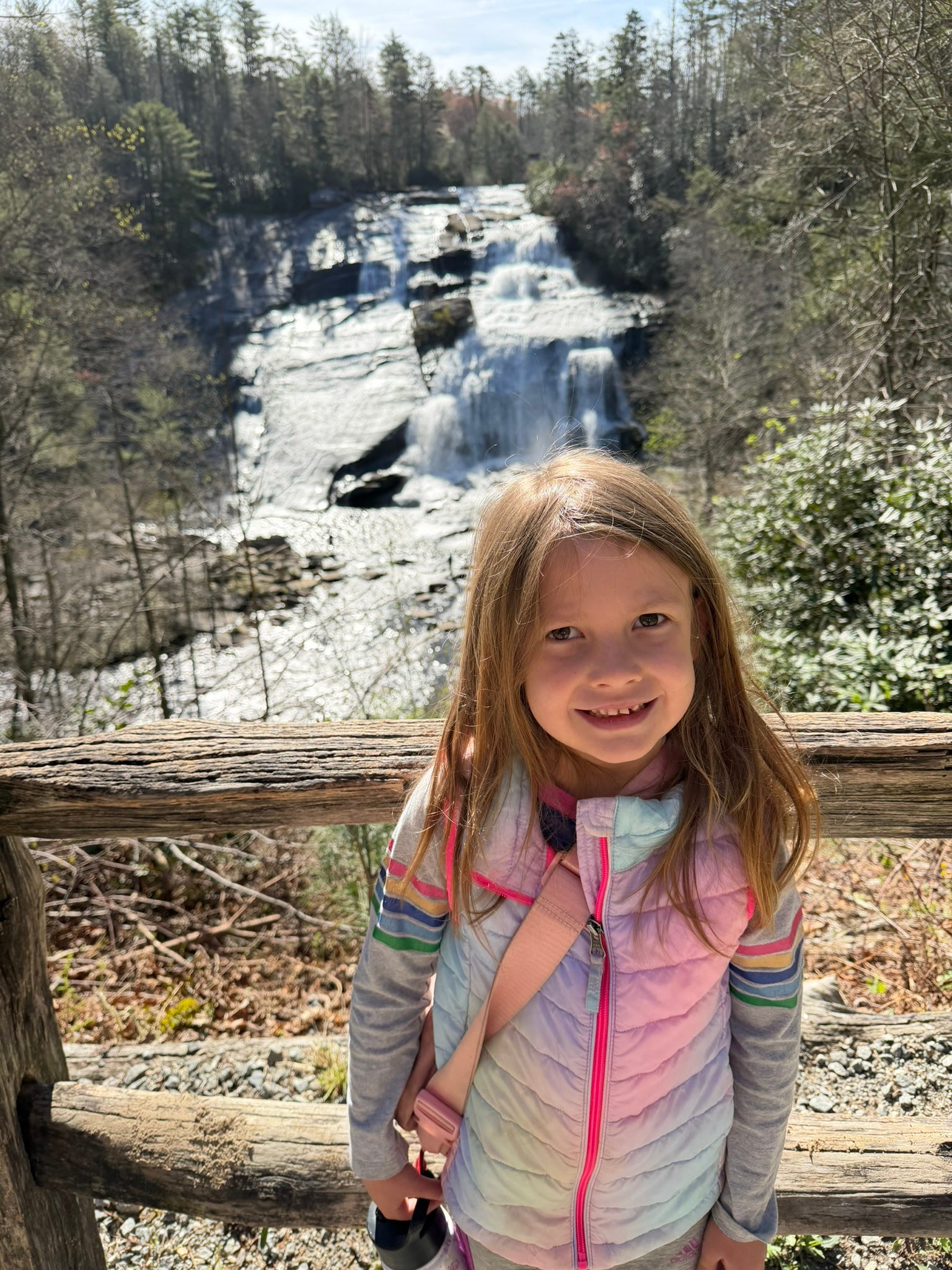
Emmylou understood this without a framework. She sat at the edge of the current and traced its surface with one finger, moving with it, then against it, then letting her hand go still and feeling the water work around her. She was not studying the river. She was in conversation with it.
Transylvania County, whose name gives Brevard its literary resonance, sits on the receiving end of one of the most precipitous elevation drops in the eastern United States. The Blue Ridge escarpment here falls several thousand feet over just a few miles, which is why the rivers are fast, why the waterfalls are numerous, and why the mist from the falls can be felt from the trail long before the falls themselves are visible. The water is in a hurry, and the hurry is geological.
There is something worth sitting with in that scale. The Little River does not know it is being hurried by an escarpment. It does not experience the gradient. It simply follows the gradient, and the gradient is the result of a continental collision that ended roughly 300 million years ago, when the ancestral Appalachians were thrust up in the same slow catastrophe that would eventually produce the Blue Ridge, the Piedmont, the Pee Dee plain (where I grew up), and the coastal strand where the land finally runs out. The water flowing over High Falls this week carries, in the most literal sense, the memory of mountains.
We carry something of that, too, I think. The body’s attunement to moving water is old… older than the names we have for it, older than the trails. When Lily reaches toward the current from Merianna’s back, she is not performing an aesthetic response. She is answering something. Whether we call that ecological intentionality or simply being alive, the act is the same.
On the drive back to our rented home in the mountains outside of Brevard, the kids were quiet in the particular way that follows genuine tiredness… not sleep exactly, but a settling. Lily still had one shoe off. Ben had the water bottle braced against his knee.
I thought about what we’d actually done. We had walked maybe three miles on well-maintained trails through a state forest on a clear day in early April. We had looked at water falling. We had eaten snacks on a warm rock. Nothing had been illuminated, exactly, and yet something had been practiced as a way of attending, a willingness to let the world arrive on its own terms before we said anything about it.
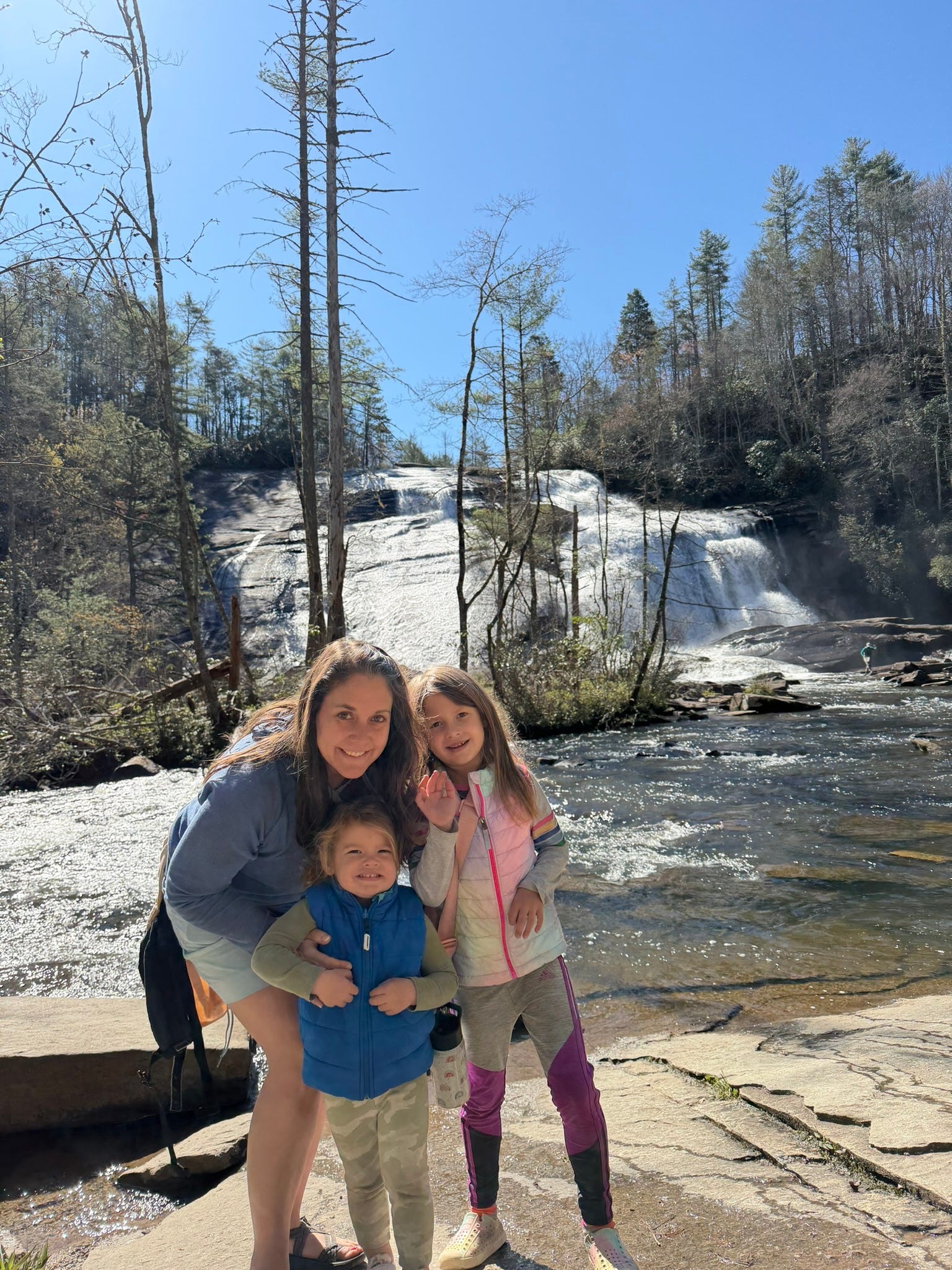
The Little River was still running when we left. It will run much the same way when Lily is old enough to come back without the carrier. The falls are patient with our inattention. They keep doing what they do regardless of whether anyone is watching, and they do not particularly change when someone is. What changes is us… something in the posture, something in the quality of silence. A loosening of the slight withdrawal that adult life requires, just long enough to feel the spray.
That seems worth the drive.
DuPont State Recreational Forest is located in Transylvania County, NC, near Brevard. The High Falls Access trailhead off Sky Valley Road provides the most direct route to High Falls and connects to Triple Falls via the 1.7-mile High Falls Loop. The forest is free and open year-round!
For further reading
Maurice Merleau-Ponty, Phenomenology of Perception, trans. Donald A. Landes (Routledge, 2012). The foundational account of the lived body and perceptual participation that runs beneath the essay’s treatment of children at the falls. Publisher page · Find via IndieBound
Henri Bergson, Time and Free Will (Dover, 2001). The most accessible entry into Bergson’s thinking on duration is the argument that lived time is a continuous flow rather than a measurable sequence. Publisher page · Find via IndieBound
Robin Wall Kimmerer, Braiding Sweetgrass (Milkweed Editions, 2013). The most widely read contemporary account of participatory attention to plant and water life is a model for this kind of writing. Publisher page · Find via IndieBound
Wendell Berry, The Unforeseen Wilderness: Kentucky’s Red River Gorge (Counterpoint, 2006). Berry’s earliest sustained attempt at the form this essay works in, lyrical ecology, braids place history with the threat of loss. Publisher page · Find via IndieBound
Gary Snyder, The Practice of the Wild (Counterpoint, 1990). Essays on watershed consciousness and embodied inhabitation of specific landscapes. Publisher page · Find via IndieBound
Beautiful, poetic, I heard the falls, felt the water. Thank you, Sam. Gene Lassiter