



Last Monday night, Spartanburg County Council took up a development agreement for the Valara NorthMark data center on South Pine Street. The motion went unseconded, and the agreement stalled.
By Thursday afternoon, after two closed sessions and a specially called meeting, the same council approved the ordinance on first reading by a four-to-one vote.
Four days. Two versions of an agreement. Nearly 294 acres of land along South Pine Street, where construction is already heavily underway.
I’ve been writing about this project for months, trying to understand what we’re being asked to accept in exchange for the promise of economic development, and how the land and water around us enter those calculations. In September, I wrote about how hard it is to understand the project through its published water figures. First 459,000 gallons per day, then a projected average of 1.2 million at full buildout. I had to reconsider what I thought I knew about the project and how the public had gotten that information.[1]
This week I found myself doing something similar, except with two drafts of a development agreement.
The county made both versions available in its meeting packets. I read Monday’s draft alongside Thursday’s. The differences are worth noticing. A clearer path to enforcing certain environmental conditions emerged. A proposed community fund disappeared, along with its payment schedule and a remedy for unpaid contributions. A restriction on other data centers within one mile vanished. Language concerning the county’s authority to adopt future regulations became more restrictive.
Some of those changes can be understood as gains for the public. Others deserve much harder questions.
I’ve spent enough time around institutions to know that documents like these rarely tell the whole story of how decisions get made. But the language that survives into the final agreement matters. It is what the county and the company will be expected to live with after everyone has left the room.
What Happened Between Monday and Thursday
On October 19, council considered an ordinance authorizing a development agreement with Numara LLC and Valara Holdings LLC, the companies involved in the data center at the former Kohler property.
Councilman Monier Abusaft said afterward that the proposed agreement lacked enough of the protections members had previously discussed, particularly regarding public health and safety. The motion failed without a second.[2]
On Tuesday afternoon, the county posted notice of a special executive session for Wednesday at 4 p.m. Its stated purpose was to discuss contractual terms involving the same companies. Another executive session followed at noon Thursday, immediately before a special council meeting at 12:30.
This time the ordinance passed first reading, four to one. Abusaft voted against it. Councilwoman Jessica Coker was absent.[3]
During Thursday’s meeting, Paul Abbott credited the Public Safety Committee’s lengthy hearings with helping shape the agreement's protections. Grant DeShields said the county had obtained concessions he considered important for people living near the facility. Abusaft remained dissatisfied with the environmental provisions and how earlier discussions were reflected in the proposed terms.[3-1]
Those are different judgments about the same negotiation. The closed sessions don’t tell us which particular requests produced which changes, or why the agreement returned so quickly after Monday’s failed motion.
The drafts do give us something to examine for ourselves.
What Changed in the Text
Thursday’s agreement contains requirements concerning lighting, noise, and landscaping. Several of those requirements were already in Monday's text. It would be wrong to treat everything in Thursday’s text as a concession obtained during the intervening days. But Thursday added language we should consider as the county making decisions not only for our individual lives and families, but also for the larger human community, our watershed, and the wider ecology.
Article XII now directs the county to address violations of the agreement’s lighting, noise, and landscaping provisions under the enforcement section of the county’s Performance Zoning Ordinance. Article VII also requires the company to maintain noise mitigation equipment and other equipment necessary to comply with the agreement’s noise limits.[4]
The second provision puts an obligation in writing that should survive the construction phase. Noise-reduction equipment will need maintenance years after the builders are gone. An initial study tells us what the facility is expected to sound like. Continued compliance requires attention to what it actually sounds like when it operates.
I would want those requirements in writing.
But something else in Article V deserves equal attention. Both versions state that the company submitted lighting, noise, and landscaping plans for county review. Thursday’s version also describes a noise study that measures existing levels and models future operations. It says the County reviewed those submissions and found them sufficient.
In the language repeated through the agreement:
The County acknowledges that this requirement is satisfied.[5]
Yet the submission dates beside the plans and study remain blank in the October 22 document. Monday’s version went further in showing its unfinished condition: a company drafting note said that the five compliance items remained subject to ongoing review. That note was gone Thursday, although the empty date fields remained.[5-1]
Maybe these are clerical blanks left behind in a document that is still moving through the approval process. They don’t demonstrate that the county failed to conduct the reviews.
But which versions of the plans and studies did the county accept? When were they submitted? Where can residents read them? What observations will determine whether the model’s predictions hold once the facility is running?
Those are answerable questions, and the answers should be public before the agreement is final.
What Was Taken Out
The most substantial deletion concerns a Community Benefit Fund.
Monday’s Article VII proposed annual contributions for the agreement's ten-year term, supporting workforce training, broadband initiatives, STEM education, watershed and land conservation, affordable housing, parks, scholarships, road improvements, and local charitable organizations.[6]
It included a formula for annual contributions, though the amount was still a placeholder:
Company shall contribute ... an amount equal to $[●] per year for the Term of the Agreement.[6-1]
An exhibit listed ten years of payments, but the amounts were blank. The company would hold and administer the fund, appoint six representatives to an advisory committee whose other seats were also not finalized, and retain final discretion over the grants it awarded. The draft described these as voluntary charitable commitments, with obligations conditioned on the county’s own performance.[6-2]
I wouldn’t describe that as a fully negotiated community benefit. The document didn’t set an agreed amount, and the company retained control over where the money would go.
Still, the framework existed. More strikingly, Monday’s Article XII gave the county a remedy if an agreed contribution went unpaid. It provided for a lien against the property, subject to the ground lease, and possible foreclosure. The company could substitute an acceptable letter of credit for that lien.[7]
By Thursday, the fund, its ten-year schedule, and that remedy were all gone.
The revised agreement’s annual reporting requirement now ends with the words:
Community or charitable contributions, if applicable.[8]
That’s a very different commitment if we read this at face value.
We can’t say Spartanburg County lost a promised sum of money. Monday’s draft never supplied one. But they removed a proposed mechanism for establishing and enforcing an annual community contribution entirely.
Why? Did the county decide the framework offered too little accountability? Did the company reject an enforceable contribution? Is a different arrangement being considered?
The documents don’t answer those questions, and I wouldn’t claim to know what happened in the closed sessions. I do think the questions belong in the next public hearing.
Another provision disappeared from Article V.
Monday’s draft said the county “has not approved and will not approve any Data Center Facility” that would put this data center within one mile of another such facility.[9]
At first glance, that could sound like a protection for nearby neighborhoods. But the provision bound the county in its decisions about other data centers. It did not establish a one-mile buffer between Valara and existing homes. Read that way, it could have protected the company from another nearby development more than it protected its neighbors.
Thursday removed the promise. That may preserve flexibility for future county decisions, although the county still has to consider any independently applicable spacing rules. Not every provision described as protective protects the same interests.
The county’s future authority also changed. On Monday, Article V reserved the application of subsequently adopted laws within the limits of state law, including laws needed to address serious public health and safety threats. Thursday’s version added further conditions: such laws must apply uniformly countywide to similarly situated properties and uses, must not target this project in purpose or practical effect, and must give the company an opportunity to be heard.[10]
The revised agreement says the county retains the police powers allowed by state law. I wouldn’t claim those powers have been eliminated. But the added contractual language clearly addresses how new county regulations might reach this property.
I understand why a developer committing billions of dollars wants certainty about the rules. I also wonder how we will respond if the conditions of the place change in ways neither the county nor the company adequately anticipated.
If groundwater monitoring reveals a problem five years from now, or noise measurements differ from today’s projections, what authority will the county have to respond? And who will have to demonstrate that a change is necessary?
Those are practical questions about a ten-year agreement in a landscape whose future cannot be settled ten years in advance.
What We’re Agreeing To
The figures in Thursday’s agreement are substantial: approximately 293.6 acres at 4000 South Pine Street, an anticipated investment of at least $2.76 billion, and a data center described as 457 megawatts, with on-site power generation, electrical substations, and water and wastewater infrastructure.[11]
The agreement also targets at least 27 full-time jobs, while expressly stating that falling short of that target will not constitute a default.[11-1]
Twenty-seven jobs alongside an investment measured in billions of dollars should make us ask what kind of public benefit is being measured, and how. The investment may have important economic consequences, but its size alone doesn’t establish what the project will contribute to the communities around it.
The company commits to annual community meetings and to reporting to the county on capital investment, construction, employment, and demand for water, electricity, and natural gas. The agreement also allows certain reports containing commercially sensitive or security information to be handled confidentially, within the limits of state public-records law.[11-2]
The county makes commitments too. Article IX describes an expedited review process, including a 45-day period for final action after the County deems an application complete. The proposed agreement states:
Failure by the County to act within the Review Period shall be considered to constitute approval to proceed based on the documentation presented.[12]
That sentence appeared in Monday’s draft as well, so it isn’t something gained or lost between the two meetings. But it belongs in any serious reading of the bargain. How would that commitment operate alongside legally required inspections and substantive review? County residents deserve to understand the limits of an approval process where the passage of time can have its own consequences.
The project is already under construction and the agreement treats it as exempt from the county’s data center moratorium. Council isn’t considering an untouched parcel and a development that may never happen. It is negotiating additional terms for a facility that has already moved far along in the permitting (and construction) process.[11-3]
That reality may limit what the county can still obtain. It’s also worth remembering when we consider the rules that will govern the next project.
What the Air and Water Have to Say
The same week council advanced the agreement, it approved a resolution requesting an additional air quality monitoring station on Spartanburg County’s east side.[13]
Earlier this month, the South Carolina Department of Environmental Services responded to a request for another public comment period on Valara’s September air permit. The Southern Environmental Law Center had raised concerns about a revised emissions factor used to estimate potential formaldehyde emissions from the facility’s natural gas turbines. SCDES declined to reopen comment and explained that the permit requires site-specific testing after operations begin, with the results used to verify compliance.[14]
That distinction between estimates and measurements is very important. It matters for air, for noise, and for water.
In September I wrote about discovering that the 459,000-gallon water figure I had carried into a sermon at the Unitarian Universalist Church of Spartanburg described only a more limited portion of the project than I understood. Spartanburg Water reportedly received the larger full-buildout projection months earlier. I had to change my own account of what the project was asking of our watershed.[1-1] That experience has really stayed with me over the last couple of months.
An environmental model, a development agreement, and an air permit each make certain project features available for public review and examination. We need those instruments to be sound. We also need the institutions using them to remain capable of correction when operating measurements show something different from what was expected.
A new monitoring station may help provide information. Who will have access to the results? What standards will they be measured against? What will happen when the evidence warrants further action?
I’d ask the same questions about water, groundwater, noise, and the surrounding landscape. We shouldn’t have to wait until something becomes intolerable to discover which institution has the authority to respond.
What a Place Holds
I’ve been thinking about the old Glendale Mill on Lawson’s Fork as I’ve read these documents.
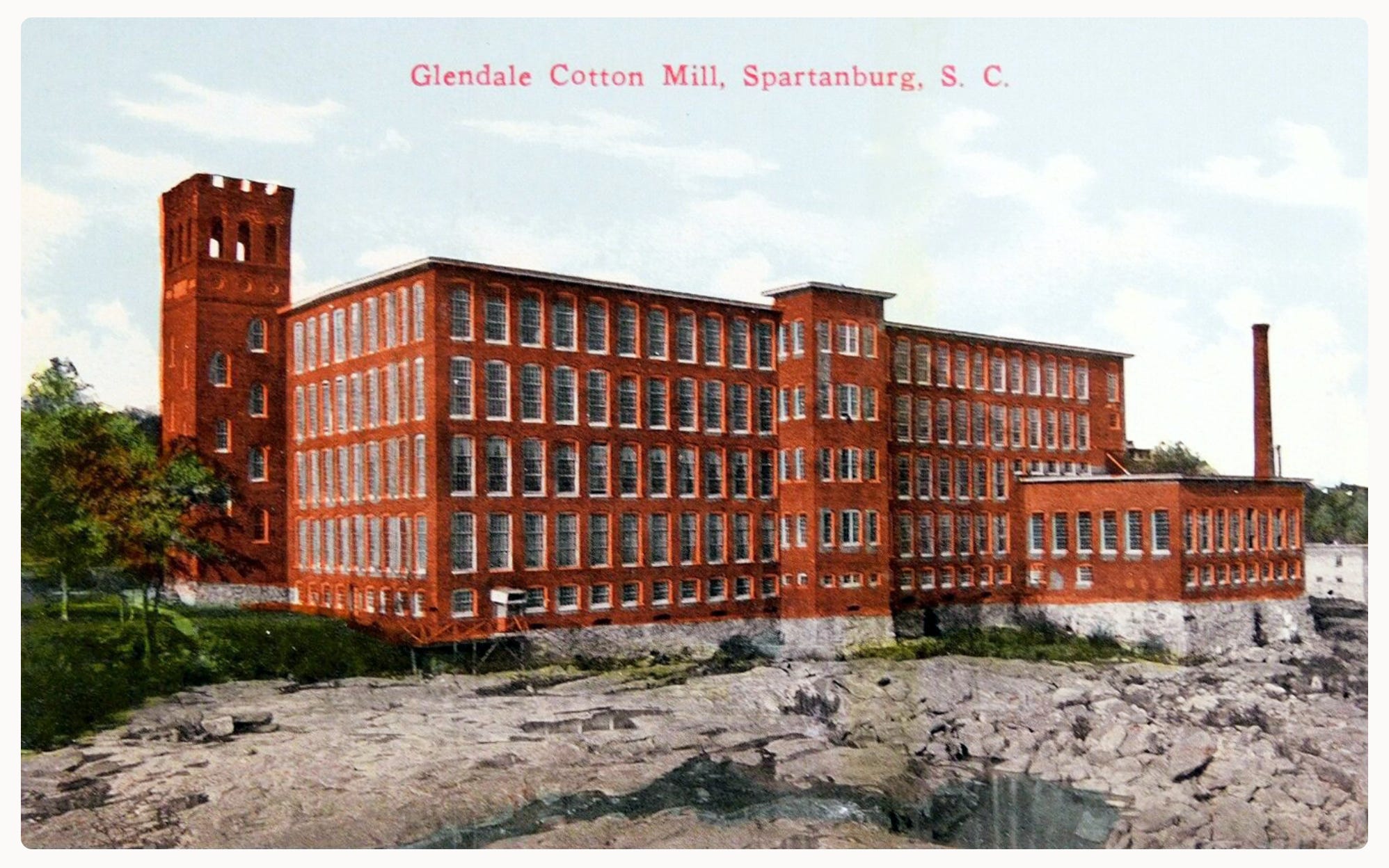
The postcard accompanying this essay shows a brick textile mill rising above the creek's rocky banks. The windows and towers dominate the image. Below them, the water follows its older course through the shoals.
Glendale was part of an earlier industrial transformation of Spartanburg County. Textile manufacturing brought work, built communities, and altered the relationships among land, water, labor, and capital throughout the Piedmont. The mill ceased production in 1961, and much of the structure burned in 2004. Lawson’s Fork still flows through what is now the Glendale Shoals Preserve.[15]
I don’t want to romanticize the mill economy. Its history includes hard questions about working conditions, ownership, and environmental change, alongside the family and community histories that grew around the mills. A contemporary data center isn’t the same enterprise, just with different machinery. Its employment patterns, energy demands, and finances work differently.
But that old photograph raises a question for me. What will people looking back at South Pine Street sixty years from now be able to see about the choices we’re making today?
The development agreement can assign responsibilities, set deadlines, and establish remedies. It can say what the county owes the company and what the company owes the county. It cannot make the watershed conform to the agreement's duration.
The air moving across South Pine Street doesn’t stop at the property’s edge. Neighbors will encounter the facility in ordinary life, perhaps first through sound, light, or some change in their surroundings, before those experiences make it into a public report.
I’ve been working through related questions in my research on ecological intentionality, particularly how consciousness and understanding develop within relationships among differently organized beings. The daily time I spend with a black walnut in my backyard keeps challenging the idea that knowing more about a being means I have come closer to possessing a complete account of it.
I can observe how the tree changes, identify fungi on a fallen branch, and watch birds move through its canopy. Every new detail also places me in contact with relationships I hadn’t noticed and histories I can only partly reconstruct. The tree is present to me without my account exhausting it.
A place is like that too. We can make claims about what is happening there, and we can test, correct, or reject them. But no single document contains the place itself.
A sentence near the end of both agreements brings this back to the people around South Pine Street. Under No Third-Party Beneficiaries, the agreement says residents, taxpayers, neighboring property owners, environmental organizations, and other members of the public do not gain a right to enforce its provisions because they are affected by the project.[16]
That is a contractual limitation, not a declaration that residents have no rights under other laws. Still, it is worth reading alongside the section titled Public Benefits. The benefits are described in the agreement, while the power to enforce the agreement belongs to its parties.
I want our county government to take that responsibility seriously, especially when the people most affected by an industrial project aren’t the ones negotiating its terms.
Before the Next Reading
Two council readings remain before final approval. The county has indicated that it hopes to finish the process in November.[3-2]
I’d like to know why the Community Benefit Fund disappeared, whether another commitment will replace it, and how the added environmental enforcement language will work in practice.
I’d like the county to make available the lighting, noise, landscaping, and noise-study documents it says it has already reviewed, along with the submission dates and the assumptions underlying the noise model.
I’d like a public explanation of what the 45-day review provision will mean for future approvals, and what authority the county expects to retain when monitoring reveals conditions that aren’t reflected in today’s studies.
Those questions can be asked in public. They can be answered on the record before a final vote.
I’ve followed this project long enough to know that some answers will complicate my own view. That’s part of the work. The changing water figures already required me to correct what I had said from a pulpit. I would rather do that than defend an account because I happened to give it first.
I want the county to remain capable of the same kind of correction.
In What the Number Lets Us See, I wrote that we have to remain willing to see again. These two agreements add another responsibility. We have to be willing to read again, including the provisions that disappeared between one meeting and the next, and the obligations that appear to have become stronger.
The county and the company are writing down what they owe each other. The rest of us have an interest in those terms because we’ll live with their consequences.
The place itself, the water moving through our watershed, the air above South Pine Street, and the land already changed by construction will keep responding to what we do there.
The agreement may be settled in November. What happens there, in that place, will continue long afterward.
Sources and notes
Image: Glendale Cotton Mill on Lawson’s Fork, Spartanburg County, South Carolina. Historical postcard via Wikimedia Commons, public domain.
Sam Harrelson, “What the Number Lets Us See,” Carolina Ecology, September 22, 2026. The essay traces the change from the 459,000-gallon figure to NorthMark’s stated projected full-buildout average of 1.2 million gallons per day.
Spartanburg County Council, October 19, 2026, full agenda packet, PDF pp. 7 and 311–338, especially the proposed development agreement. See also WSPA’s report on the failed first-reading motion, October 20, 2026.
Spartanburg County, Data Center Information & Resources, including the October 21 executive-session notice, October 22 meeting recording, vote, and status of the agreement. See also WYFF’s October 22 report.
October 22 county packet, Article VII (PDF p. 15, agreement p. 10), and Article XII (PDF p. 19, agreement p. 14). Compare October 19 packet, Article VII (PDF p. 320) and Article XII (PDF p. 325).
October 19 development agreement, Article V (PDF pp. 317–318), including the company’s ongoing-review drafting note and blank submission dates; October 22 version, Article V (PDF pp. 12–13), including the remaining blank dates and statements that reviews have been completed.
October 19 development agreement, Article VII (PDF pp. 321–322); and Exhibit D, Public Benefit Schedule, listing ten annual placeholders and a placeholder total.
October 19 development agreement, Article XII, “Creation of Lien” (PDF p. 325). The remedy was limited to unpaid fund commitments and subject to the ground lease and letter-of-credit provisions.
October 22 development agreement, Article VII, Reporting (PDF p. 16). The later agreement does not include the separate Community Benefit Fund framework, lien remedy, or Exhibit D schedule.
October 19 development agreement, Article V, item 5(b), PDF p. 318. Compare October 22 version, Article V, which omits this county commitment.↩︎
Compare October 19 agreement, Article V, PDF p. 317, with October 22 agreement, Article V, PDF p. 12.
October 22 development agreement, Recitals and Articles III–VII (PDF pp. 7–16); and introductory ordinance (PDF p. 3), concerning the project’s exemption from the moratorium.
October 22 development agreement, Article IX (PDF p. 17, agreement p. 12). For the earlier version of the same review provision, see October 19 packet, Article IX.
Spartanburg County Council, October 19 agenda, Public Health and Human Services Committee, item IX(A); WSPA, October 22, on council’s action requesting additional monitoring.
South Carolina Department of Environmental Services, “Valara Holdings High Performance Compute Center”, October 14, 2026 update concerning the September air permit and formaldehyde emission factor.
Glendale Mill history, including its 1961 closure; and Spartanburg Area Conservancy, Glendale Shoals Preserve, concerning the preserved property along Lawson’s Fork.
October 19 development agreement, Article XVII, “No Third-Party Beneficiaries”; October 22 agreement, Article XVII, same provision.