


I have been intently watching the black walnut in our backyard for just over a year now, and I am still not sure I know what it is doing.
That sentence probably sounds strange. We have words for what trees do, from photosynthesis and transpiration to allelopathy and mast production, and the black walnut is particularly well-documented in this regard. Its roots secrete juglone, a toxic chemical compound that harms many neighboring plants, meaning it does not merely occupy space but actively shapes the community around it. It is doing something, in the measurable sense. We have instruments for this.
But I mean something else by the question. I mean, what is the walnut doing from the inside?
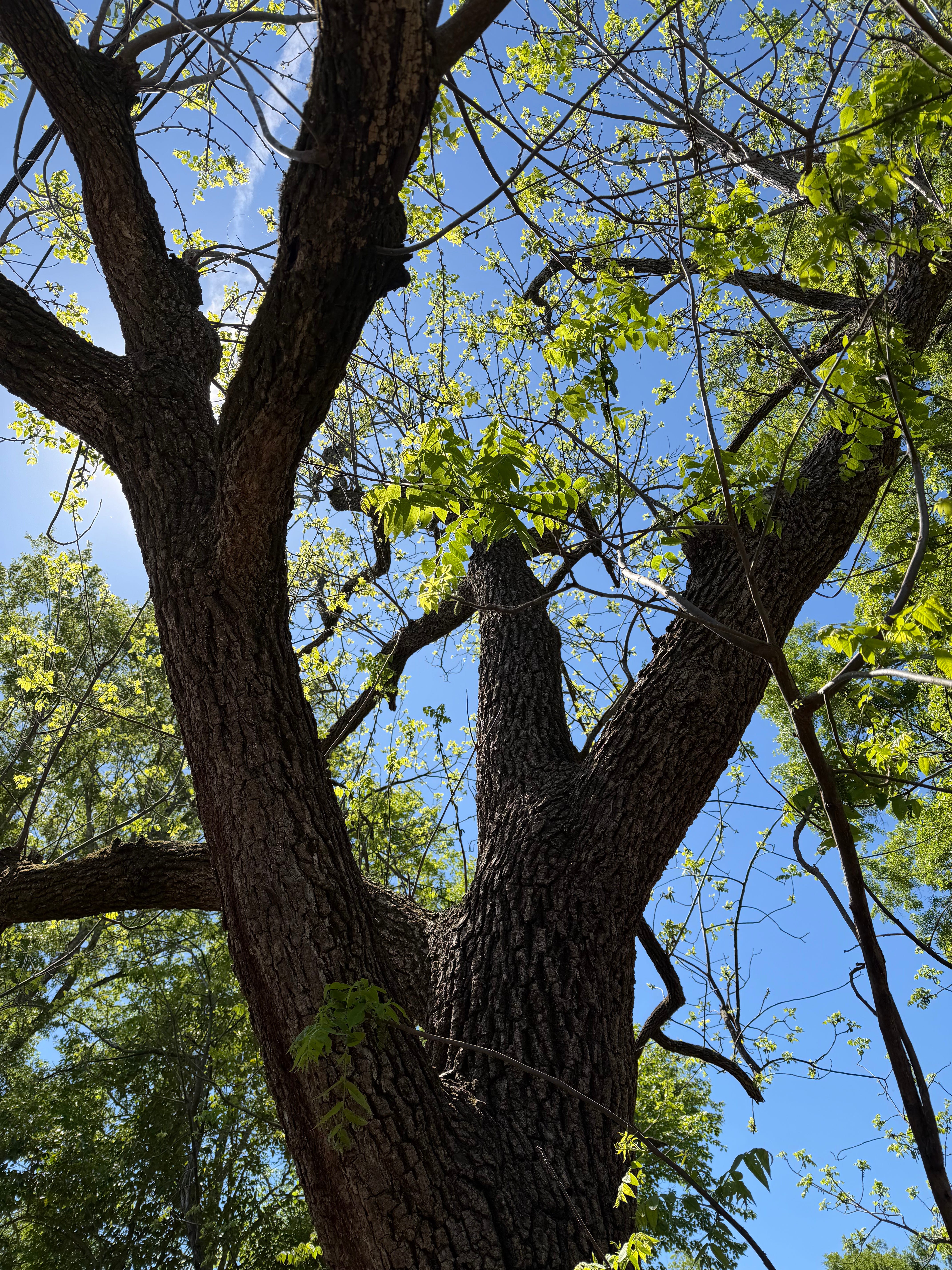
I started “watching” (being with) this tree as part of a graduate seminar in my PhD studies in January 2025, a practice of almost daily observation, written reflection, or just sitting “with.” The assignment was simple enough at the time... return to the same organism at the same location over an extended period of time and attend carefully. No agenda. No hypothesis to confirm. Just attention, sustained and patient, as a discipline in itself.
What I did not expect was how much of that practice would consist of watching the tree appear to do nothing.
Through November and into December, the walnut shed its compound leaves in long, slow stages, the leaflets dropping before the central stalk, the stalks yellowing and releasing one by one until the branches stood bare against the gray Piedmont sky. January brought ice once and a good deal of snow yet again, a glaze that made the bark look lacquered, every ridge and furrow filled with light. February was mostly stillness. I would stand at the edge of the yard in the cold and take notes and feel, some mornings, faintly absurd... a man in his late 40’s with a notebook watching a dormant tree, waiting for something that might not come.
The bark was the only thing that changed, and then only when it rained. The walnut’s bark is deeply furrowed, almost architectural in its ridging, dark gray-brown in dry weather. When rain comes, the furrows darken first, then the ridges, the whole surface shifting toward black, toward something that looks almost wet and alive in a way the dry bark does not. I began to look forward to rainy mornings specifically. The tree seemed more present to itself somehow, more legible, though I could not have said what it was saying.
Then, this past week, in early April, the first buds appeared.
Not leaves just yet... just the swelling at the branch tips, a greening at the nodes, the faint suggestion of what is coming. After five months of apparent stillness, the tree is doing something visible again. And what surprised me was not the buds themselves but my response to them as something close to relief, or recognition, as if the tree had confirmed something I had been quietly doubting all winter.
Which raises the question again, in a different way. What was the walnut doing in February? Was it dormant (which is to say, was it doing nothing), or as close to nothing as a living thing can come? Or was it doing something for which we simply do not have good instruments?
The philosopher Henri Bergson spent much of his career arguing that the deepest problem in how we think about living things is that we borrow our categories from physics. We understand matter in terms of isolable parts, reversible states, and spatial positions. We understand organisms the same way as machines with components, as systems with inputs and outputs, as mechanisms whose behavior can in principle be mapped and predicted. What we lose in this borrowing, Bergson thought, is time. Not clock time, not the time we measure, but duration... the continuous, irreversible, accumulating character of a life actually being lived.
A stone has no past in the relevant sense. You could, in principle, reverse all its molecular states, and it would be the same stone. An organism cannot be reversed. It carries its history in its tissues, its timing, its chemistry. The black walnut in my yard is not the same tree it was in January, not because something dramatic has happened, but because it has continued, because duration has moved through it and left its mark in ways that no instrument fully captures.
The French philosopher Raymond Ruyer, writing in the mid-twentieth century, pushed this further. An organism, he argued, is not a surface that can be observed from outside, but it is what he called an “absolute surface,” a domain equipresent to itself, holding its own form together through something like immanent self-attention. Not a machine surveyed by an engineer. A form that surveys itself. The walnut in February, bark darkening in the rain, held its form from within and was not dormant so much as equipresent to itself in ways I was only beginning to notice.
This is what the buds in early April are telling me, I think. Not that the tree has woken up, as if it were sleeping before. But that what looked like stillness was in fact a kind of accumulated tending and the slow work of a living form carrying its past forward into a new season, doing something for which dormancy is not quite the right word.
There is a philosophical tradition, running back at least to Plotinus in the third century C.E., that holds contemplation to be not an exclusively human act but the fundamental activity of all living things. Plants, animals, even the generative forces of nature itself... all are understood, in this tradition, to produce form through a kind of silent, attentive self-coincidence. Not thinking in the way we think. But not nothing, either. A mode of presence to one’s own form, and through that form, to the whole of which it is an expression.
I find I cannot dismiss this idea when I am standing in front of the walnut in April, watching the buds swell. It is too easy, and I think finally too dishonest, to say that what the tree is doing is merely chemical, merely mechanical, merely the sum of its processes. Something in the act of sustained attention resists that reduction. Not because attention is mystical, but because it is precise — and precision, held long enough over a living thing, keeps turning up more than mechanism accounts for.
The juglone in the walnut’s roots is not random cruelty. It is a claim on the surrounding soil, a shaping of the community according to the tree’s own requirements, or, as ecologists call it, allelopathy, and what I am tempted to call, less technically, intention. Not conscious intention in the way I intend things. But a directedness. A form that knows, in some sense, what it needs and moves toward it.
I do not know what the walnut knows. I am not sure that formulation is even quite right. But after a year of watching the bare winter branches, the bark darkening in rain, the five months of apparent stillness, and now these first buds opening in early April like a sentence the tree has been composing all winter, I am less certain than I was that the question is a category error.
The tree is doing something. I am trying to learn how to see it.
Further Reading
(feel free to message if you’d like a copy of any of these but not able to purchase)
On trees and plant intelligence
Zoë Schlanger, The Light Eaters: How the Unseen World of Plant Intelligence Offers a New Understanding of Life on Earth (Harper, 2024) — Bookshop.org
Peter Wohlleben, The Hidden Life of Trees: What They Feel, How They Communicate (Greystone, 2016) — Bookshop.org
David George Haskell, The Songs of Trees: Stories from Nature’s Great Connectors (Viking, 2017) — Bookshop.org
Robin Wall Kimmerer, Braiding Sweetgrass: Indigenous Wisdom, Scientific Knowledge, and the Teachings of Plants (Milkweed, 2013) — Bookshop.org
On duration, living form, and the philosophy behind this essay
Henri Bergson, Creative Evolution (1907; Dover edition) — Bookshop.org
Raymond Ruyer, Neofinalism (1952; Univ. of Minnesota Press, trans. 2016) — Powell’s (a must read!)
Tano Posteraro, Bergson’s Philosophy of Biology: Virtuality, Tendency and Time (Edinburgh UP, 2022) — Powell’s
On attention as ecological practice
Yves Citton, The Ecology of Attention (Polity, 2017) — Bookshop.org
Michael Marder, Plant-Thinking: A Philosophy of Vegetal Life (Columbia UP, 2013) — Bookshop.org
On Black Walnut specifically
Mary Oliver, “The Black Walnut Tree” (poem, from Twelve Moons, 1979) — Oliver’s own black walnut poem, which wrestles with the tree as familial memory and creaturely presence… worth reading alongside this essay
Linda Chalker-Scott, “Do Black Walnut Trees Have Allelopathic Effects on Other Plants?” — WSU Extension… the most honest scientific summary available that I’ve found… rigorous on what we actually know about juglone, and notably candid about how much we don’t
Robert Gardening Myths, “Walnuts, Juglone and Allelopathy” — Garden Myths… a plainspoken lay review of the same uncertainty, good for general readers
Juglans nigra species profile — USDA PLANTS Database… range maps, habitat, and basic natural history for the species in its native context