


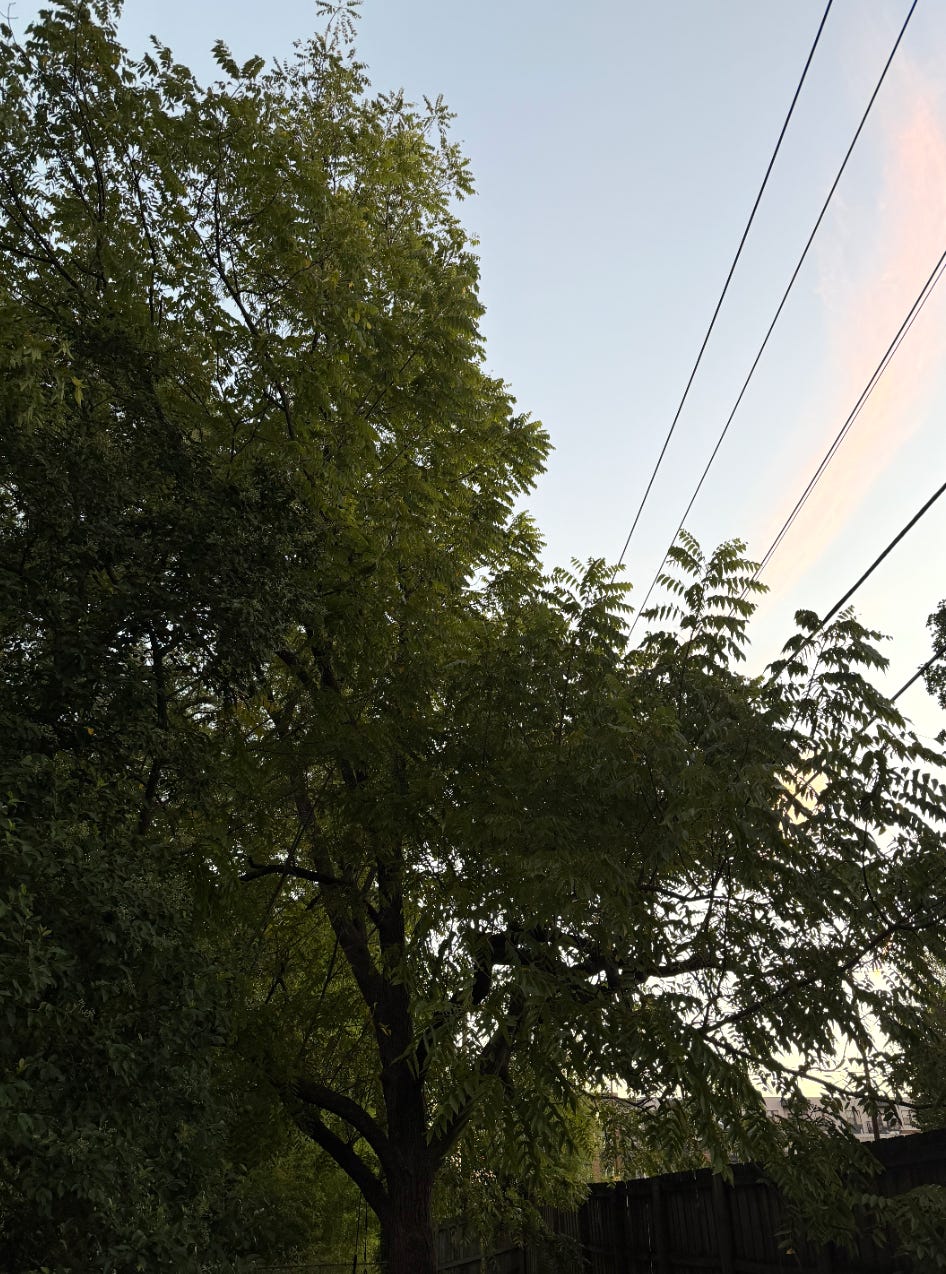
This morning I sat under the black walnut behind our house a little after sunrise and looked at the power lines. The tree was mostly dark against the early sky, its canopy filling one side of what I could see while the lines crossed the other, running beside a pale cloud catching the first light. Squirrels moved around, birds came and went, and the fence did what fences do: sit there quietly while carrying considerably more human history than a few boards ought to hold.
I had gone outside with a question: What in this scene shapes the walnut’s life without belonging to the walnut, and what can’t become visible through more attentive perception? That question, which became this morning’s Black Walnut field note, turns out to be a pretty good description of where much of my academic work has landed this fall.
For the past few years I’ve been using the phrase ecological intentionality to name something I thought I could see happening in sustained encounters with other living beings: a disciplined way of paying attention to another creature as relationally present, genuinely other, and never exhausted by whatever it happens to look like from the human side. I’m considerably less certain than I was a few months ago that it names what I originally thought it named. From the standpoint of doing a PhD, that’s inconvenient. From the standpoint of doing philosophy, it’s probably a very good sign.
I’ve been keeping a public record of this experiment at ecologicalintentionality.org, where the Black Walnut Field Notes sit alongside a running page on where the inquiry currently stands. What follows is a version of that page in my usual language, which means less of a research dashboard and more of an attempt to say what this work is starting to teach me about paying attention to actual places.
The walnut has not cooperated, though
I began the public Black Walnut Field Notes earlier this month because I wanted the tree to function as something other than an illustration. That’s an important point because it would be very easy for me to sit beneath an old black walnut with Robin Wall Kimmerer in one hand and Edith Stein in the other, watch sunlight move through the leaves, hear squirrels throwing walnuts onto the ground, and discover that, amazingly enough, the tree confirms everything I already believe about relation, reciprocity, creaturely life, and the sacredness of the more-than-human world. Trees are wonderfully cooperative theological props when we don’t permit them to object.
So I’ve been trying to arrange the practice differently. I sit for twenty or thirty minutes, photograph what’s there, talk through what I’m actually seeing in an audio recording based on what I perceive and in connection to the readings I’m doing, and then make the notes answer to the philosophers rather than allowing the philosophers to narrate the tree in advance. The working rule has become that the walnut must remain capable of resisting the concepts that taught me to notice it, and, as it turns out, it has been remarkably good at doing exactly that. That’s also why attention has become a concept in its own right in the project rather than a nice word for looking carefully.
Franz Brentano was the first person to make things more difficult. In Psychology from an Empirical Standpoint, intentionality has a technical meaning, and perceiving something, judging something, remembering something, desiring something, valuing something, and feeling grateful for something aren’t necessarily interchangeable versions of “being related to the world.” That sounds obvious until you start listening closely to your own language. I see shade; I benefit from shade; I experience the shade as something received; I say the walnut gives me shade; I call the shade a gift. Those sentences may all belong together, but they aren’t saying the same thing.
Edmund Husserl has made the problem harder still. I went into this work partly expecting to find a point where classical phenomenology ran out of road, and ecological intentionality had to take over. Instead, Husserl keeps explaining more of the encounter than I expected. A tree is given through profiles; I never see all of it at once, and yet hidden sides belong to the perception without becoming visible. Memory and anticipation hold the tree together through time. My own body gives me an oriented world with a here and a there, near and far, reachable and unreachable. Habit shapes what catches my attention, familiarity creates horizons of expectation, and in Ideas II, even value and practical significance belong much more deeply to perceptual life than a simple picture of neutral sensation followed by intellectual interpretation would suggest.
So ecological intentionality has not yet earned the right to call itself a new kind of intentional act. That has become one of the project's most important findings. It may turn out instead to name an education or formation of intentionality, a disciplined configuration of capacities we already possess, but even that more modest claim is now under pressure.
Yellow is not yellowing
One of the first problems came from the onset of autumn over the last few weeks (and our wonderful turn of weather). A yellow leaf is perceptually present, but leaf yellowing is more complicated because development unfolds over time. The yellow I see this morning belongs to the same living being whose greener canopy I remember from July and whose bare branches I anticipate seeing in January. The more I watched, the harder it became to pretend that “livingness” was another quality sitting beside green, rough, tall, shaded, and moving. That problem became its own thread around vegetal encounter.
This is one place Edith Stein has become indispensable. I began with her On the Problem of Empathy, where she gives me a discipline I continue to find extraordinarily important: another life can genuinely become present to me without becoming my experience. Empathy isn’t fusion, and the other is given precisely as other. Plants complicate the account because Stein lets us apprehend phenomena of life in vegetal bodies without granting ourselves access to a plant’s interior life as though it were a strangely quiet human being. That distinction has become one of the guards against sentimentality in this project.
But Stein’s Finite and Eternal Being, which I’m working through now, pushes much further. There she describes living beings in terms of potentiality and actuality, temporal becoming, internal formation, differentiated parts belonging to a living whole, and what she calls a kind of natural measure. That gives me language for a question phenomenology by itself doesn’t settle: suppose I can perceive correctly that this walnut has lost a branch. How do I know whether the loss counts as injury?
A leaf falling in late September isn’t the same thing as a leaf falling in June. A walnut dropping isn’t necessarily failure, dormancy isn’t diminished life, and more growth isn’t automatically better growth. To call something flourishing or damaged is already to have crossed from description into norm. The sequence I’m working with has therefore gradually become: apprehend the condition → articulate the organismic norm → distinguish who or what bears the good → justify the ethical response. Those arrows contain most of my dissertation problems right now because an organismic norm isn’t yet an ethical obligation.
Even if Stein is right that a living being contains within itself some measure of fuller and poorer actualization, it doesn’t automatically follow that I know what I ought to do about it. I’ve often summarized the project with the phrase first, the seeing, then the keeping, but I’m less certain now that the sequence moves in only one direction.
When shade becomes gift
Robin Wall Kimmerer is partly responsible for that complication. “The Gift of Strawberries” in Braiding Sweetgrass asks what happens when the world is received as gift rather than commodity, and I find that extraordinarily compelling. But the walnut forced me to slow the sequence down. There is shade. The shade benefits me. I receive the benefit. I experience gratitude. I call the shade a gift. At what point did description become interpretation, and does it matter?
Kimmerer doesn’t need the strawberry to behave like a tiny Cartesian subject consciously deciding to present itself to a human being. Gift is partly a transformation in the receiver's relationship, which means gratitude might actually educate perception. The way I care may change what I can see. Keeping may teach seeing, gratitude may disclose value, and attention may be formed by obligation rather than always preceding it.
But there’s another danger here. If I experience something gratefully and then use that gratitude as proof that the thing intended to give itself to me, I’ve created a lovely philosophical circle and climbed inside it. A storm last week made that obvious. After branches came down from the walnut earlier this month, I found myself thinking almost immediately in the grammar of gift: wood given, material received, perhaps something to carve or keep. Except a branch given in perception isn’t thereby given to me. Detachment isn’t permission, availability isn’t gift, usefulness isn’t consent, and restraint isn’t automatically reciprocity because I’d like to call it that.
Kimmerer’s “Honorable Harvest” makes that even harder. Sometimes respectful taking can contribute to flourishing, and sometimes leaving something untouched can allow harm. No universally innocent posture is available to us called “noninterference.” Care has to remain corrigible, and corrigibility, it turns out, is one of the words doing the most work for me right now. It’s also part of what I’ve been trying to name through remainder: what exceeds the confidence of my present perception, interpretation, or account without becoming a blank excuse not to act.
What formed a being is not necessarily good for it
That brings me back to the power line this morning. I initially wrote in my notes that “the wire is visible; the grid is not,” and Husserl made me correct that almost immediately. Of course I can see the wire as a power line. I’m not encountering a neutral black shape and only later deducing that electricity probably passes through it. In the practical world Husserl describes in Ideas II, things already show up as tools, roads, buildings, signs, cultural objects, useful things, dangerous things, and things belonging to shared human worlds.
The power line can therefore be perceptually given as a power line. What attentive perception can’t give me is the contingent history of this grid: who owns it, which easements run across which properties, why the line follows this route, who decided which branches had to be cut, what maintenance standards govern them, what laws authorize those decisions, and what histories of development, public investment, private ownership, engineering, and political power brought that wire into this exact relation with this exact tree. No amount of squinting will reveal the deed.
The better formulation is that cultural givenness is not historical explanation. A scar can be visible without carrying the story of the wound inside it, a fence can be visible without property law being visible in the boards, and a road can be visible without revealing who was displaced, prioritized, protected, or endangered when its width and speed were decided. A functioning present doesn’t explain how that present came to be.
That has become a major correction to ecological intentionality. Better attention is necessary, but better attention isn’t enough. It’s one reason place and agency have become increasingly central to the work.
Spartanburg keeps making the philosophy embarrassingly concrete
This would all be easier to keep in a seminar room if Spartanburg would stop supplying examples. For much of this year I’ve been writing here about the data center being constructed on South Pine Street. I’ve driven past it repeatedly, and anyone who does can see the physical transformation: earth moving, trees disappearing, infrastructure arriving, a large industrial site becoming something different.
But you can’t look at the building and see its water demand, and, importantly, you can’t look harder and make the number appear. For months, many of us, including me, were working from the publicly reported figure of roughly 459,000 gallons of water per day. On September 21, WYFF reported that NorthMark now projects average water demand of about 1.2 million gallons per day at full buildout, with a projected maximum of 1.6 million gallons per day. NorthMark said the earlier figure came from a Phase I wastewater survey rather than the full-build water projection, and that it had provided the larger figures to Spartanburg Water in February.
It’s almost a laboratory demonstration of the problem I’ve been wrestling with under the walnut. The facility is perceptible, but its metabolism requires other forms of inquiry. The water doesn’t become visible merely because I attend more carefully to the walls. You need documents, engineering, hydrology, journalism, public meetings, institutional records, questions asked by people who know what questions to ask, and the willingness to revise what you previously believed when the evidence changes.
I used that earlier figure myself in sermons and talking points with local groups. Corrigibility can’t be something I demand from county government, corporations, philosophers, or ecological management while exempting my own writing. If the number changes, the account has to change. The walnut has been teaching me something similar, although considerably more quietly.
The timing also makes the local question bigger than a single site. The day after NorthMark’s water numbers were reported, WYFF reported that Spartanburg County had joined other South Carolina counties in adopting a temporary one-year moratorium on nearly all new data center development. Whatever policies eventually emerge from that process, the ecological question won’t be answered by deciding whether a building can be seen, permitted, or supplied. It requires asking what systems of water, energy, land, infrastructure, and public decision-making become entangled in the project, including the parts that don’t announce themselves to perception.
The problem of intending harm
Another version of this question is unfolding in environmental law. In July, the U.S. Fish and Wildlife Service and National Marine Fisheries Service rescinded the federal regulatory definition of “harm” under the Endangered Species Act, with the rule taking effect on September 14. The administration says the prior definition exceeded the statute’s text and that the change restores what it regards as the law’s proper meaning. Environmental groups and a coalition of states have challenged the change.
Then, on September 16, Catrin Einhorn reported for The New York Times on an internal Fish and Wildlife Service directive interpreting the Act’s prohibition on “take” to apply to acts intentionally and purposefully directed at a protected animal. Under the directive’s reasoning, incidental injury or death resulting from an action directed at something else would not itself constitute a prohibited take. Legal scholars and conservation groups quoted in subsequent reporting have disputed that interpretation, including its relationship to the Supreme Court’s 1995 decision in Babbitt v. Sweet Home.
Whatever ultimately happens in the courts, the conceptual problem should sound familiar. What happens when responsibility begins and ends with the human actor's focal intention? An action can be directed toward timber, housing, mining, transportation, computation, agriculture, or profit while its ecological consequences unfold somewhere other than the intended object. The endangered bat doesn’t have to become what I’m thinking about for my action to enter its life. The creek doesn’t have to become the object of my intention for runoff to reach it, and the walnut doesn’t have to become the intended target of an electrical grid for the grid to shape the tree’s actual form.
One mistake ecological intentionality has to resist, then, is assuming that the structure of my intentional act supplies the architecture of the ecological world. It doesn’t. Relations are already underway before the human act makes one piece of the world its object.
Place is not context
Vanessa Watts has been especially important here. Her essay “Indigenous Place-Thought & Agency Amongst Humans and Non-Humans” has made me suspicious of one of the quiet assumptions I bring even to very careful phenomenology: first there is a human perceiver, then there is a nonhuman thing, and then there is the environment surrounding the encounter.
Watts’s specifically Haudenosaunee and Anishnaabe account of Place-Thought shouldn’t be flattened into another Western slogan that “everything is connected.” That would miss the point and domesticate the challenge. The harder question is whether I’ve already granted the human perceiver too much metaphysical priority by making the world the surrounding context of our encounter.
Husserl can give an extraordinarily rich account of an ego situated within a surrounding world. Watts makes me ask whether “surrounding” is already doing more philosophical work than I noticed. And so the question has moved from asking, How do I perceive this walnut?, toward another question: What relations were already underway before I arrived with the category of perceiver?
Integrity without isolation
At the same time, I don’t want “relation” to become the next magic word in my work (even though I believe everything is relational). A photograph I took a few days ago shows one of the walnut’s branches appearing to reach toward an oak thirty or forty yards away. “Reach” arrived in my mind immediately, and so did cooperation, communion, and relationship. The photograph almost begged for them.
But what was actually given was orientation, distance, overlapping canopies, and two trees in one perceptual field. Husserl makes an important distinction in Ideas II: intentional relation isn’t the same thing as real causal relation. Two trees can appear together without their ecological interaction becoming perceptually available, just as genuine ecological interaction can happen without announcing itself to vision.
Stein then prevents me from swinging too far in the other direction. A living being isn’t an isolated machine whose proper form is untouched by its circumstances. Soil, light, damage, competition, water, weather, pruning, disease, and other organisms can open and close real possibilities for its development. So the phrase I’m testing now is integrity without isolation; relation without dissolution; good without guaranteed harmony.
Ecology doesn’t mean that everything works out. A dead tree can become habitat for another creature without death, therefore becoming flourishing for the tree. A canopy gap created by one organism’s loss may allow another to grow. A fallen walnut may be reproductive possibility for the species, food for a squirrel, material for decomposition, or failure for that particular seed.
“What is good for the whole” therefore becomes suspicious language very quickly if nobody has established where the whole begins and ends. That’s why one of my current warnings to myself is: do not let ecology borrow the unity of the organism without argument. A grove isn’t necessarily one organism, a watershed isn’t necessarily one subject, coordination isn’t sameness, and relation isn’t fusion.
And Merleau-Ponty is still waiting
Which brings me to the philosopher I’ve deliberately not allowed to solve all this yet. Maurice Merleau-Ponty is sitting just downstream, and I know where this is heading: flesh, chiasm, reversibility, écart, and the intertwining of perceiver and perceived in The Visible and the Invisible and the later nature lectures. Those concepts have shaped this project for years, but I’m trying not to let them arrive too early.
It’s very tempting to look at two overlapping canopies and say chiasm. It’s very tempting to experience bodily belonging in a place and say flesh, or to encounter difference within relation and say écart. Maybe those are eventually the right words, but the walnut deserves the chance to make them work for a living.
Raymond Ruyer is waiting even farther downstream with Neofinalism, where questions of living form, self-survey, value, and immanent finality may become important. But Stein has already raised the bar considerably. If Ruyer is going to matter here, he’ll need to add something beyond the claim that living beings possess an internal norm or center of formation. Nobody gets a free conceptual lunch anymore, not even the French philosophers. Especially not the French philosophers. For anyone interested in following the academic trail farther than is probably healthy, I’m keeping the primary texts and adjacent readings together on a running Sources & Reading page.
So what is ecological intentionality now?
I’m not entirely sure, and that’s probably the most accurate update I can give. It may not be a new structure of consciousness, it may not be a special human capacity for ecological perception, and it certainly can’t mean that sustained attention eventually reveals everything worth knowing about a place. The power lines cured me of that this morning.
What I increasingly think ecological intentionality may name is a discipline of coordinated attention. Phenomenology has one task, biology another, and history another. Indigenous thought may question the architecture within which I divided those tasks in the first place. Law tells me things perception can’t, political analysis tells me things metaphysics can’t, metaphysics asks questions empirical description can’t answer, and ethics begins where description alone no longer tells us what ought to be done.
Theology, which is still waiting rather patiently in the background of all this, asks what kind of creature the perceiver must become to inhabit those limits without turning them into possession. Those forms of knowing need one another, but they also need to remain distinguishable. Perhaps ecological intentionality is partly the practice of refusing to let any one of them pretend to be the whole.
That would make the task less spectacular than I once imagined, but also considerably more demanding. Look carefully, say what was given, notice what you added, learn what kind of living being stands before you, find out what happened before you arrived, and ask whose good you mean when you say “the good.” Let another discipline correct you, let the place correct you, let the evidence correct you, and don’t mistake the fact that something survived what happened to it for evidence that what happened was good.
The black walnut outside my window has lived through drought, storms, squirrels, pruning, power lines, children, lawn equipment, hot summers, cold mornings, and me sitting under it asking increasingly complicated questions. Its present form bears those relations, but it doesn’t explain them and certainly doesn’t justify them.
Tomorrow morning I’ll go back outside. For now, that remains the method.