


Thanks to The Walking Spartan for the inspiration to write this.
On the morning of February 22nd, Dolores Dalton was trying to get to church.
She was 75 years old, a faithful Catholic, a hairdresser by trade, a woman whose obituary describes as someone who “never met a stranger.” She had attended St. Paul the Apostle on East Main Street here in Spartanburg for fifteen years. She parked, she stepped out, she crossed East Main Street, with its four lanes and a 25 miles per hour speed limit sign (something closer to 40 in practice), when an SUV traveling westbound hit her. She died at the hospital at 8:28 that morning.
The driver was also on their way to church.
Two people, headed toward the same general hope on a Sunday morning, separated by a road that was designed, not accidentally, not through indifference exactly, but through a specific philosophy of space, to move cars as fast as possible through the kind of urban fabric that makes a city worth living in. The road didn’t just fail Dolores Dalton. It failed the driver, too. It failed everyone who has to calculate, every time they step off a curb, whether the gap is wide enough, the cars slow enough, the morning light bright enough to make a crossing across a third of a mile of uninterrupted asphalt. There are no crosswalks on that stretch. The South Carolina Department of Transportation is now proposing to change all of that.
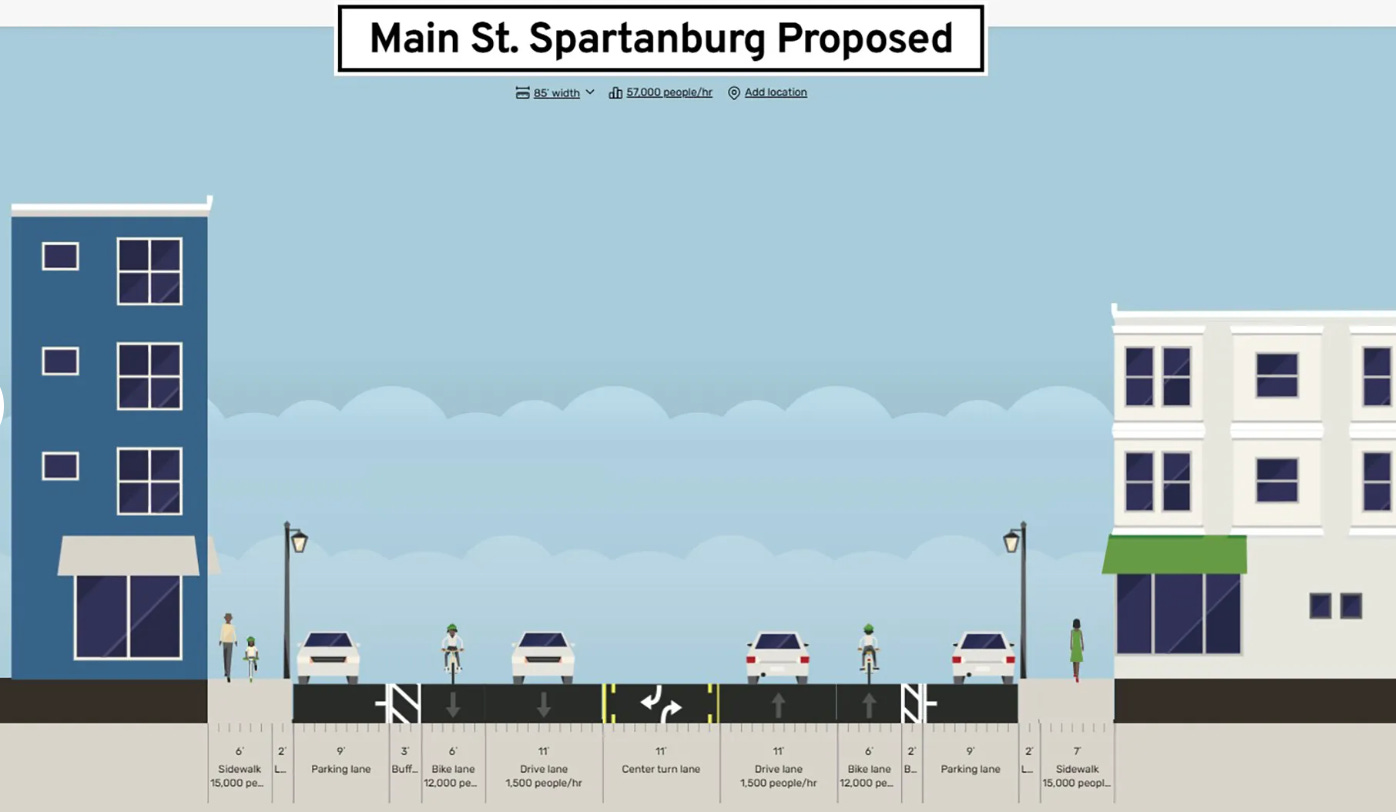
The proposal is called a “road diet,” which I think is an oddly metabolic term for what is really a philosophical reorientation. Between Converse Street and East St. John Street, SCDOT wants to reduce East Main from four to two lanes, with a center turn lane, bike lanes on both sides, and crosswalks. The project would take place in coordination with already-scheduled repaving work, so there would be no additional footprint or cost, just a different answer to the question of what a road is for.
The opposition, which showed up at the April public meeting and will likely show up again before this is done, is easy to predict from congestion, inconvenience, the fear that a slower East Main will push traffic into Converse Heights, and the vague sense that something is being taken away. These concerns are understandable, and they deserve honest engagement. But the data on road diets is, at this point, not particularly contested. SCDOT’s own spokesperson pointed to a comparable project on Augusta Road in Greenville that saw a 42% reduction in crashes. The Federal Highway Administration has found reductions between 19 and 52 percent, depending on the corridor. What feels counterintuitive turns out to be basic physics, since when a road has excess capacity, drivers fill it. Widen a lane, and people accelerate or likewise narrow it, and they slow down… not because they’ve been moralized at but because the perceptual field has changed.
Back to my ongoing point about humans' perceptual field!
Maurice Merleau-Ponty (bear with me here, because this is actually practical) argued that perception is not a camera recording a fixed external world. It is a bodily orientation toward possibility. We don’t just see a chair, we see a place to sit. We don’t just see a door, we see an opening. And crucially, we don’t just see a road, we see an invitation to move at a certain speed, with a certain kind of attention, past a certain kind of environment. A four-lane arterial invites one mode of being. It says that you are a vehicle. Move. What is beside you is not necessarily your concern.
This isn’t a metaphor, it’s phenomenology applied to transportation and civic engineering. The width of a lane, the number of lanes, the presence or absence of a median, the proximity of sidewalks to moving cars… these aren’t neutral choices about infrastructure. They are decisions about what kind of creatures we assume people to be, what relationships we assume they are capable of, and what they will notice as they move through space. A road built for maximum throughput at 40 mph does not ask you to see the person on the sidewalk as someone who might need to cross. It asks you to see the red light ahead, the gap in traffic, and the time you’re going to be late.
The city of Spartanburg and SCDOT have been trying to think this through, in fits and starts, for years. The Hub City Hopper, Denny’s Tower, the walking trails along Lawson’s Fork and out to Glendale Shoals, and the ones here in Duncan Park are fragments of a different vision and a different set of assumptions about what the body moving through a city might want to encounter. The road diet on East Main is, in this sense, not just a safety measure. It is a tentative argument about perception. It is the city saying, “Here is a stretch of road where we want to invite a different kind of attention.”
There is something worth noticing about the specific geography of this proposal. The stretch between Converse Street and East St. John runs along the edge of what you might call the contested urban margin, or the zone where downtown’s institutional density begins to give way to older residential neighborhoods, where churches sit across from parking lots, and where foot traffic is not hypothetical but actual. St. Paul, First Baptist, and First Presbyterian are right there (and our beloved Venus Pie). So is the Denny’s Tower, and Converse University is just up the road as well as the shops on East Main. People walk here. People cross here. They do so because the geography of their lives requires it, not because a planner has designated it “pedestrian-friendly.”
What the current road says to those people, functionally, is that you are tolerated, not designed for. The four-lane configuration is a legacy of when East Main served as a U.S. highway, before St. John Street took over that function. The road is overbuilt for what it currently does as it carries traffic volume that could be handled by two lanes, but it carries that volume at a speed and with a perceptual field that treats the whole corridor as a through-road rather than as a place. That’s a huge difference.
I also want to say something about opposition to projects like this, because I think there’s something real underneath the noise about congestion. People who push back on road diets are not, in most cases, simply in love with cars or indifferent to safety. They are often expressing something more like a territorial anxiety or a fear that change is being imposed on a place they understand and that the understanding they’ve built up, the mental map they carry of how to move through this city, is being invalidated without their consent.
That is a real thing and I understand that view. I think it deserves acknowledgment. And it also needs to be pointed out that territorial anxiety is largely a product of the fact that we built and then rebuilt this city (like so many in the mid 20th century as car culture dominated) around a set of perceptual assumptions that centered the driver of vehicles, and any adjustment to those assumptions will feel, to people whose habits formed within them, like a loss. It is not a loss in any objective sense. The evidence is clear that road diets reduce crashes, do not meaningfully reduce traffic capacity on over-built corridors, and tend to increase the economic vitality of the adjacent urban fabric. But, it feels like a loss because it shifts who the street is oriented toward, and that shift is perceptible even when it can’t quite be articulated.
Dolores Dalton’s death is, in this light, not an exception or an anomaly. It is the kind of outcome that the current perceptual field makes probable. The coroner’s report noted that the driver simply didn’t see her in time. The road was designed for a speed at which seeing and responding are not the same thing.
I live on the East Side and drive East Main regularly as I also attend church there with my family. I have noticed what Officer Parris pointed out at the public meeting about the proposal regarding the width of that road, which invites a speed that the posted limit doesn’t authorize. It seems like a through-corridor even when you’re trying to move through it at residential pace. The buildings and parking lots slip by in a kind of peripheral blur and the sidewalks feel like afterthoughts as they often do on Union or Pine Streets.
After a road diet, that would change. Not because the city has passed a law requiring you to pay attention, but because the geometry of attention would be different. The field of movement would be narrower, and narrower fields of movement produce slower speeds, which produce more time for the eye to settle on what is beside and ahead, which produces the perceptual conditions in which a person crossing a street is visible as a person crossing a street and not as an obstacle in a threshold zone.
This is what Strong Towns calls human-scale infrastructure or what Merleau-Ponty would call the perceptual conditions for an encounter with the other. What I’d just call a street you can actually be on.
I am aware that “the road diet is philosophically sound” is not, by itself, a complete argument for anyone who commutes across Converse Street every morning and is worried about an extra four minutes in traffic. So I’ll just say this plainly… the evidence from comparable projects shows that the traffic concerns are mostly unfounded. The Augusta Road diet in Greenville reduced crashes by 42% without triggering the congestion spiral opponents predicted. Research on similar corridors across the country consistently shows that road diets on overbuilt urban arterials maintain traffic throughput within a few percentage points of previous levels while dramatically improving safety metrics. The people who say “no one bikes in Spartanburg” have not, I think, been paying attention or at least on the Rail Trail or here on the East Side of Spartanburg lately. More importantly, the reason bike infrastructure often looks empty is that its absence has selected out the population of people who would use it. Infrastructure precedes demand in this domain, not the other way around.
I don’t know what Dolores Dalton saw in the moment she stepped off the curb on a Sunday morning in February, the air still cold, the church a few hundred feet across the width of a road that was built to be something different from what it is now surrounded by. I don’t know whether she looked both ways, whether she tried to use a crosswalk that wasn’t there, or whether a gap in traffic closed faster than she anticipated.
What I do know is that the city manager called a third of a mile without a crosswalk “a concern,” and that the road diet would add crosswalks and a center refuge, reducing by seventeen feet the distance a pedestrian has to cross while navigating moving traffic. I know that another pedestrian death on that corridor in that circumstance is, after this summer, less probable than it was last February. I know that probability is not guarantee, and that guarantee is not the point.
The point is that a road is an argument about who the city is for. East Main’s argument, until now, has been for fast-moving cars, just as Pine Street’s feels like fast-moving tanker trucks. The proposed revision says that the argument would also be for people moving slowly, crossing, cycling, and attending church on a Sunday morning.
That is not a radical argument. It’s a modest one. It is exactly the kind of small reorientation, the kind that gets approved at a public meeting with a handful of residents and a DOT spokesman and a police officer who has driven that road long enough to see what it does, that gradually changes the perceptual field of a city, the assumptions that accumulate in the body as it learns to move through a place, the possibilities the street seems to hold.
I hope it goes through for Dolores and all of Spartanburg.
Sources & Further Reading
Local reporting
“A Section of East Main Street in Spartanburg Will See a Road Diet.” Walking Spartan (Substack), April 2026. — Highly recommended, especially the parking-protected bike lane argument.
“Road Diet Proposed for Portion of E. Main Street in Spartanburg.” WSPA 7News, April 2026.
“Spartanburg Residents Weigh In on Proposed East Main Street ‘Road Diet’.” WSPA 7News / AOL News, April 17, 2026.
“Spartanburg Road Diet Plan Aims to Improve Safety on East Main Street.” FOX Carolina, April 17, 2026.
“SCDOT Public Invited to Learn More About Proposed Road Diet in Spartanburg.” FOX Carolina, April 13, 2026.
“A Section of Spartanburg’s East Main Could Soon Get Thinner.” Post and Courier, April 2026.
“Officials: Woman Hit, Killed by SUV in Spartanburg While Walking to Church.” FOX Carolina, February 22, 2026.
“Woman Hit by Car, Killed in Downtown Spartanburg Crash.” WSPA 7News, February 24, 2026.
Obituary: Dolores Briseno Dalton. Jackson Funeral Service, February 2026.
Data & policy
East Main Street Road Diet — SCDOT Project Portal. South Carolina Department of Transportation.
“What Are ‘Road Diets,’ and Why Are They Controversial?” Kinder Institute for Urban Research, Rice University, 2015.
“Road Diet Seven Years in the Making — Was It Worth Every Minute?” Strong Towns, June 2022.
“A Los Angeles Road Diet That Worked.” Strong Towns, October 2016.
Speck, Jeff. Walkable City: How Downtown Can Save America, One Step at a Time. North Point Press, 2012.
Marohn, Charles. Confessions of a Recovering Engineer: Transportation for a Strong Town. Wiley, 2021.
Philosophy & phenomenology
Merleau-Ponty, Maurice. Phenomenology of Perception. Trans. Donald Landes. Routledge, 2012 [1945].
Merleau-Ponty, Maurice. The Visible and the Invisible. Trans. Alphonso Lingis. Northwestern University Press, 1968.
Citton, Yves. The Ecology of Attention. Trans. Barnaby Norman. Polity Press, 2017.
A genuinely exceptional piece!!! Thank you so much for putting this together!