


By late July, the Pacolet has pulled back from its banks, and the shoals below the old mill are starting to show their bones (even more with the rainfall shortage we’ve had this year). You can stand on a warm rock at Glendale and watch the current thread between stones that spend most of the year underwater. If you have a similar bend near you and have been coming to that same spot for a while, you begin to read the low water the way you read a face you know... this much drought, this much heat, this much taken upstream. I still do it when I go back home to Mullins, SC, and pass over the long bridge spanning the Great Pee Dee River on the border of Florence and Marion counties. A river doesn’t pronounce any of this in our human sense, but shows itself to folks who have learned to stand still in their noticing.
From Ursula Le Guin’s magnificent Always Coming Home:
“The only way I can think to find them, the only archaeology that might be practical, is as follows: You take your child or grandchild in your arms, a young baby, not a year old yet, and go down into the wild oats in the field below the barn. Stand under the oak on the last slope of the hill, facing the creek. Stand quietly. Perhaps the baby will see something, or hear a voice, or speak to somebody there, somebody from home.”
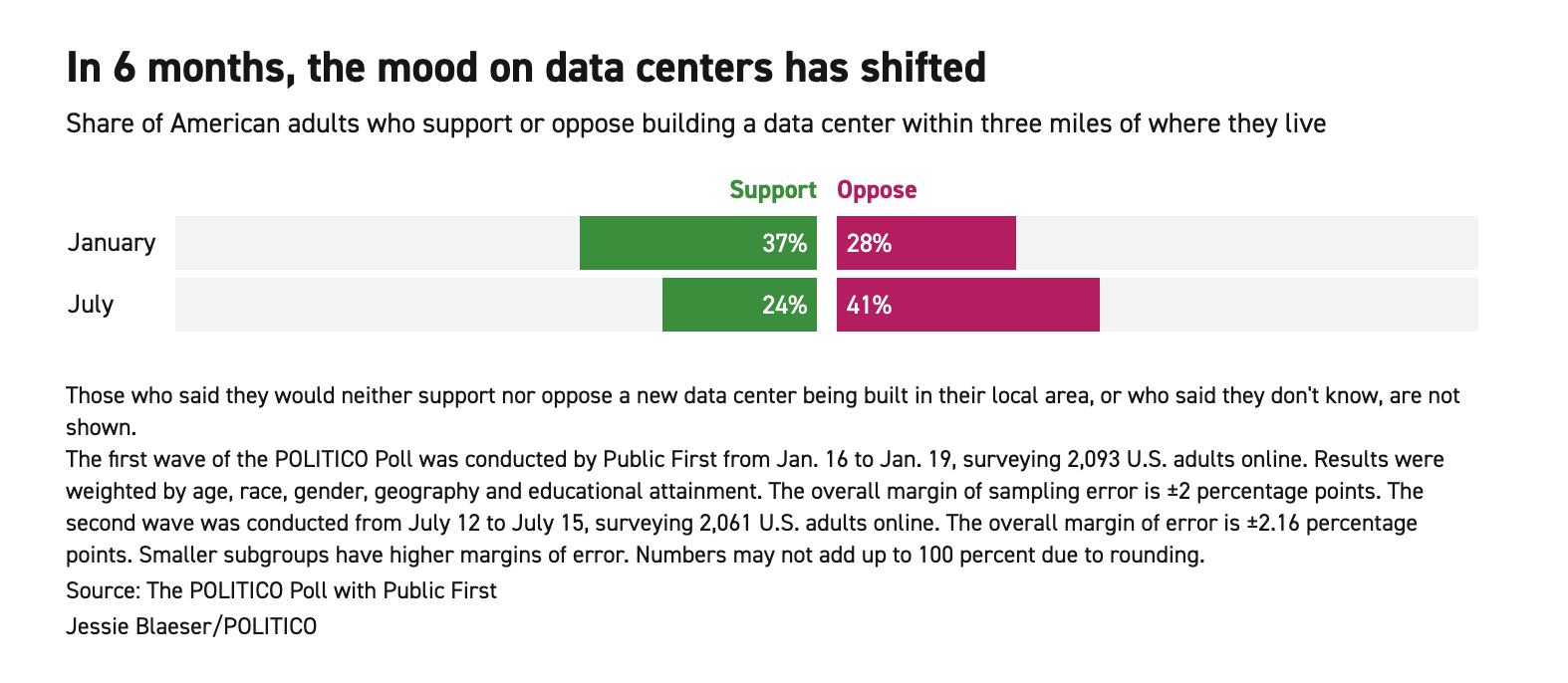
I was thinking about that low water this morning while reading the news. Politico and Public First released a poll on Tuesday as a story about political parties and perceptions. In six months, the country’s mood has turned. In January, 28% of Americans said they’d oppose a data center built within three miles of home; by July, that figure had climbed to 41%, while support fell from thirty-seven percent to twenty-four. The pollster remarked on the rarity of opinions moving this fast on a question usually left stale and partisan.
Interestingly, it’s happening on both sides of “the line” between political divides we’re constantly reminded about in the entertainment-news complex. Among the people who voted for Harris in 2024, opposition reached 53%. Among Trump voters, it rose eight points, from 26% to 33%. Here in South Carolina, Nancy Mace (a self-described MAGA Republican) has endorsed a data center moratorium. It feels as if something’s moving underneath what we’re told is a non-permeable partisan surface in the United States (and Europe in response to data center developments), and it’s moving in the same direction on either side of a line we keep being told not to cross.
The data centers are large windowless warehouses of computation that drink water for cooling and pull power off the grid until the grid strains and the ratepayer’s bill climbs, but they’re almost beside the point in my thoughts here. What fascinates me is the word that drives the argument on “both sides.” Resource. We debate how to allocate the resource, how to price it, and whether the jobs and the tax base are worth the draw on it. The word “resource” does its quiet work before debates begin. To call the river a resource is to have perceived it a certain way... as a quantity held in reserve that is standing by for human use. The water becomes potential-for-something-else. Its own life, the low shoals in July, the salamanders under the cool stones here in the Upstate of SC, the way a river carries the county’s weather down toward the sea, all of it flattened into a number on a permit.
The work I’ve been doing under another term, ecological intentionality, is becoming practical with these types of polls and news. The three-mile figure in the polls here measures nearness. When people say they don’t want this thing within three miles of home, they haven’t been handed a new principle about water rights or grid economics that convinced them.
Something in our group perception has moved or changed over the last few months. The abstractions of “data,” “cloud,” “grid,” and especially “resource” acquired an address. The resource, kept for years at the safe distance of a statistic, has come near enough to be seen as what it always was... water, power, air, and the particular creek behind a particular house. Once a thing has been perceived that way, the human notion of ethics tends to follow on its own volition, almost without argument or process.
Edith Stein spent her early philosophical work on the question of how one consciousness comes to feel its way into the life of another, and she gave that feeling a careful anatomy. It works beneath judgment, as a mode of perceiving by which the other stops being an object in my field and becomes a center of experience in their own right.
The ecological version of this perceiving is what the poll is showing us, dimly and from a distance. People are beginning to feel their way into the watershed, concerned about data centers. Maurice Merleau-Ponty would say the body wasn’t a spectator of the world to begin with, that we perceive from within the same flesh we are trying to see. The river wasn’t over “there,” a resource across the room. We are already standing in it. Most of the time, we forget, and that forgetting is what lets the term “resource” do its work. The poll is a brief record of a few million people remembering something from home, as Le Guin admonished us.
I keep writing about perception and empathy on Carolina Ecology because the usual order runs in the opposite direction. We’re accustomed to being argued into our ethics by preachers or pundits on a cable news show panel or TikTok influencers, and handed a principle, then asked to apply it. An ethics received that way is mostly held a little at arm’s length, always one counterargument away from collapse. “Prove me wrong” culture via social media Reels makes great use of this.
An ethics that grows up out of perception is harder to talk someone out of. There isn’t a premise beneath it for a clever argument to pull loose. It rests on something they’ve seen or perceived. You can’t easily un-see the creek once it has become your creek. Perception before ethics doesn’t postpone or flatten ethics. Rather, ethics is given a root of sorts. And the perceiving is already doing moral work in itself, before a single ought is spoken, because to see the river as a life rather than a reserve is to grant it a standing the old word of resource denied it. The eye that has learned to look that way is doing the work with every glance.
This is the ground that the Ecology of the Cross brings me back to in my dissertation work this year. The Cross is the place where nearness and cost are held together and can’t be pried apart. The Cross is where love shows itself as the willingness to draw near to what will cost you something (not in the Penal Substitutionary Atonement sense). A perception that costs nothing is usually one that has kept its distance. To let the watershed come within 3 miles, to let it become near enough to grieve for, is to accept that seeing it truly will lay some claim on you... on your comfort, your rates, your sense of what progress is owed. The people answering that poll may not know they have taken on a cost. But the movement in the numbers is the movement of a distance closing, and that new distance asks something of us. That doesn’t cross a party line, but is a human movement, and older than any political party in the United States.
The black walnut in our backyard is dropping its first hard, green-husked fruits now (early this year), given the relative dryness of our summer. The walnut draws its water from the same table the river draws from, the same table a cooling tower would draw from if one came. I don’t think most of us decide to care about such things. I think we are brought, slowly and against our forgetting, near enough to see them, and the caring comes on its own once we do. The poll is a small sign that the bringing-near is underway. Perhaps, a Great Turning. The work now is to keep looking, past the three-mile line, until the whole watershed is close enough to be seen.
PUBLIC NOTICE OF AMENDED HEARING/AVAILABILITY SESSION LOCATION AND EXTENDED COMMENT PERIOD
Around three miles from the black walnut and our home, there is already something to look at. The air permit for the NorthMark data center stays open for public comment until July 31st this month, and the Southern Environmental Law Center has already challenged it. A public comment is perception made a matter of record, a way of saying that you have seen the water and will not consent to un-see it. That window closes at the end of the month here, and what little is ours to do, we do now, or we don’t do at all.