


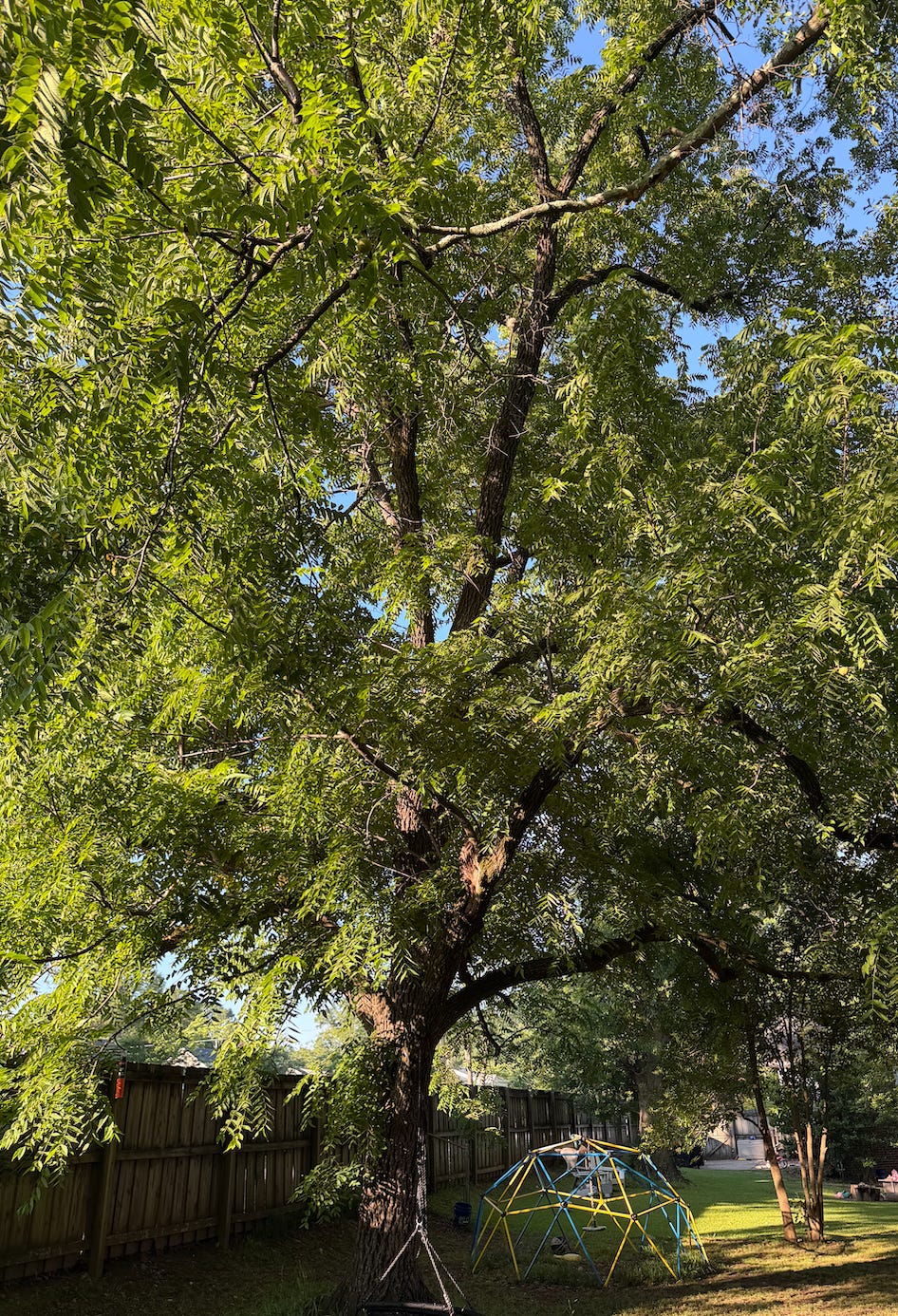
I respect a well-cared-for lawn. The ground beneath the black walnut in our backyard isn’t a lawn per se (and it was never going to be one). I’ve got a green thumb, and when we first moved here, I was perplexed by the understory of this tree that I’ve grown to admire and love. Moss takes the north side of the trunk while violets come up where they want. The grass and anything else that is planted or takes root isn’t so happy with the juglone that the Juglans nigra produces.
By late summer, the seed husks fall and stain our children’s hands the color of old iodine. The tree fixes juglone into its own root zone, the way it casts a shadow over the morning at my beloved sitting spot near its trunk, and the result is a patch of earth that ultimately doesn’t abide by the tidy green expectation we’ve been taught to carry in our eyes before we ever reach the yard. For a long time, I thought of this refusal as a problem to be solved. I’ve spent the better part of these last few years at CIIS in my PhD studies, unlearning that reading.
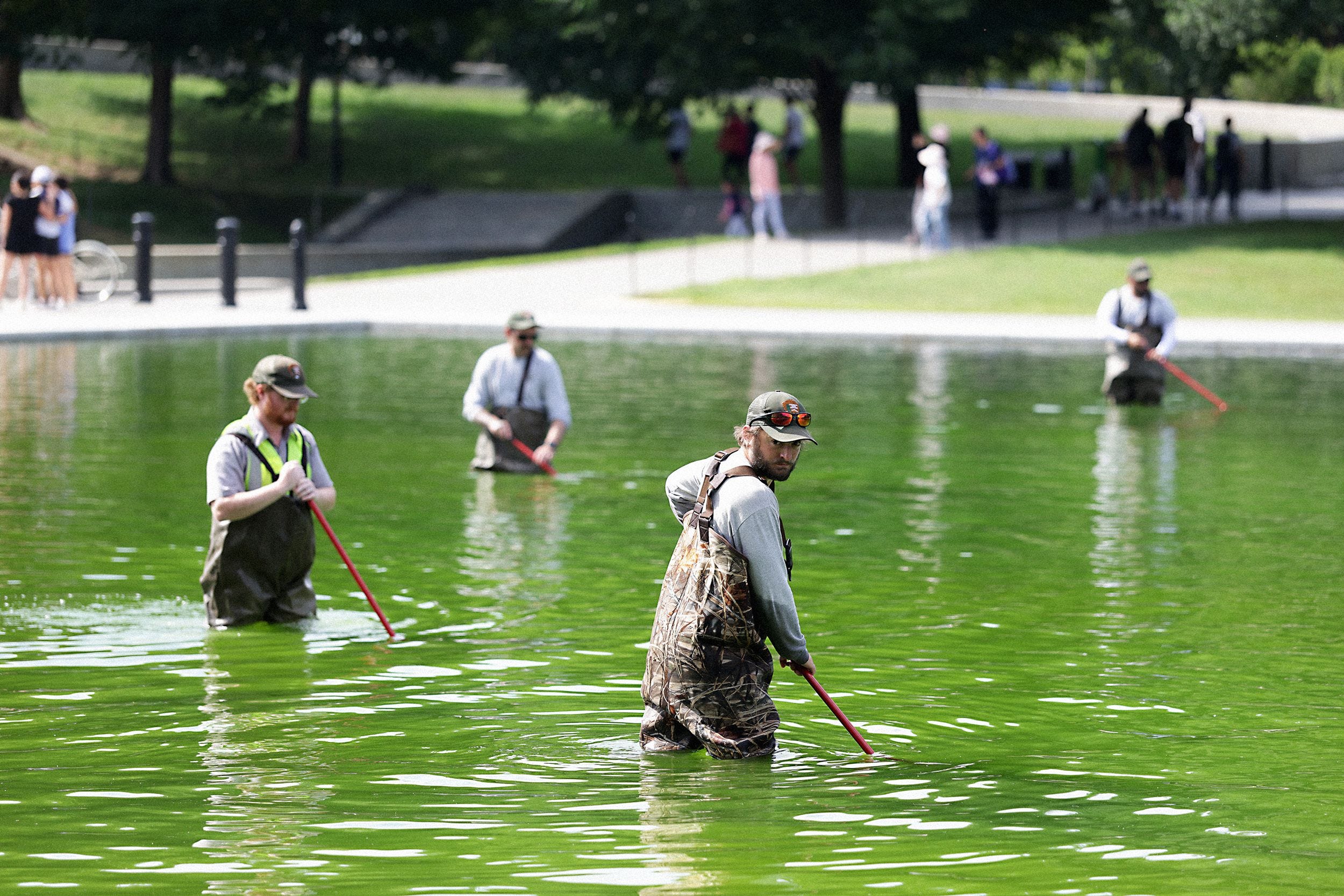
Perhaps it’s all my reading for comps this summer, but I’ve been fixated on the human eye, and about how much arrives already inside the looking and how much it does to shape our perceptions before images reach our brain via the optic nerve (even those with plaque on them like mine). A few hundred miles north of the black walnut in our backyard, the Lincoln Memorial Reflecting Pool has spent the past two weeks turning green again.
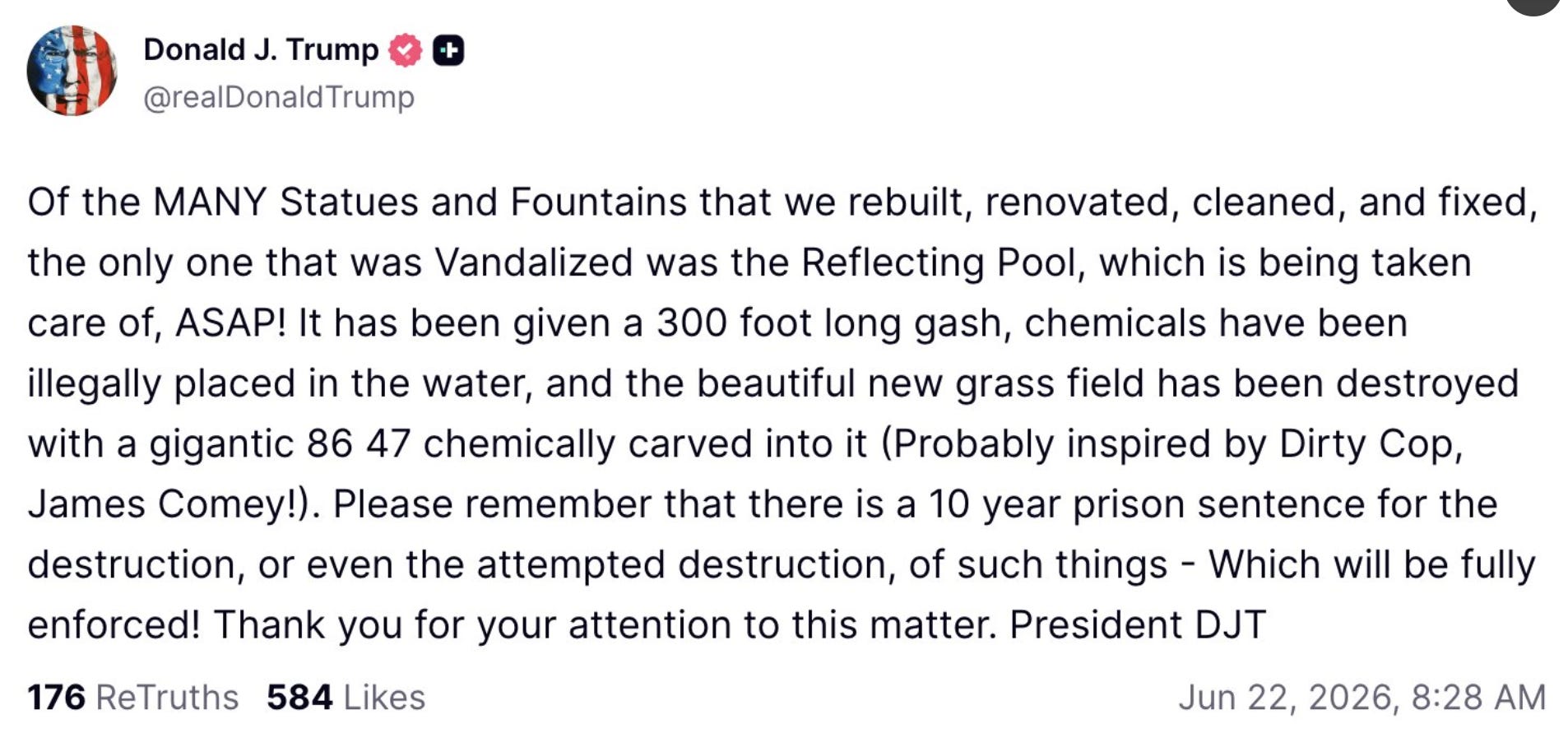
The basin was drained, resurfaced with a darker coating someone decided to call “American flag blue,” and refilled at a cost that has now climbed into the neighborhood of $15 million, all of it timed to the country’s two hundred fiftieth summer (or someone’s 80th birthday extravaganza). Within days of being “fixed,” the water… bloomed. Crews have recently been pouring in 12% hydrogen peroxide, running ozone through the water in clouds of fine bubbles, and vacuuming dead algae off the bottom like a Carolina backyard pool in July. The official language of someone has ranged from filth to sabotage to now vandalism. Scientists, when the press happens to ask them, keep saying the same patient thing with the pool being shallow, sunlit, slow, and now darker than it was, which means warmer, and warm shallow still water full of leftover nutrients is the most ordinary cradle for algae that the summer knows how to make. The bloom isn’t a wound in the system. Rather, an algal bloom is actually the “system” telling the truth about itself, no matter how humanly constructed the container is.
We don’t see green water and then decide it is filth at first. The judgment is already folded into the seeing itself. The pool was asked to hold a fixed and decorative form, a color borrowed from a flag, and when the living water answered with a form of its own, we read that answer as a failure before we had finished perceiving it. In classical and koine Greek, κόσμος (kosmos) means “order,” or the “arrangement” of a world. K/cosmos also means “adornment,” such as the ornament we lay over a surface, which is why our word cosmetic descends from it. The renovation of the Reflecting Pool aligns with the adornment's intent. It wanted the pool to be an ornament, a held image, the monument’s blue mirror straight out of Forrest Gump rather than MLK’s “I Have a Dream” speech. But what the water did was the first meaning, its own order, with the green arrangement shallow warm water arrives at when left to be what it is.
Aristotle comes to mind as I think about neo-classical overlays, adornments, and perception in the District of Columbia. A thing can be in a state of capacity, δύναμις (dynamis), potency, the not-yet, or it can be in the condition of being fully at work as itself, ἐνέργεια (energeia), and beyond even that, in the completeness of having its end within it, ἐντελέχεια (entelecheia), form held in act. The blue coating is δύναμις that was done and called finished, as a potency frozen into a picture, never to move. The bloom is ἐνέργεια, the water at work being water, the basin coming into the only completeness available to a sunlit shallow with no shade and nothing to do with the light but warm under it. We have spent a great deal of public money and public anger insisting that a living surface behave like a painted one, and we have called its living the very name of its disgrace. There is even a small irony buried in the chemistry. The pigment doing the blooming is named for its color, χλωρός (chloros), the pale green that also names chlorophyll and named chlorine, so that the green we are fighting and the green-named element we long reached for to fight it are kin in the same ancient word and concept of our human vocabulary.

Once you have felt that hinge of perception turn its wheel, you start to notice it everywhere, and nowhere more plainly than in the lawn the Reflecting Pool is meant to crown. Before World War II, the most prized component of a good lawn seed mix in this country was clover (which makes my favorite honey). Gardeners judged the quality of a mixture by how much clover it carried. Clover is a legume that draws nitrogen from the air and fixes it into the soil, so the grass nearest the clover grew the greenest, and the bees worked the small white flowers all summer. Then the war’s chemistry came home. 2,4-D, the first synthetic broadleaf herbicide as Weedone, a chemical of half of what would later be sprayed over the forests of Vietnam as Agent Orange, turned out to kill clover along with the (useful and beautiful) dandelion and plantain, indiscriminately, because that is what a broadleaf killer does.
Dow and DuPont couldn’t make 2,4-D spare clover (or didn’t want to invest in the means to do so after grabbing patents that have long since expired). So, they did the cheaper thing. They changed the eye instead of the chemical. Within a few seasons, the advertising had reclassified clover as a weed, a blemish, a thing to be poisoned out of a respectable yard of a respectable family. One of the men who helped discover 2,4-D admitted in print that calling clover a weed would have shocked the older gardeners who once measured a seed mix by its clover content. The “weed” was invented as a perceptual category dressed as a botanical one, and we bought it by the bag (and still do).
A weed, after all, has never been a kind of plant. It’s a verdict we have learned to deliver at a glance, a name for any living form whose shape does not match the image we were sold for those of us looking to be respectable. However, a uniform green carpet isn’t the natural condition of a yard recovering its order (coming from someone who loves golf in theory). A green lawn is a manufactured κόσμος in the cosmetic sense, an ornament held in place by quarterly chemistry and by seventy years of being told what a lawn is supposed to look like. We learned to see clover as filth for the same reason someone or a crowd at the Reflecting Pool learned to see an algal bloom as sabotage. The seeing was trained, and the training served someone.
Which brings the whole circuit home, down the Piedmont to my own watershed, because the green we demand on the lawn and the green we evidently abhor or cheer in the Reflecting Pool aren’t opposites. They’re the same green, fed by the same thing. The nitrogen and phosphorus we spread to keep our lawns uniform and unnaturally bright don’t stay on the grass. They run off the manicured yards of Spartanburg’s beautiful and respectable neighborhoods with the next hard rain, down the gutters and the storm drains, and into Duncan Park Lake, Lawson’s Fork, Fairforest Creek, and our many tributaries in between, where in the slow warm pools of late summer they do what the leftover nutrients did in the Reflecting Pool on the Mall. They bloom.
The fertilizer that gives the lawn its lifeless perfection is the same fertilizer that greens the creek and starves it of oxygen downstream. We poison the clover to hold an image of health, and the chemistry of that image travels to the water and produces, a few hundred yards away, the very bloom we would call filth if it surfaced at our feet or on our neighborhood’s pond. The lawn and the algae are one process wearing two faces. What we kill in the yard, we feed in the creek.
All of which leaves me with a question I’ve been pondering in my “What if I Were Someone?” mode. What if we left it? Not out of neglect, and not because a bloom is harmless, since a bloom in warm and overfed water is a symptom before it is anything else, an index of the nutrients we put there and the heat we keep adding. But the pool was built to reflect, and a surface held blue by chemistry reflects only what we have already decided to see. A surface allowed to green would reflect the watershed (such as the Potomac with all of its troubles) we actually inhabit, the runoff and the warming and the long summer we have made, and it would hold that condition up at the center of the Mall, where the nation goes to look at itself. Truth that meant unconcealment, or ἀλήθεια (alētheia), the state of a thing no longer hidden as frequently referenced in both the New Testament and countless ancient sources. A reflecting pool left to bloom would be ἀλήθεια in the plainest sense, the most photographed water in the country declining to hide its own metabolism. The question is whether we could bear to keep looking at it, and what it would ask of us once we had. Or would we walk away from Omelas? Plant a tree in Thneedville?
The Reflecting Pool bakes in the warm and humid D.C. summers because it has no shade and nothing between it and the sun; the ground under the walnut stays cool and mossy and clovered because it has too much shade and juglone for any monoculture to take hold. The same condition is seen as failure in one place and as refuge in the other, and the only difference is what we came expecting to see. The slow work, the only work I trust anymore, is learning to let perception run the other direction, toward the living form and not away from it... to see the bloom as the water in act, the clover as the soil feeding itself, the unbought ground beneath an old tree as an order rather than a lapse. The Reflecting Pool was built by humans to reflect monuments of human achievement and bravery. What it has reflected instead, all this green and anxious summer, is us, and the demand we have learned to carry in the eye before we ever arrive at the water.