


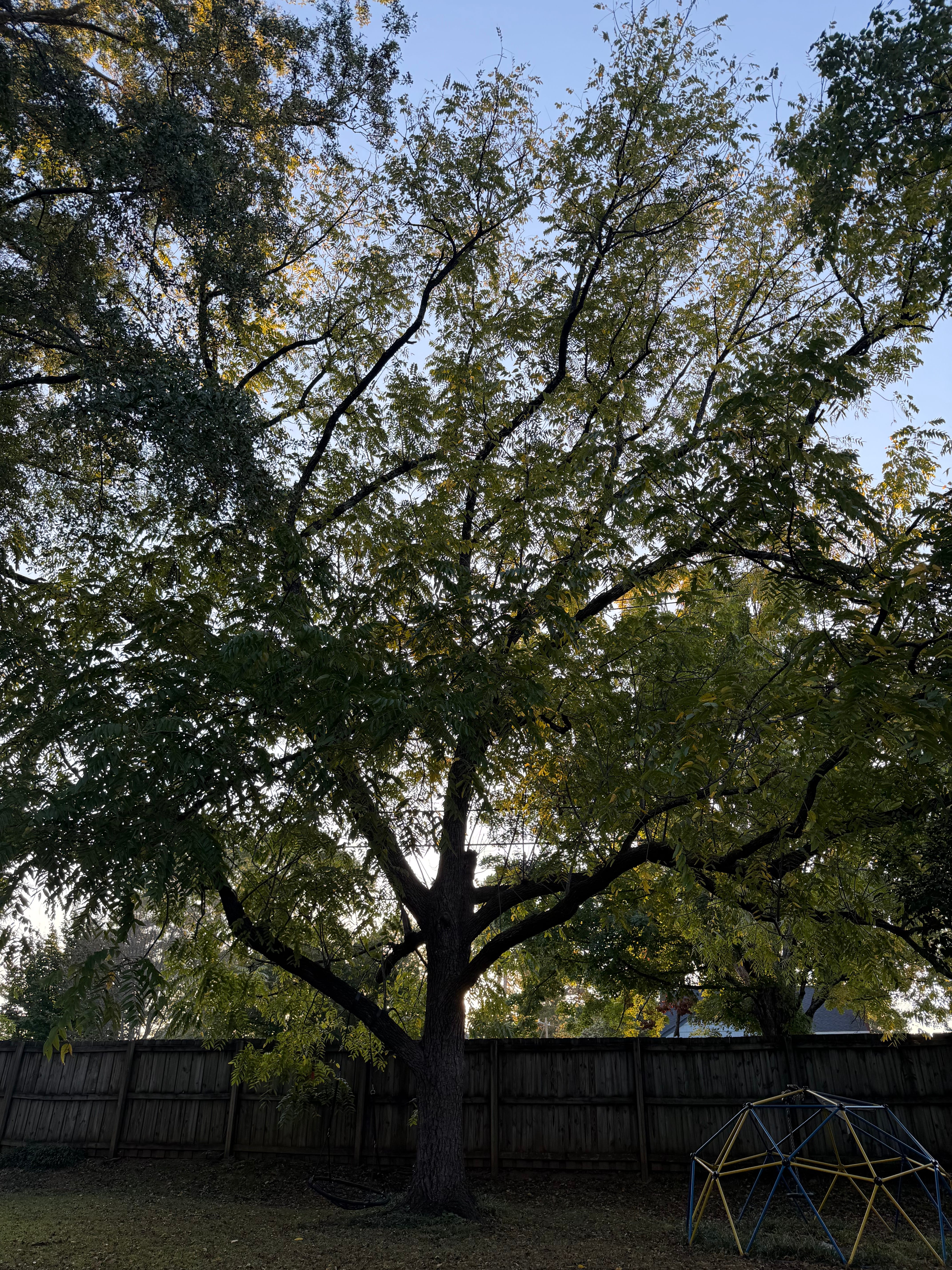
A swing hangs from a branch of the black walnut tree in our backyard.
The swing has a purpose. My children play on it. It’s part of our family’s experience of this place, and I know what we intended when we put it there.
But the branch has a different history.
It wasn’t growing toward the possibility of becoming a swing support. It developed over the tree's life, shaped by years of growth and its relationships with soil, water, sunlight, weather, and the other organisms that share this place.
This morning, I noticed a little gap between the swing’s loop and the branch. I couldn’t tell from looking whether the attachment was causing any harm. But I found myself thinking that I should probably take the swing down for the cooler months, partly out of concern for the tree.
That small moment made me pause and consider form, purpose, intent, and what’s “good” for our family and the black walnut.
The swing has a purpose we gave it. The tree has a life that doesn’t depend on our purposes. Yet those two histories have become entangled in the same backyard.
And I wonder whether that tells us something about the way we understand our relationship with the world.
The world is not waiting for our intentions
We spend a great deal of time imagining the world as something toward which we direct our attention, intentions, and plans.
We decide what land is for. We decide how water should be used. We construct neighborhoods, highways, businesses, and churches according to purposes we’ve already established.
Of course, we have to make decisions. Human communities can’t exist without intentions and plans.
But there’s something peculiar about imagining that our intentions come first and the world comes afterward, as though the living relationships that make our communities possible are merely resources waiting to be organized.
A watershed doesn’t begin with a development proposal. A forest doesn’t begin with our designation of land as property. The lives of other creatures aren’t suspended until we decide whether they’re useful, beautiful, inconvenient, or worth protecting.
Those relationships are already underway.
And so are we, within them.
This is one reason I’ve been developing a philosophical idea called ecological intentionality as part of my doctoral research at the California Institute of Integral Studies.
The central proposition is this:
Ecological intentionality doesn’t begin by asking how consciousness possesses the world, but how consciousness comes to be through relations with a world it can never possess.
I’m asking whether our consciousness and shared purposes are formed through relationships with other beings, including beings that don’t share our intentions or even our forms of consciousness.
A tree doesn’t have to intend what I intend to participate in the conditions of my life.
And perhaps the relationship goes deeper than we ordinarily recognize.
More than knowing we’re connected
We’ve become pretty comfortable saying that everything is connected.
And that’s true in important ecological ways. Water moves across property boundaries. Soil and vegetation participate in cycles that sustain other lives. Decisions made in one place can have consequences far beyond the people making them.
But I think there’s a larger question here.
What if ecological relationships don’t merely influence the decisions we make, but participate in forming the very possibilities from which our intentions arise?
That’s a stronger philosophical proposal, and I haven’t demonstrated it merely by sitting beneath a walnut tree.
My intention to remove the swing could be explained through ordinary concern, learning, and changing judgment. And whether removing it actually benefits the walnut depends on the tree’s condition, not merely on my good intentions.
Those are important distinctions to consider.
Still, I think we need to investigate whether consciousness is something we possess independently and then direct outward, or whether the world has been participating in its formation all along.
Philosophers, ecological thinkers, and Indigenous scholars have been exploring versions of these questions for a long time. I’m not claiming to have discovered interconnectedness or relational consciousness.
I’m trying to understand what more remains to be said about intentionality when the lives around us aren’t reduced to what they mean for us.
What would this change in the Carolinas?
I think about this whenever we discuss development, water use, land conservation, or the future of our communities.
The familiar question is often: How can we accomplish what we want while minimizing the environmental consequences?
That’s an important question.
But what if we began with a different one?
How might the ecological relationships that already sustain this place change what we understand our purposes to be?
That doesn’t eliminate the need for development, infrastructure, or economic decisions. It asks us to examine the assumptions beneath those decisions.
What would it mean for a neighborhood to understand itself as part of a watershed rather than merely a collection of properties?
What would it mean for a church to understand its grounds not only as land to maintain, but as a place where other lives unfold alongside the congregation’s own?
What would it mean for a community to consider whose lives, histories, and vulnerabilities have been excluded from its definition of progress?
Those questions require ecological science, historical knowledge, and serious attention to who bears the consequences of our decisions. Philosophical reflection alone can’t answer them.
But philosophy can help us recognize that the purposes we’ve inherited aren’t necessarily the only ones available to us.
An ecology of the cross
This work has a theological dimension, too.
My larger project is called The Ecology of the Cross. It grows out of Christian questions about creatureliness, participation, incarnation, vulnerability, and what it means to live faithfully in a world we didn’t make.
I keep returning to the possibility that belonging doesn’t mean possession.
Christian faith offers resources for thinking about received existence, humility, divine solidarity, and refusing to treat power over others as the highest expression of life.
The cross isn’t a metaphor that makes ecological suffering good. Nor does the fact that creatures depend on one another mean their interests always harmonize.
Rather, I want to ask what spiritual communities might become if they understood themselves as participants in creation rather than its owners.
That’s a question worth bringing into worship, education, property decisions, mission, and community life.
And it can enter a much wider conversation with other spiritual traditions and ways of understanding our relationships with place.
Still learning from a tree
I’ve been sitting with this particular black walnut nearly every day since September, recording observations and testing philosophical ideas against what I actually encounter.
Some mornings have produced new questions. Others have forced me to reconsider assumptions. And some have been wonderfully ordinary.
The walnut isn’t there to validate my philosophy. It has its own life, which is part of the point.
But returning to the same place has helped me formulate a question that I think matters well beyond our backyard:
What becomes possible for our communities when we allow the lives and relationships that sustain us to change not only how we accomplish our purposes, but what our purposes might become?
I don’t think ecological crises will be addressed by better intentions alone. They certainly haven’t so far given mainstream political, religious, civic, or public discourses, sermons, or campaign speeches in this election season.
Perhaps we also need to reconsider where our intentions come from.
Read the larger philosophical argument: I’ve written a new constructive essay based on all of this that goes a little deeper into the philosophical and theological sides, Consciousness in a World We Cannot Possess, at Ecological Intentionality this morning. It’s part of my ongoing Black Walnut Field Notes, where I’m developing these ideas through daily encounters, philosophical reading, and theological reflection.
First, the seeing. Then, the keeping. And now, the creating.