


I updated my academic CV this weekend. That’s usually the sort of task I do that falls between cleaning up a bibliography and organizing a desk drawer. Add a paper, change a date, move a presentation into the right section, upload the new PDF, and get back to the actual work.
This time felt a little different, though.
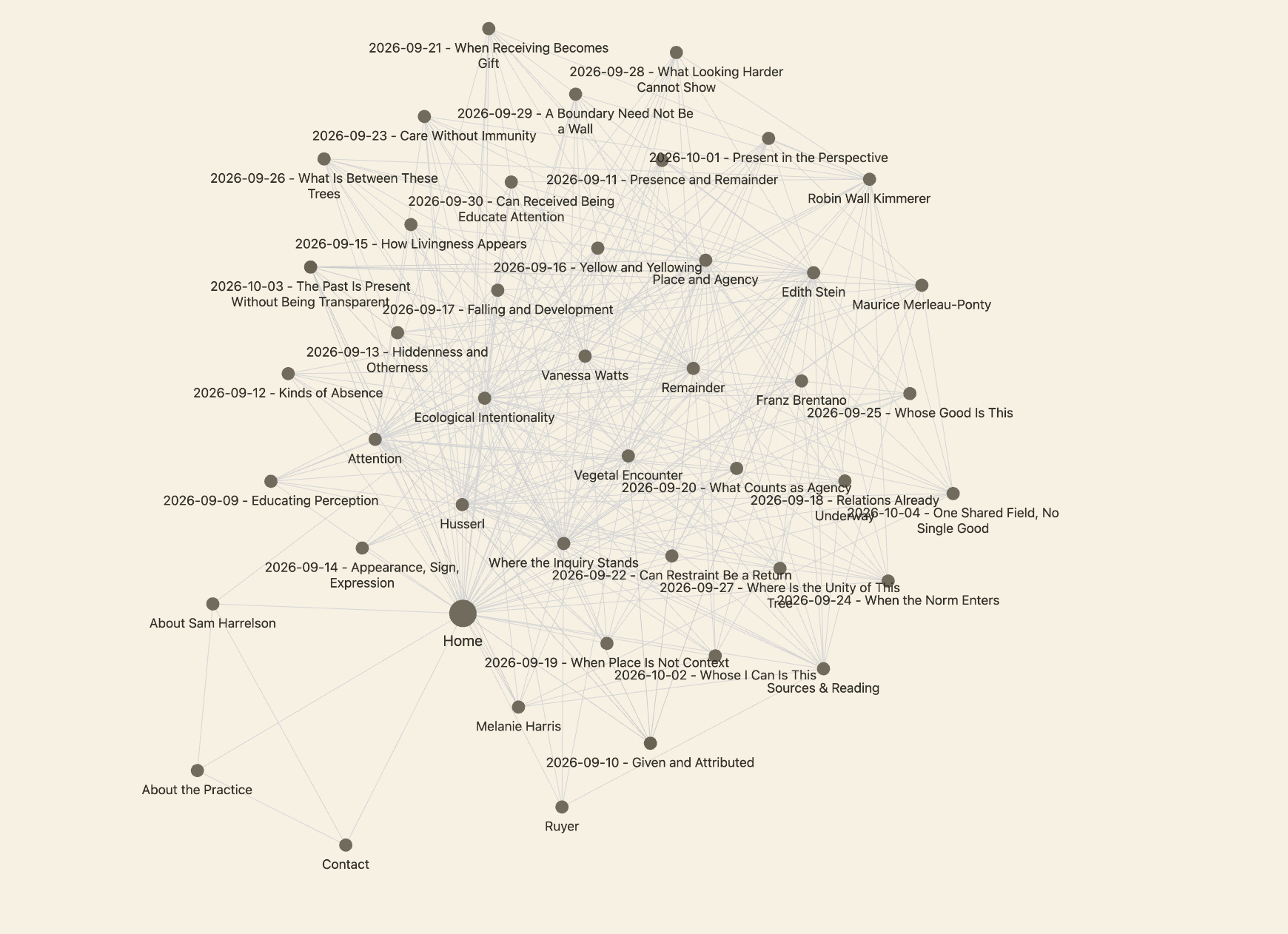
Looking over the last few months, I realized that several projects I’ve tended to think about separately have begun to converge. My doctoral work at the California Institute of Integral Studies, writing here at Carolina Ecology, preaching and teaching, questions about water and development in Spartanburg, public work around children and neighborhoods, and a daily practice of sitting beneath a black walnut tree behind our house are increasingly asking versions of the same question.
How do we learn to inhabit a place well enough to perceive what is actually happening there?
That question has become central to what I’m calling ecological intentionality. In the most basic sense, I’m interested in what happens when the directed life of another creature becomes perceptible to us without being reduced to our own needs, categories, or expectations. A tree isn’t just shade, lumber, carbon storage, habitat, property value, beauty, or symbol. It can, and does, participate in all of those relationships, of course, but none of them exhausts what the tree is or what it is doing in the world.
The same problem appears at larger scales. A watershed can become a utility while a forest can become acreage. Neighborhoods can become parcel maps and zoning prospects. A creek can become drainage infrastructure. A community can become demographic data in a high-stakes election year. Even the word environment can subtly suggest a stage surrounding the human actors who supposedly occupy the center (one reason I push back on the term, as well as “nature”).
We need those categories. I’m not arguing that maps, measurements, policies, engineering studies, or ecological models somehow prevent us from seeing the world. Quite the opposite. Good knowledge can teach us to notice relationships we would otherwise miss. But every way of knowing also brings something into focus while leaving something else at the edges.
The question is whether we remember the edges are still there.
That has become especially vivid through the Ecological Intentionality Field Notes I began this fall. Most mornings, I spend twenty or thirty minutes sitting with a mature black walnut behind our house in Spartanburg. I take a photograph, listen, watch what is happening around the tree, and carry questions from whatever I’m reading into that encounter.
Some mornings involve Edith Stein and empathy. Others involve Husserl and perception, Aristotle and living form, Robin Wall Kimmerer and gift, or Maurice Merleau-Ponty and the strange intimacy of inhabiting a world we can never stand outside of and survey from above.
And some mornings involve rain, squirrels, falling walnuts, yellowing leaves, mosquitoes, or a branch dropped by a storm.
Those mornings have been useful correctives.
It’s easy for ecological language to become beautiful too quickly. I can sit beneath a tree and begin talking about reciprocity, gift, communion, belonging, or kinship. Then a storm tears away a limb, or one organism thrives at another’s expense, or human needs collide with another creature's, and the language has to be accountable to the world again.
That has changed one of the questions I’m bringing to this work. Attention is important, but better apprehension isn’t yet adequate care. Seeing another creature more clearly doesn’t automatically tell us what we owe it. Recognizing that organisms belong within shared ecological fields doesn’t erase the fact that their goods can differ and sometimes conflict.
A black walnut wants things that I don’t want.
That sounds almost comically obvious, perhaps. But current ecological rhetoric sometimes makes it surprisingly difficult to say. We often move quickly from interconnectedness to harmony, as if belonging together means wanting the same outcomes. It actually doesn’t. Roots compete while trees shade one another. Predators eat prey. Humans need houses, schools, roads, electricity, water, and places to work. Other creatures are trying to continue their own forms of life in those same places.
So the ecological question can’t only be whether everything is connected. We already know that.
The harder question is what kinds of attention, judgment, restraint, reciprocity, and public decision-making might allow different forms of life to flourish in a world none of them possesses alone.
That’s where this increasingly feels like Carolina work to me rather than only dissertation work.
I’ve been writing here about the rapid growth of data centers and the demands they place on electricity, land, and water. I’ve been paying closer attention to development and water use in Spartanburg County. I recently spoke at a South Carolina Legislature public hearing about children’s well-being, housing, transportation, green space, environmental exposure, and neighborhood stability. Earlier this year, I preached about watersheds and what our communities ask of water.
Those can look like different subjects. But increasingly, I don’t think that they are.
A child experiences a neighborhood as a whole long before a planning document separates housing policy from transportation, schools, tree canopy, water infrastructure, and environmental health. A creek doesn’t recognize the boundary between a development parcel and the property downstream. A tree’s roots don’t stop at the conceptual categories through which we manage land. The electrical demand of a data center becomes part of a landscape somewhere, even when the servers themselves appear almost placeless from the browser window.
Place keeps putting the pieces back together.
That may be one reason I’m becoming more interested in attention as an ecological practice. Attention isn’t passive observation. It’s a discipline of becoming corrigible before a world that exceeds the story we arrived with.
Sometimes that means learning to see something we’ve overlooked. Sometimes it means discovering that a cherished ecological metaphor doesn’t survive contact with an actual organism. Sometimes it means listening to people whose histories and needs disclose a place differently than our own. And sometimes it means realizing that the language of sustainability can conceal as much as it reveals if we never ask whose water, whose land, whose energy, whose neighborhood, and whose future are being sustained.
I don’t have a tidy method for resolving all of those questions. In fact, the last few months have probably made me less interested in tidy resolutions.
What I do have is a growing conviction that ecological thought has to remain answerable to places.
Not “place” as a romantic abstraction, but this creek, this walnut, this neighborhood, this watershed, this child walking to school, this development proposal, this summer afternoon when the grid is strained, and the air is heavy with humidity.
The academic language I’ve been developing gives me some tools for thinking about those encounters. Ecological intentionality asks how another life becomes present without being absorbed into our own horizon. The Ecology of the Cross asks what we might have to relinquish before we can receive that presence without immediately turning it toward possession or use.
But the concepts don’t get the final word. The place, and currently the black walnut, does.
That may be what I noticed while updating my CV. The work I’ve been doing isn’t becoming more coherent because I’ve finally found one theory that can organize everything else. It’s becoming more coherent because the same places keep asking the questions back.
A black walnut stands behind our house. There’s a watershed beneath Spartanburg. There are children growing up in neighborhoods shaped by decisions being made right now. Forests, streams, farms, substations, highways, churches, schools, server racks, and people are trying to make lives together across the Carolinas.
The work is becoming a place.
And I’m increasingly interested in what happens when we stay long enough to be changed by what we learn to see.