


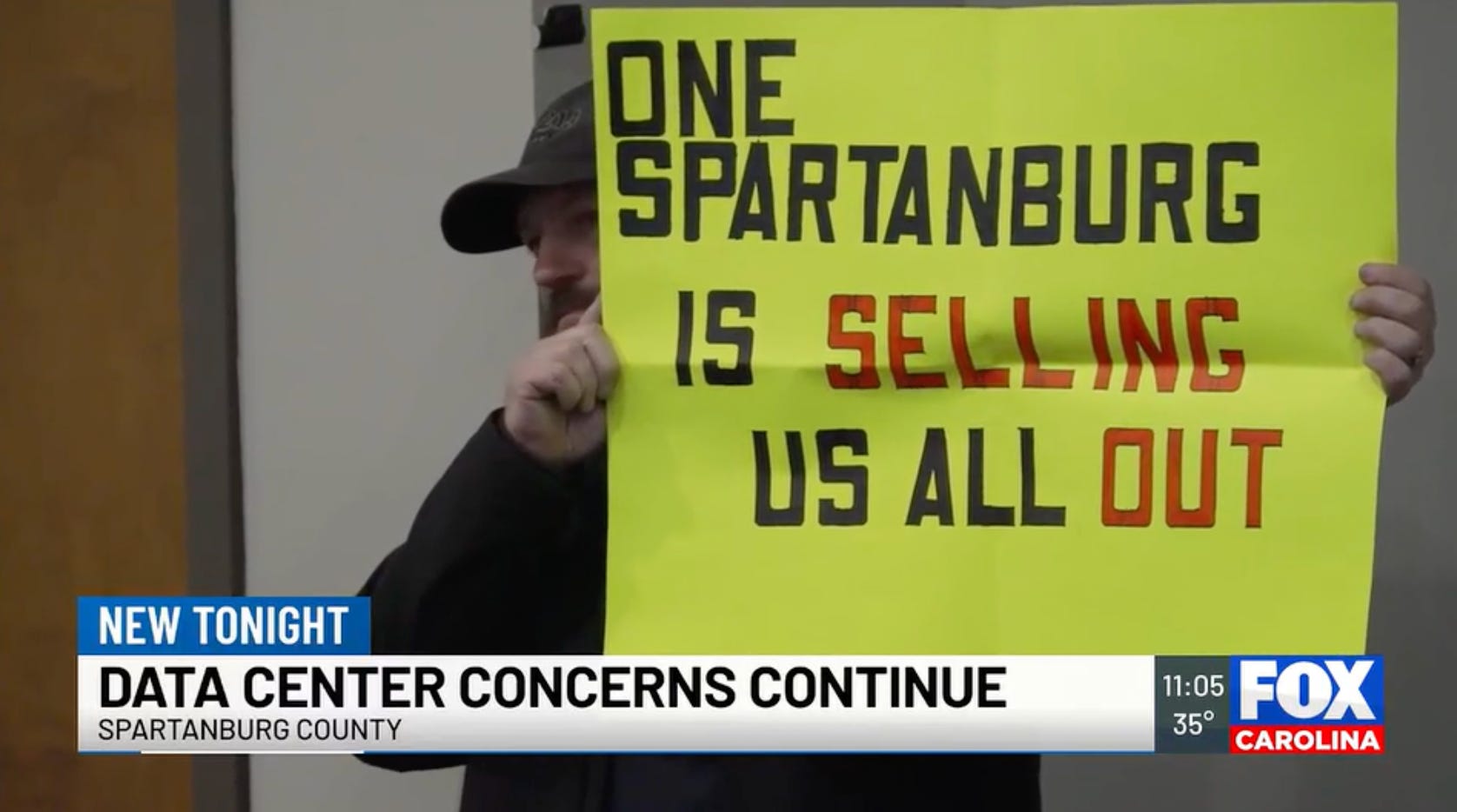
There are moments when a place begins to notice itself. Not in the abstract sense of policy or planning documents, but in the more immediate and embodied way that happens when people show up, sit together for hours, and refuse to leave until they are heard. That happened this week in Spartanburg (Fox Carolina).
The County Council meeting lasted over 3 hours, and the room remained full. People waited through agenda items that had nothing to do with why they came, holding their place for public comment, staying attentive long past the point where most meetings empty out. Many of them were there because of data centers and the growing sense that something significant is unfolding in this region without the kind of shared visibility that meaningful decisions require.
What’s important here is that data centers were not even formally on the agenda. And yet they surfaced anyway, through side conversations, through tension in the room, through the accumulation of questions that had not found a place to land in official channels. By the time public comment finally opened late into the evening (I imagine the County Council officials had hoped for a thinner crowd as they moved through the more tedious business at hand), the tone shifted toward something more focused and deliberate. People were paying attention in a sustained way that felt different.
What People Are Actually Asking
If you listen carefully to the video linked here and the news report, the questions being asked are not especially complicated and are not driven by simple resistance to technology. They are rooted in time and in the lived experience of inhabiting a place.
Some of the proposed agreements tied to these projects span decades, with tax structures and infrastructure commitments extending 40 years into the future. That is not an abstract horizon. That is something that shapes the lives of multiple generations in a community.
There is also a noticeable shift in who is showing up. Meetings that once drew only a handful of regular attendees are now filled with residents seeking to understand what is happening, asking questions about water, energy, land use, and governance. That change in attention matters as much as any vote that might eventually take place.
What is emerging is not simply opposition to a single project. It is a recalibration of perception. People are beginning to notice the systems that quietly shape their daily lives, systems that have long remained out of view.
The Ecology Beneath the Conversation
One of the things I keep returning to in my own work in the Religion and Ecology PhD Program is that ecology is not limited to forests, rivers, or species. It is about relationships that persist over time, often below the threshold of everyday awareness.
Infrastructure is ecological in this sense. Water systems, electrical grids, land-use patterns, and industrial developments all participate in a single web of relationships. Data centers, especially at the scale being proposed across the Southeast, are not neutral additions to a landscape. They are metabolically intensive systems that draw on water, energy, and land in ways that extend far beyond their physical footprint.
Much of that metabolism remains hidden, and that hiddenness is part of what people are responding to. The concern is not only about the presence of these facilities, but about the opacity surrounding them. When residents ask for transparency, they are not simply asking for more documents or technical briefings. They are asking to be included within the time horizon of decisions that will shape their environment for decades.
Patterns, Not Projects
Another detail that continues to surface in these conversations is that people are already thinking beyond a single proposal. There is an awareness that one project rarely remains one project, as we’re seeing two more proposed data centers now in Spartanburg.
Industrial patterns tend to replicate. One site becomes two, two becomes a cluster, and, over time, a new kind of landscape emerges, layered atop existing ecological and social systems. By the time that pattern is fully visible, much of it has already been set in motion.
This is part of why the intensity of public engagement matters right now. These are early moments, even if they do not feel early. There is still, however narrow, space for communities to shape how these patterns unfold.
Staying in the Room
There is something almost liturgical about a meeting that lasts for hours and yet remains full. People sit through proceedings that test their patience, not because they expect immediate results, but because being present becomes part of the work itself.
Speaking during public comment is one piece of that. But so is listening. So is watching how decisions are framed, how information is shared or withheld, how time is structured within the meeting itself. This is how a community begins to understand its own processes, not in theory, but through lived participation and shifting perceptions.
A Different Kind of Development Question
The question before Spartanburg is not simply whether data centers are good or bad. That framing is too narrow for what is actually at stake.
The deeper question is whether communities can cultivate forms of attention that match the scale of the systems now arriving in their midst. Whether decision-making can slow down enough to include those who will live with the consequences. Whether ecological costs, not just economic projections, can be held within the same field of consideration.
Recent decisions to delay or reject incentives tied to large data center proposals suggest that something is shifting, even if the long-term trajectory remains uncertain.
What happened this week was not a resolution. It was something quieter, but in some ways more important.
People stayed.
And in staying, they began to see more clearly what has been here all along.
On another topic…
American Rivers presented the 2025 dam removal results. The Catawba has 11 hydropower Duke dams that prevent passage or make mincemeat out of aquatic creatures.
Almost every other state, particularly in the NE, had good removal numbers. North Carolina including the Catawba had nothing to show.
Do you have any intel on this? (I’m finishing up my essay on why Helene landed so hard in my area- Black Mountain.)
So well observed and expressed 🌱🌿💚