


There’s a dam down the hill from my house in Spartanburg that forms a beautiful lake. We walk there often, and my children love seeing the ducks and minnows on the edge of the shore. On certain mornings, especially when the light comes in low through the pines and the red clay holds onto the night’s dampness, it’s hard not to feel that the landscape itself is holding something just beneath the surface that’s not hidden, exactly. More like waiting.
We don’t have to reach far, geographically or imaginatively, to encounter the underworld.
It’s in the sediment and water pooled behind that dam. It’s in the anaerobic soils where roots and fungi carry on their exchanges out of sight. It’s in the slow decomposition of leaves that fell months ago and are now becoming something else entirely. Death, here, is not an abstraction. It is a process that sustains the visible world.
And yet, we carry stories... old ones... about what it means to go down into death and come back.
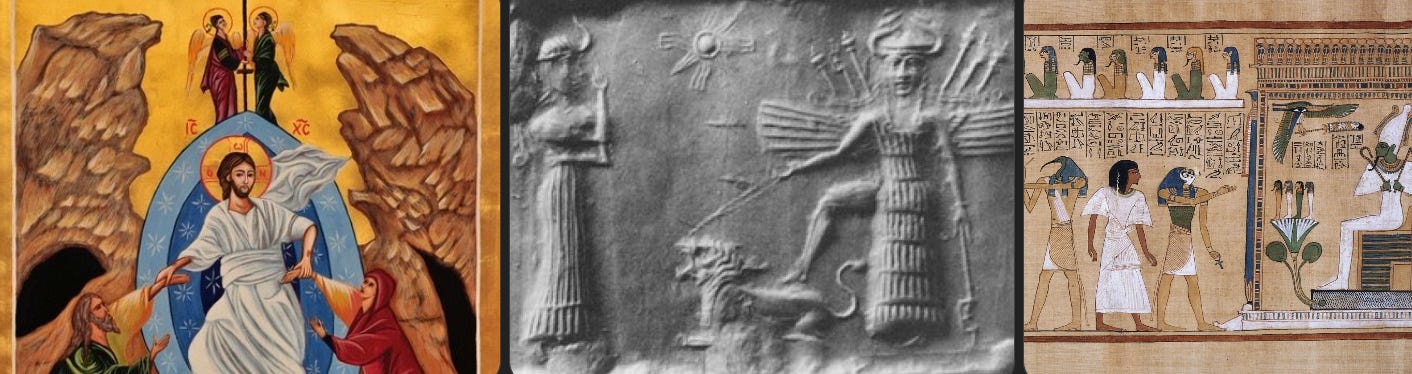
The Christian tradition gives us the Harrowing of Hell, that strange and powerful image of Christ descending into the realm of the dead, not to visit but to break something open. In the old icons, he stands over shattered gates, reaching down and pulling Adam and Eve up by the wrists. It’s not a negotiation or a cycle, but more like a rupture. Death, in that moment, is not simply part of the order of things. It is overcome.
But that is not the only story we’ve told ourselves.
Long before those icons were painted, Inanna passed through seven gates into the underworld, stripped of everything that made her who she was, until nothing remained to rescue her sister. However, she didn’t conquer death. She was undone by it, and only through a fragile exchange was she allowed to return. In Egypt, Osiris did not escape the underworld at all. He became its center, holding together the continuity between death and life as part of a larger order as its overseer. In Greece, Orpheus almost succeeded in bringing Eurydice back, but failed at the threshold, turning too soon (much like Lot’s wife), losing her again in the act of looking.
These stories do not agree with one another, but they return to the same intuition that to live fully is to be entangled with what lies beneath, and descent is not optional.
What shifts, and what matters, is what we believe happens there.
In the Carolinas, we are surrounded by forms of descent that we rarely name as such. Our rivers are dammed, slowed, and forced into holding patterns where silt gathers and oxygen thins. Our forests, particularly here in the Piedmont, grow out of soils that are already the remains of earlier worlds... agricultural exhaustion, erosion, regrowth. Even our weather, with its long humid summers and sudden storms, carries the sense that the boundary between life and decay is thin and constantly negotiated.
If we read the Harrowing of Hell as a story of total victory over death, it can be a heavy read in a place like this, where death is so clearly part of what sustains life. The black walnut in my backyard does not defeat death. It depends on it. Its roots extend into soil structured by generations of decay and exchange. The fungal networks beneath it move nutrients not in spite of death, but through it.
So the question becomes harder and more interesting.
What does it mean to speak of breaking the gates of hell in a world where those “gates” might also be the conditions for life?
One way forward is to take the Harrowing less as a biological claim and more as a perceptual one. Before it is a statement about what happens after death, it is a claim about what death is allowed to mean. In the icon, Christ does not erase the underworld or conquer it… he enters it and stands within it to preach. But something about its structure no longer holds.
The gates are broken not so that death disappears, but so that it is no longer closed.
Because what we face in places like Spartanburg is not death in the abstract, but forms of enclosure. A dam that turns a river into a holding basin. A data center proposal that treats water and energy as resources to be locked into extraction cycles. Systems that assume the underworld... the unseen layers of soil, water, atmosphere... are there to be used without consequence.
Those are, in a very real sense, gated worlds.
And the question is whether we imagine our task as overcoming them entirely or as learning to move within them differently.
The older myths suggest that descent is something to be endured, navigated, or accepted as part of a larger pattern. The Harrowing suggests that something in the structure of death itself can be opened.
I’m not convinced those are exactly opposites.
Standing by the creek here in our neighborhood, watching the water move more slowly than it should, it seems more likely that what we need is not a rejection of descent, but a refusal of its closure. Not an escape from the underworld, but a reconfiguration of how we inhabit it.
That might mean removing dams where we can (and should). It might mean rethinking how we draw water and power from the systems we depend on. It might mean something as simple as paying attention to what is already happening beneath our feet, or as difficult as paying attention to what is already happening beneath our feet.
Because the underworld is not somewhere else.
It is here, in the soil, in the water, in the slow work of decomposition and renewal.
And whatever it means to speak of resurrection in a place like this, it will have to begin there... not above it, not against it, but within it.