


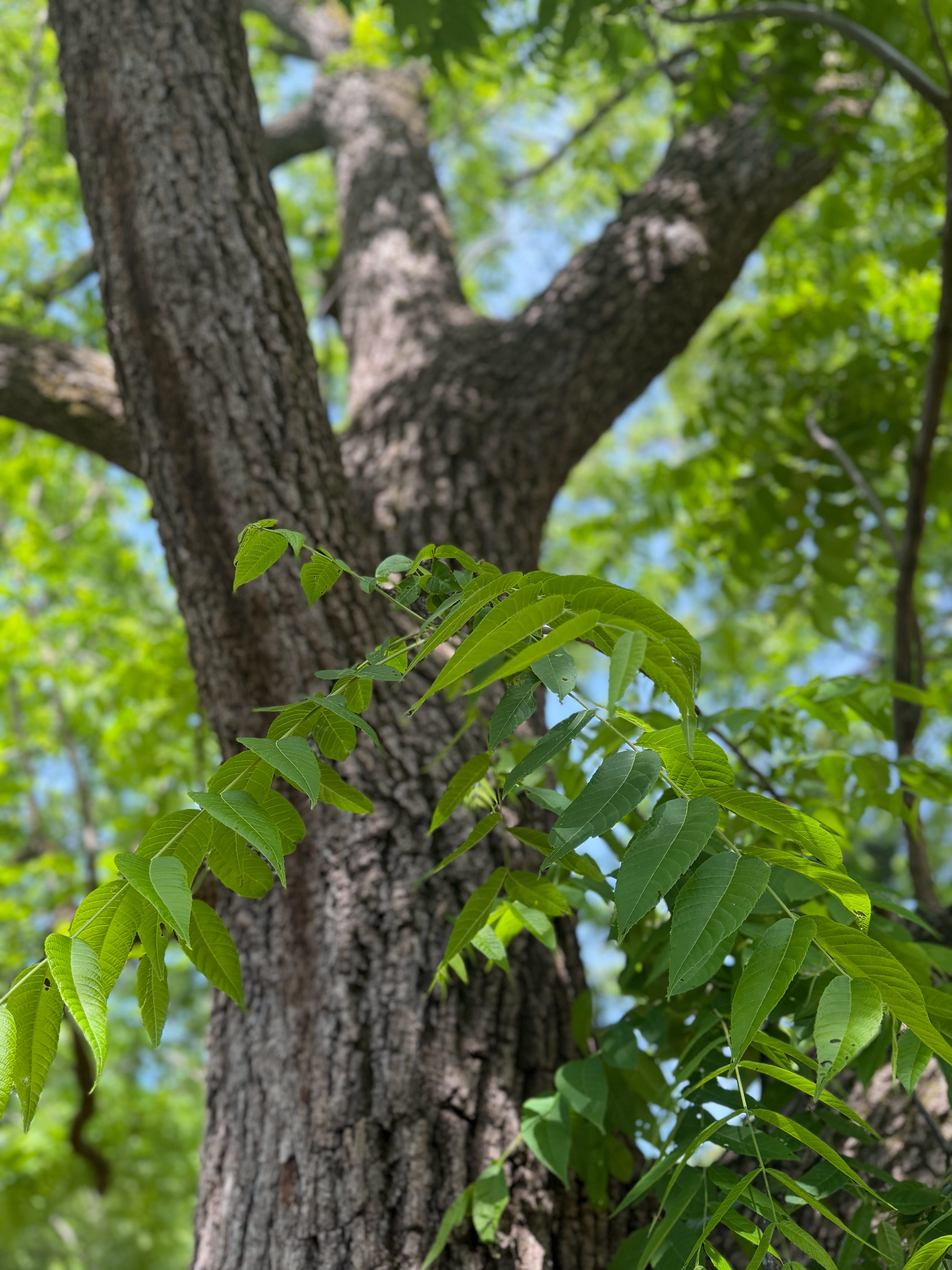
I’m delighted that the trees here in Duncan Park have filled in again. The red maples, beloved oaks, sweetgums, tulip poplars, and black walnuts have moved from the tentative green of early spring into something thicker and more confident. The roadsides have become unruly in the best way with Queen Anne’s lace, clover, violets, and grasses rising in the margins where mowers have not yet flattened them into compliance. The air feels different now, too. It’s heavier and more inhabited. The evenings carry that particular Upstate dampness that makes every sound seem closer than it was in February, even though we’ve had low relative humidity lately.
After rain, especially after dry weeks, the Piedmont knows how to perform abundance. But that performance can mislead us.
One of the habits I am trying to unlearn in my own ecological attention is the assumption that green equals well. We are deeply trained to read greenness as health, as recovery, as restoration. A brown yard signals trouble. A green yard signals success! A full canopy suggests resilience, and a swollen creek after rain suggests replenishment. We look at the surface and assume the system beneath it has returned to balance. Maybe I’ve been reading too much Hildegard and her wonderful concept of viriditas.
But the world is often more complicated than that.
The recent rains across South Carolina have certainly been welcome. You can feel it in the garden soil and see it in the leaves. Farmers and growers across the state have needed it, and the first good soaking after a dry stretch carries a kind of bodily relief. The dust settles while the plants lift themselves. Even the birds seem to sing with more gusto. The human nervous system seems to unclench a little when rain finally arrives after weeks of watching forecasts and clouds that do not deliver. We all certainly need that these days.
But rain is not the same thing as repair.
A very dry spring does not disappear because we had a wet weekend. Drought doesn’t end in the imagination simply because the yard turns green again. The deeper question is not whether the leaves look alive (and they certainly do). The question is what the soil has been asked to endure, what the roots have had to negotiate, what creeks have carried too little for too long, and what kinds of pressure will follow now that heat and moisture are arriving together.
This is where mid-May becomes such a revealing season in the Upstate. It is beautiful, but not simple. The same rain that brings relief also brings potential rot, fungus, insects, and disease pressure in fields and gardens. The same humidity that makes the woods smell alive also creates the conditions for other forms of stress. The living world doesn’t move from scarcity to abundance in a straight line. It moves through entanglement. Moisture returns, and with it come both healing and vulnerability.
We could learn something from that.
We tend to want ecological stories to resolve quickly. Drought, then rain. Damage, then recovery (especially in the aftermath of storms like Helene). Extraction, then mitigation. Development, then offset. The pattern is familiar because it is so common in public discourse about land use in the South. Something is taken, but something else will be added. Trees are cut down and removed, but landscaping will be installed. A watershed is burdened, but the impact will be managed. A data center requires water and power, but “efficiency” will be improved along with our ubiquitous access to cutting-edge AI, promising a better life. A road is widened, but traffic will flow. A field is cleared, but growth is on the way.
There is always a promise that the system will absorb the wound. But the land keeps a different kind of perspective, I believe.
The Piedmont is not a blank surface on which we place our projects, like a game of SimCity. It is old, worn, eroded, beautiful, and still living while echoing its ancient past and the many people who have lived among these hills and creeks. Its red clay remembers forests, Cherokee hunting grounds, farms, textile mills, highways, subdivisions, churches, schools, creeks, and the long history of people treating land as background rather than participant. When rain falls here, it does not fall onto abstraction. It falls onto compacted yards, wooded ravines, kudzu edges, storm drains, construction sites, school playgrounds, church parking lots, farms, and the thin green borders left between one human claim and another.
To pay attention in mid-May is to notice how much is happening at once.
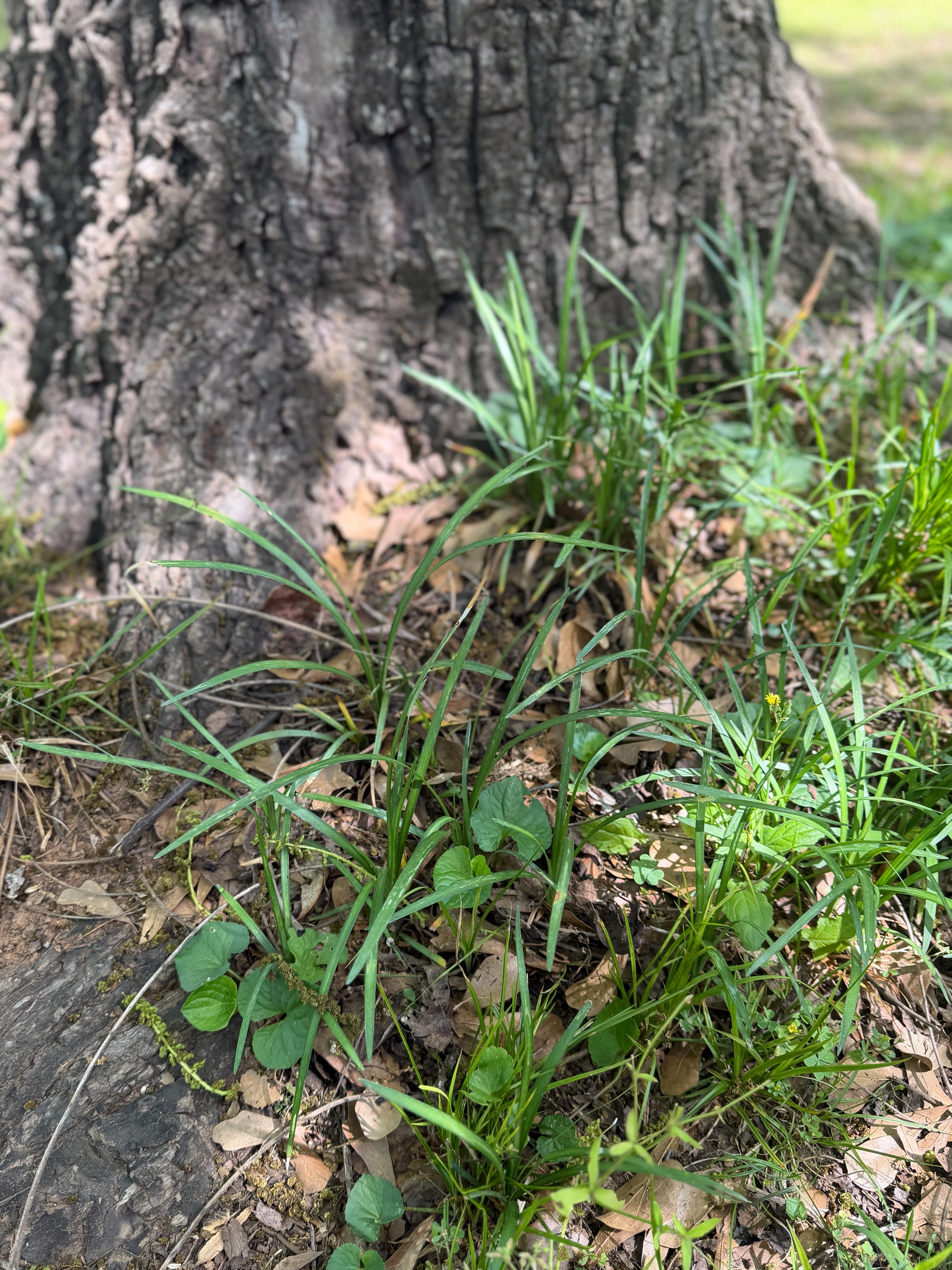
The black walnut in our backyard is fully awake now. Its leaves have moved past emergence into declaration. The shade beneath it has returned, not yet the dense shade of July, but enough to change the feel of the ground below, and as I moved our patio furniture across the yard to enjoy its shade and the shade from a mighty oak, I said my prayers of thanksgiving. Around the black walnut, smaller plants are negotiating their place in the walnut’s chemical field, that quiet allelopathic power by which the tree shapes its own neighborhood. The cardinals, squirrels, and wrens move through its branches with an ease I envy. In the evening, the whole tree seems to hold the day’s heat and then slowly release it.
It would be easy to look at that tree and see only beauty. I often do. But the better practice is to see beauty without letting beauty become anesthesia.
That is the temptation of spring in the Carolinas. The world becomes so visually generous that we stop asking harder questions. We stop asking where the water came from, where it went, what it carried, what it failed to replenish. We stop asking why some trees leaf out while others decline. We stop asking what happens to insects when we spray every edge into silence. We stop asking why our neighborhoods are hotter where shade has been removed, or why some communities inherit asphalt while others inherit canopy. We stop asking why “growth” so often means the thinning of the very world that makes life here bearable.
The green world can comfort us, but it should not pacify us. I keep thinking about this in relation to Spartanburg’s current context. So many of our local questions are ecological questions, even when dressed as economic development, traffic planning, school construction, housing demand, or utility infrastructure. The debates over data centers, road diets, water use, and industrial recruitment are not separate from the greening (Hildegard again) trees of mid-May. They are part of the same story and ask what kind of attention we are willing to practice before decisions become consequences.
Because once a tree is cut, it is not enough to say the neighborhood still looks green and once a creek is burdened, it is not enough to say the rain has returned. Likewise, once a community is asked to absorb another large-scale project, it is not enough to say the numbers look good on paper.
The work of ecological attention is slower than that. It asks us to remain with the place after the obvious drama has passed (Donna Haraway has a wonderful phrase of “staying with the trouble”). It’s not just about public meetings, but the watershed afterward. Rather than just the chainsaw, attend to the silence afterward. Enjoy the rainstorm, but practice attention towards the soil afterward. Not just the promise of investment, but the long life of what has been altered.
That kind of attention can feel inconvenient because it resists closure and refuses the easy relief of saying, “At least everything is green again.” It asks us to notice the difference between appearance and recovery, between growth and flourishing, between greenness and health.
Mid-May in the Upstate is one of the best teachers of that difference. The world is lush right now. It is also strained. The rain has come, but the deeper thirst remains. The leaves are full, but the systems beneath them are still negotiating drought, heat, compaction, runoff, and our endless appetite for more before the inevitable hot weather of June and July. To see all of that together is not to become gloomy. It is to become more faithful to the place itself.
The green is real, but so is the wound. Maybe the real work of Carolina ecology begins there, in refusing to let one cancel out the other.
Further Readings:
South Carolina Drought Portal. “Current Drought Status.”
A helpful local reference point for tracking drought conditions across the state, including Spartanburg County. The April 30, 2026, update listed Spartanburg under severe drought, which is part of the larger impetus behind my thoughts here, and that rain may return before the drought has truly ended.
https://www.scdrought.com/current.htmlDrought.gov. “Drought Conditions for Spartanburg County, South Carolina.”
This gives a county-level view of drought, streamflow, agricultural impacts, and longer-term precipitation patterns. It is especially useful for seeing how drought is not only a visual condition, but a layered reality affecting soil, pasture, crops, water supply, and public health.
https://www.drought.gov/states/south-carolina/county/spartanburgClemson Cooperative Extension. “South Carolina Field Update: Finally, Some Rain!” May 4, 2026.
This short field update captures the strange complexity of spring rain after drought. Clemson notes that the rainfall was welcome but not nearly enough to break drought conditions, and also warns that wet weather can increase disease pressure on crops.
https://hgic.clemson.edu/south-carolina-field-update-may-4-2026-finally-some-rain/Clemson Cooperative Extension. “South Carolina Field Update: Insects and Disease Increase as Forecast Shows Warming Trend.” May 11, 2026.
A good follow-up to the previous update. It makes clear that the return of rain and warmth is not a simple recovery story. Moisture brings growth, but it also brings fungus, root rot, leafhoppers, thrips, and other pressures that growers have to watch closely.
https://hgic.clemson.edu/south-carolina-field-update-may-11-2026-insects-and-disease-increase-as-forecast-shows-warming-trend/South Carolina Native Plant Society, Upstate Chapter.
A practical local resource for learning more about native plants in the Upstate and supporting habitat restoration close to home. Their work is a good reminder that ecological attention can become a practice of planting, restoring, and learning the names of the living communities around us.
https://scnps.org/upstate/South Carolina Native Plant Society. “Native Plant Directory.”
A useful guide for identifying native plants and thinking beyond lawn-based landscaping. This is a good resource for readers who want to move from noticing the difference between greenness and health toward actually cultivating healthier yard and neighborhood ecologies.
https://scnps.org/plants/Donna J. Haraway. Staying with the Trouble: Making Kin in the Chthulucene. Duke University Press, 2016.
Haraway’s phrase “staying with the trouble” gives language to the slower form of attention this piece is trying to practice. Rather than rushing toward resolution or despair, Haraway asks us to remain with damaged places and complicated relationships long enough to perceive our obligations differently. Wonderful book and highly recommend (reach out if you need me to send a copy)
https://www.dukeupress.edu/staying-with-the-troubleHildegard of Bingen. Selected Writings. Penguin Classics.
A great entry point into Hildegard’s theology, cosmology, songs, letters, and writings on medicine and the natural world. Her concept of viriditas is often translated as greenness, freshness, vitality, or fecundity, but it is richer than any one English word can capture.
https://www.penguinrandomhouse.com/books/333416/selected-writings-hildegard-of-bingen-by-hildegard-of-bingen/Hildegard of Bingen. Hildegard of Bingen: On Natural Philosophy and Medicine. Boydell & Brewer.
For readers interested in Hildegard’s more explicitly ecological and medical imagination (which is incredible), this work offers selections from her writings on the “natural” world. It helps place viriditas within a broader medieval understanding of plants, bodies, healing, and divine life.
https://boydellandbrewer.com/book/hildegard-of-bingen-on-natural-philosophy-and-medicine-pb/Robin Wall Kimmerer. Braiding Sweetgrass: Indigenous Wisdom, Scientific Knowledge, and the Teachings of Plants. Milkweed Editions.
Kimmerer’s work is one of the best contemporary guides for learning to see plants not as scenery or resources, but as teachers and relations. Her weaving of botany, Indigenous wisdom, and personal narrative fits especially well with the kind of ecological attention my work is trying to cultivate. Must read!
https://milkweed.org/book/braiding-sweetgrass
Very powerful
🙏🏼 Sam.