


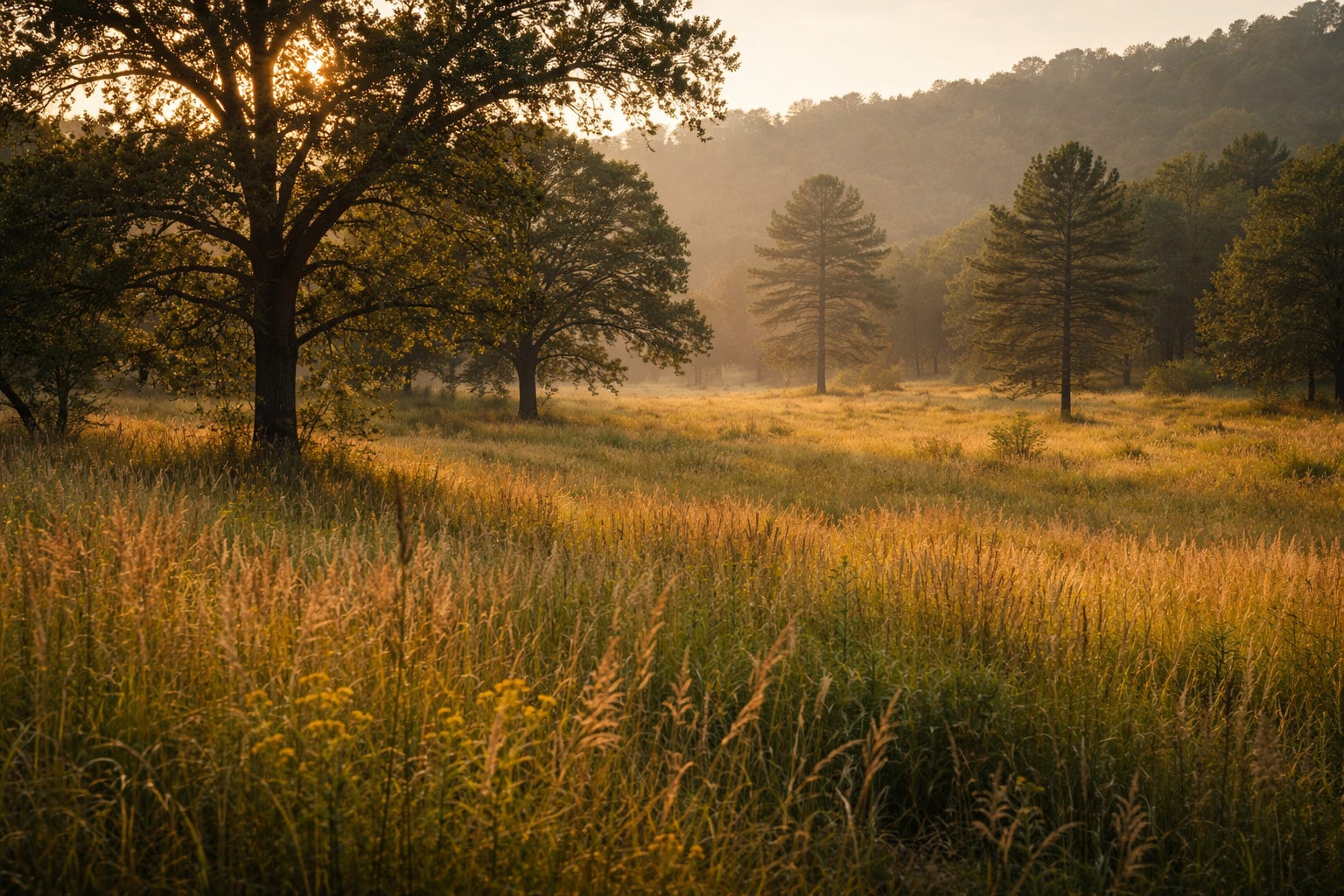
If you drive through the Carolina Piedmont today, the landscape can feel reassuringly familiar. Rolling hills fold gently toward the horizon. Hardwoods and pines gather along creeks and climb the slopes. Old pastures slowly disappear beneath young forests. From Spartanburg down toward Columbia, across into North Carolina and Georgia, the region gives the impression of continuity… as though the woods have always been here.
But the Piedmont we see today is, in many ways, a relatively recent creation.
Much of what appears to be an ancient forest is actually second-or third-growth. Many of the dense woodlands that dominate the region have emerged only over the past century, growing back over land that was once plowed, grazed, burned, or logged. Beneath these forests lies the memory of a very different ecological pattern, one that has nearly vanished from public awareness.
Before widespread European settlement and the agricultural transformation that followed, large portions of the Carolina Piedmont were not closed forests at all. Instead, the region was shaped by open woodlands, savannas, and prairie-like grasslands maintained by regular fire. Longleaf pine savannas stretched across parts of the Southeast, while oak woodlands and grassy openings dotted the uplands. In many places, the understory was not thick with saplings and shrubs but open, filled with native grasses and wildflowers that could tolerate frequent burning.
It is also right and important to recognize that the landscapes of the Southeast were shaped for thousands of years by Indigenous communities whose ecological knowledge included the careful use of fire. Fire was not simply a disturbance within this system. It was part of the system itself.
Lightning ignited some fires during summer storms, but Indigenous communities across the Southeast also used intentional burning as a land management practice. These fires cleared dense undergrowth, encouraged certain plant communities, improved hunting conditions, and helped maintain the open character of the landscape. The result was not a wilderness untouched by people, but a mosaic environment shaped by long-standing relationships among humans, fire, plants, and animals.
Early travel accounts from the eighteenth and nineteenth centuries sometimes describe scenes that are difficult for modern readers to picture. Visitors wrote about riding horses through open oak woodlands where the ground was grassy and the trees were spaced widely enough that one could see far ahead between their trunks. The land was described as park-like, bright, and airy, with sunlight reaching the ground.
To someone accustomed to the dense forests that now cover much of the Piedmont, those descriptions can sound almost unbelievable.
What happened is not mysterious. The ecological shift unfolded gradually through agriculture, logging, and a profound change in how people understood fire.
During the nineteenth century, large areas of the Piedmont were cleared for cotton farming. Hillsides that had once supported native grasses and open woodland systems were plowed year after year. When the cotton economy collapsed in the early twentieth century, many of those fields were abandoned. Trees returned quickly to the worn soils, and secondary forests began spreading across the region.
At the same time, fire was increasingly treated as an enemy rather than a participant in ecological processes. Across the United States, forest policy shifted toward aggressive fire suppression. The regular burns that had once maintained open landscapes disappeared. Without them, forests thickened. Saplings crowded beneath mature trees. Shade replaced sunlight at the forest floor.
Over decades, the Piedmont closed in on itself.
Today’s landscape, with its dense understory and tangled thickets, often feels natural and inevitable to those of us who live here. Yet ecologists increasingly point out that this landscape represents only one phase in a much longer ecological story. Beneath many of these forests lies the lingering potential of older systems… grasslands, savannas, and fire-shaped woodlands that once supported an extraordinary diversity of plant and animal life.
In scattered places across the Southeast, restoration efforts are beginning to reveal glimpses of that older world. When prescribed fire returns to certain sites, something remarkable often happens. Seeds that have rested quietly in the soil for decades suddenly germinate. Native grasses reappear. Wildflowers that had seemingly vanished from the region emerge again in the sunlight.
It can feel almost as though the land remembers.
Walking through one of these restoration areas can be disorienting if you have spent most of your life moving through the dense second-growth forests that dominate the modern Piedmont. The openness, the light, and the diversity of grasses and flowering plants suggest a different ecological imagination, one in which forests and grasslands are not opposites but partners within a shifting landscape.
None of this means that we can simply rewind history. Too much has changed. Urban development, altered soils, invasive species, and climate shifts have all reshaped the region, making full restoration impossible. The Piedmont of three centuries ago will not return in any pure form.
But learning about these ghost ecosystems still matters.
It reminds us that the landscapes we inhabit are not fixed backdrops. They are layered with memory, shaped by relationships between people, plants, fire, animals, and climate over long stretches of time. What we see around us today is only the latest arrangement within that unfolding process.
Once you begin to recognize this, the hills and forests of the Piedmont look a little different. A roadside clearing may hint at the prairie that once spread across similar soils. A thin band of native grasses might suggest an ecological pattern waiting for the right conditions to reappear. Even the dense woods themselves become part of a larger story rather than the final chapter.
Ecology, at its best, invites us into this deeper way of seeing. It teaches us that landscapes are not static scenery but living histories, full of presences that extend beyond our own brief moment within them.
And sometimes the most important thing we can do is simply learn to notice what the land and soil still remember.
Here’s some suggested reading:
If the idea of “ghost ecosystems” in the Carolina Piedmont interests you, the following books and essays offer deeper ecological and historical context for landscapes like the one I described above. These works explore Indigenous land stewardship, fire ecology, Southern landscapes, and the shifting relationship between people and the land.
Charles C. Mann — 1491: New Revelations of the Americas Before Columbus
Internet Archive Link
This remarkable book reshaped how many readers (and me) understand the ecological history of the Americas. Mann gathers research from archaeology, ecology, and anthropology to show that Indigenous peoples actively shaped their environments long before European arrival, often using fire to manage forests and grasslands. The Americas Europeans encountered were not untouched wilderness but landscapes carefully influenced by human cultures over thousands of years.
Stephen J. Pyne — Fire in America: A Cultural History of Wildland and Rural Fire
https://uwapress.uw.edu/book/9780295975924/fire-in-america/
Pyne’s work is one of the most important histories of fire ecology ever written and has greatly shaped my own PhD work. He traces how different cultures in North America used fire to shape the landscape and how modern policies of fire suppression dramatically altered ecosystems across the continent. His work helps explain why many Southeastern landscapes changed so dramatically once regular burning disappeared.
Timothy Silver — A New Face on the Countryside: Indians, Colonists, and Slaves in South Atlantic Forests, 1500–1800
https://www.amazon.com/New-Face-Countryside-Colonists-Environment/dp/B008W33ILK (I hate linking to Amazon, but here we are)
Silver’s book is one of the best historical studies of how colonial settlement transformed the forests of the Southeast, including the Carolinas. It carefully documents how Indigenous land management, European agriculture, and enslaved labor reshaped Southern landscapes during the early colonial period.
William Bartram — The Travels of William Bartram
Project Gutenberg Link
Bartram’s late-eighteenth-century travel narrative offers some of the most vivid early descriptions of Southeastern landscapes, in language typical of the time (and I still find it fascinating). His accounts frequently describe open woodlands, savannas, and fire-maintained ecosystems that look very different from the dense forests that dominate much of the region today.
Wendell Berry — The Unsettling of America
Internet Archive Link
This is the book that got me into the study of Religion and Ecology 25 years ago. Berry’s reflections on agriculture, land use, and ecological memory remain among the most thoughtful writings on how human communities shape landscapes over time. While not focused specifically on the Piedmont, his work offers a philosophical lens through which to think about how land remembers the decisions societies make.
Daniel Wildcat — Red Alert!: Saving the Planet with Indigenous Knowledge
https://www.fulcrumbooks.com/product-page/red-alert
Wildcat, a Yuchi member of the Muscogee Nation and a philosopher of Indigenous science, argues that Indigenous ecological knowledge offers crucial insights for navigating the environmental crises of the present century.
The Longleaf Alliance
https://longleafalliance.org
This organization works across the Southeast to restore longleaf pine ecosystems and the fire-maintained landscapes that once covered millions of acres. Their publications and educational resources offer an accessible introduction to the region's ecological history.
Upstate Forever — Land Conservation Resources
https://www.upstateforever.org
Closer to home here in South Carolina’s Upstate, Upstate Forever provides thoughtful materials on land conservation, forest restoration, and the changing ecological character of the Piedmont.
If you know of other books or essays about the ecological history of the Carolina Piedmont, I’d love to hear about them. One of the quiet pleasures of studying landscapes is discovering how many stories are still waiting beneath our feet… and how many people are paying attention to them.
Sam, this essay is outstanding! Thank you for your work.🌿🙌🏼