


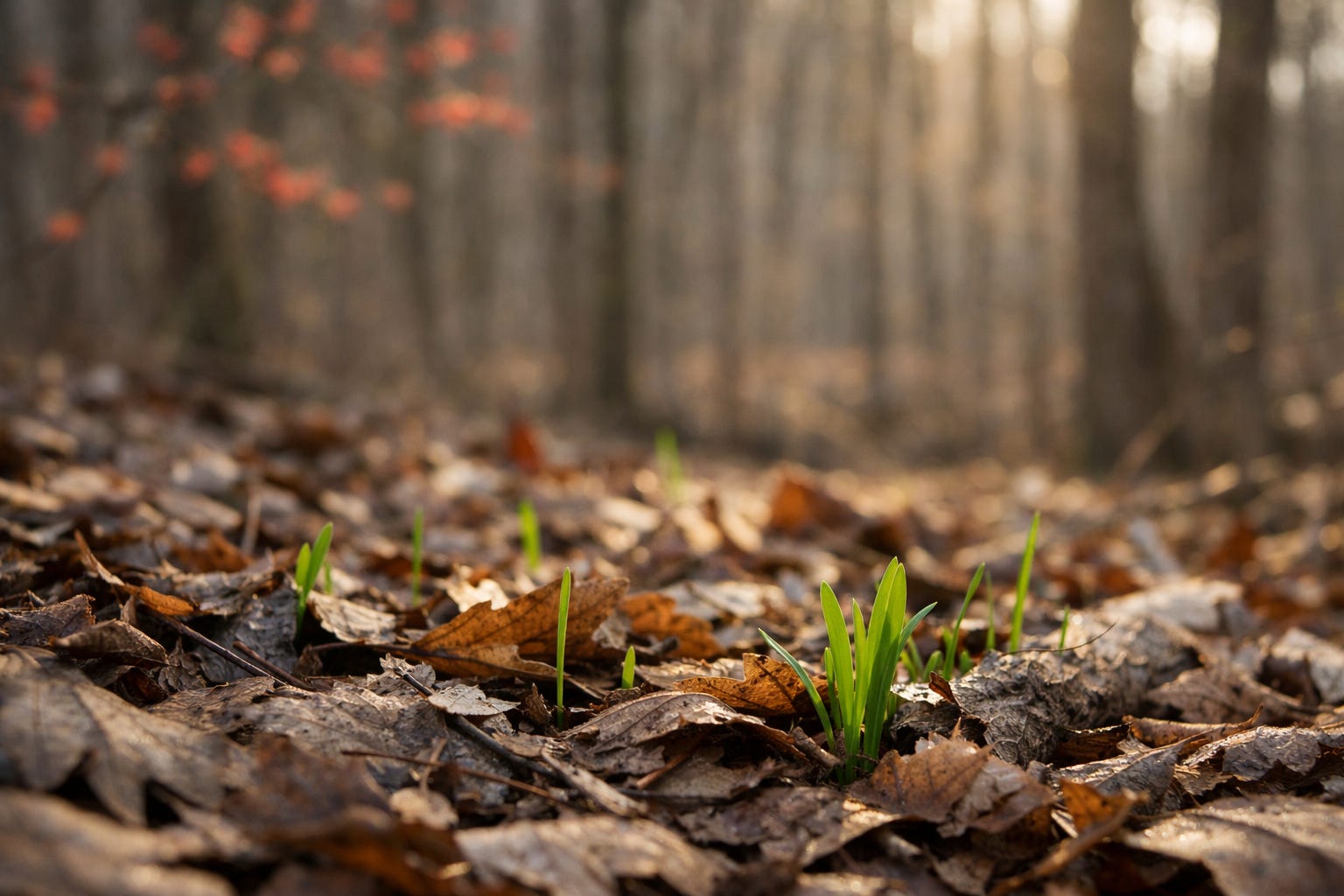
A few days ago, I noticed the red maple beginning to flower in our yard here in Spartanburg. Their blossoms appear before the leaves… small bursts of red scattered through otherwise gray woods. If you walk, bike, or drive past them quickly, you might miss them entirely. But once you see them, you realize they are everywhere.
Early spring in the Carolina Piedmont does not arrive dramatically. It was a Long December (and there's reason to believe maybe this year will be better than the last) or The Long Winters, depending on your preference.
There is no single day when winter ends and spring begins. Instead, it creeps in quietly through small changes that only become visible if you have been paying attention through the colder months.
The woods are still mostly brown.
Last year’s leaves cover the forest floor in thick layers. The grasses are flattened and dull from winter cold. Fallen branches lie where storms dropped them months ago. At first glance, everything appears dormant, even “lifeless” to borrow a phrase that I don’t give much meaning to these days.
But the browning is not the absence of life. It is the preparation for it. To get to Hildegard of Bingen’s “greening” or viriditas, you must first have the browning. Or as Carl Sagan reminds us in Cosmos, “If you wish to make an apple pie from scratch, you must first invent the universe.”
We are constantly inventing the universe with our perception. This is something that living in the Piedmont teaches if you spend enough time outside. The green explosion of April and May does not emerge from “nowhere” (another term I’ve found myself discarding the last few years). It grows out of the long, quiet work of decomposition… leaves breaking down, soil organisms stirring, nutrients cycling back through the ground.
In other words, spring depends on the brown as much as apple pie depends on the basic atomic structures that we’ve just begun to glimpse and tried to record on our cuneiform tablets of the periodic table.
Donna Haraway has a phrase I often come back to when thinking about ecological life… composting. She uses it as a way of describing how life continues through processes of breakdown, recombination, and transformation. Nothing simply disappears. Things are continually folded back into the living systems that surround them.
The forest floor in late winter is one of the best teachers of this idea.
Every brown leaf underfoot is a kind of memory. It carries the story of last year’s sunlight, last year’s rain, last year’s growing season. The carrier of memory from light-eating organisms with their own stories and tales to tell. As those leaves decompose, that memory does not vanish. It becomes part of the soil that will nourish the next generation of plants, fungi, insects, and trees.
The greening of spring is therefore not a fresh beginning.
It is the visible result of countless acts of composting that have been happening quietly all winter.
Haraway reminds us that living well on Earth requires learning how to “stay with the trouble.” That phrase is often interpreted as a call to face the ecological or political or social crises of our time honestly. But I think it also invites us to notice the more subtle forms of resilience (and resistance) and renewal that happen constantly in the more-than-human world.
The Piedmont in late February and early March is full of these quiet lessons.
The soil softens slightly after winter rains. Birds begin testing out new songs in the early morning. Small green shoots appear in places that looked completely dormant only days and weeks before. Even the light itself begins to shift, lingering a little longer in the evenings despite our human inclination to set our clocks back an hour to compensate for the cyclical shifts in our planet’s axial tilts and wobbles.
None of these changes are dramatic on their own.
But together they signal that the landscape is already moving toward another season of growth.
And that growth is possible only because of the long season of browning that came before it.
The composting of memory is happening everywhere around us. Leaves returning to soil. Fallen logs becoming habitat for insects and fungi. Nutrients cycling through systems far older and wiser than any human economy. Paying attention to these processes changes how we understand both time and hope.
Spring in the Carolina Piedmont is not a sudden miracle. It is the patient unfolding of relationships that have been working beneath the surface all along.
If we learn to see that work… the browning, the breaking down, the composting… then the greening of spring becomes something more than a seasonal change.
It becomes a reminder that renewal is rarely separate from decay. Often, it grows directly out of it.