


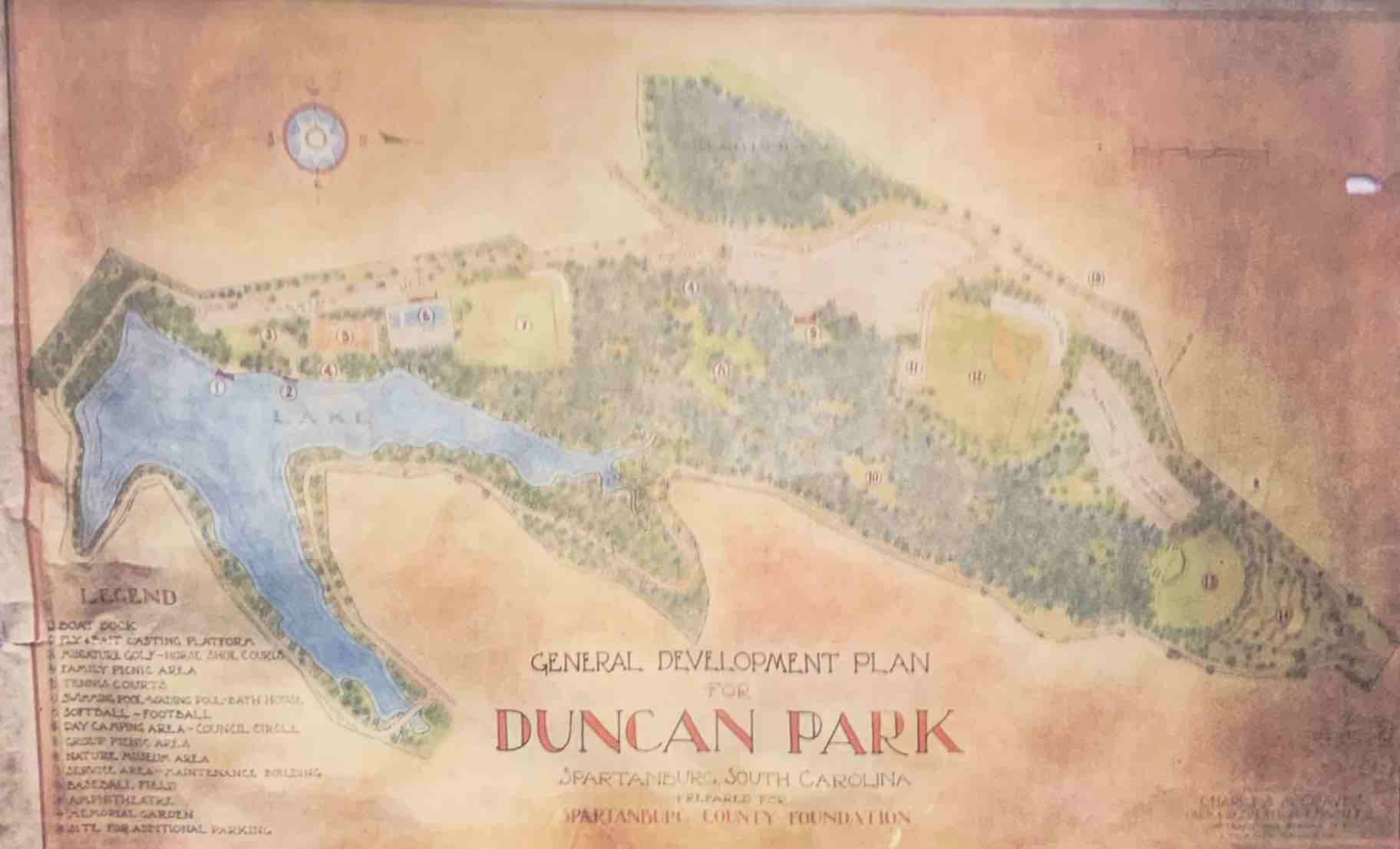
There is a small dam in Duncan Park that runs through our neighborhood just east of downtown Spartanburg and beside our home. It was built by the Civilian Conservation Corps in 1935. The water of Fairforest Creek (tributaries, not the main stem) pools quietly behind it, a still mirror of sky and tree canopy, and to most people walking the path alongside it, it probably reads as a natural feature of the landscape... something the land has always done, something stable and given. My children enjoy feeding the ducks and seeing the fish that swim by on our morning walks. It’s recently been “restocked” with bass and bluegill and has added a kayak dock. My favorite baseball player, Ryne Sandberg of the Chicago Cubs, once played for the Spartanburg Phillies at the historic stadium built in 1926, which still stands.
But the lake itself is not a natural feature. It is a decision someone made at some specific moment in the past to hold that water of Fairforest Creek, which is still part of an incredible watershed system here. And decisions, unlike geological facts, can be reconsidered.
I have been thinking about that dam more than usual since news began arriving about the Klamath River. By early 2024, the largest dam removal project in American history had begun to unfold along the Klamath in northern California and Oregon... four dams coming out, more than 400 miles of river corridor opening back up, salmon returning to waters they had not reached in over a century. The scale of the project is hard to grasp. But what strikes me most is not the engineering involved, or even the decades of legal and political struggle that preceded it. It is the shift in orientation the project represents… a collective decision to ask not just what these dams provide but what they interrupt, and whether the interruption is still worth the cost.
Robert Macfarlane has been asking a version of this question in his recent work. In Is a River Alive?, he challenges the assumption, so common in how we talk about environmental management, that rivers are resources or systems to be allocated, monitored, and optimized. What he finds, moving through landscapes shaped by rivers and through the scientific and legal movements now recognizing rivers as rights-bearing entities, is something more like what process thinkers would recognize as relational agency: a river is not merely a quantity of water moving through a channel, but a layered, ongoing process with its own forms of responsiveness, its own temporal depth, its own way of engaging the world. Holding that process still is not a neutral act. It is an act with consequences that extend well beyond the visible.
Here in the Carolinas, those consequences are distributed across a landscape so thoroughly reshaped by dam-building that it is difficult to see it clearly anymore.
The Catawba-Wateree system of the Carolinas is the most striking example. What the map labels as lakes... Lake Norman, Lake Wylie, Lake Wateree, and several others... are not lakes in any ecologically meaningful sense. They are sections of a river that has been stepped and slowed by a chain of dams operated largely by Duke Energy, stretching from the North Carolina mountains down through the Piedmont of South Carolina. The system generates electricity, supplies drinking water to millions of people, and provides recreation across an enormous region. By conventional measures, it is a recreational, capitalistic, and big beautiful success.
But the river underneath it, the Catawba (the Indigenous Catawba people were “the people of the river” after all), as a river, has been substantially transformed in the process. Sediment that once moved through the system now settles behind dams. Migratory fish species that depended on an uninterrupted river corridor no longer have access to their full range. Seasonal flood pulses that shaped the floodplain forests and wetland communities downstream have been regularized into something closer to industrial schedules. The reservoirs themselves support vibrant ecosystems, but they are not the same ecosystems the river once sustained, and the communities of organisms that depended on the river’s movement, sedimentation, variation, and connectivity have mostly disappeared, without anyone officially deciding they should.
This is one of the ways in which dams function as both perceptual and physical interventions. They do not merely change the water. They change what we expect water to do. People who grow up around Lake Norman or Lake Wylie think of these as stable, permanent features of the region, not as rivers that were altered during their (now great?) grandparents’ generation. The shoreline becomes relatively fixed. The water level becomes something that should behave. And what has been displaced... the river’s older self, its own way of occupying the landscape... becomes invisible simply through familiarity.
The Pee Dee River and its watershed, where I grew up, tells a somewhat different story, but it is no less shaped one. The Pee Dee runs more freely through its lower reaches in South Carolina than the Catawba does, and its floodplain forests, remnant bottomland hardwoods, oxbow wetlands, and Carolina bays embedded in the surrounding landscape remain among the most ecologically significant landscapes in the state. But even here, the river’s behavior in South Carolina is substantially determined by decisions made upstream in North Carolina, by the Yadkin-Pee Dee chain of dams that structure flow, temperature, and sediment delivery before the water ever crosses the state line. What arrives in Marlboro County, looking like a freely moving river, is already a human-manipulated river, one whose pulses have been calibrated by release schedules rather than by rainfall alone.
Recent basin planning work across South Carolina (and the development of the new Interstate 73 in the Pee Dee region) has begun to surface the pressure these systems are now under. Population growth across the Carolinas, expanding industrial water demand, and the increasing variability of precipitation under changing climate conditions are creating stresses that the infrastructure was not designed to accommodate. What was engineered for a particular set of hydrological assumptions (relatively stable precipitation patterns, slower population growth, lower summer temperatures) is now being asked to perform under conditions that are shifting faster than the engineering can adapt.
There is a phenomenological dimension to all of this that I keep returning to in my own work, and it has to do with what attention reveals when we let it settle on something long enough.
A river, attended to over time, does not behave like a managed resource. It behaves like what it is… a process with its own rhythms, its own memory of the landscape it has moved through, its own responsiveness to rainfall, season, and the communities of organisms that depend on it. Henri Bergson wrote about duration (durée) as the experience of time as lived continuity rather than as a series of measurable instants. Something like this is available in rivers, if you pay attention long enough to notice it.
Fairforest Creek in Duncan Park is not just the water that is there today. It carries sediment from upstream, it holds the traces of last week’s rain, it responds to the shade of the trees along its bank in ways that will matter to the insects and the birds and the soil chemistry downstream. Holding it still behind even a small dam interrupts that continuity, not catastrophically, perhaps, but genuinely.
This is what Edith Stein’s work on empathy helps me see in these contexts. Stein describes empathy not as projection but as a movement of attention toward the experiential structure of another, a genuine, if always partial, encounter with something’s way of being in the world. To attend to a creek, or a river, with something like empathetic seriousness is not to sentimentalize it. It is to ask, carefully and honestly, what it is doing when left to do its own thing, and what is lost when that doing is interrupted. The Klamath salmon did not simply disappear from the upper river when the dams went in. They lost access to the habitat that had shaped their biology over thousands of years. The river itself lost the sediment movement that salmon carcasses had redistributed across the watershed. These are not abstract losses. They are losses in the relational fabric of a place.
None of this leads straightforwardly to a conclusion about what should be done with the dams we have.
The Klamath removal was a long time coming and required extraordinary coordination among tribal nations, state and federal agencies, environmental organizations, and private utilities. The dams were old, their relicensing costs were high, and the ecological case for removal had been building for decades. The Catawba-Wateree system is a different situation entirely, with newer infrastructure, active management by a major utility, and millions of people dependent on its outputs for daily life. Nobody is proposing, or should be proposing, tearing out Lake Norman (though some may argue about the questionable human developments that have sprung up around it this century).
But the Klamath is still useful as an orientation... a way of asking questions that the presence of large, stable infrastructure tends to suppress. What are these dams still doing that justifies what they have changed? Are there smaller dams in the watershed, on tributaries or in parks or on agricultural land, where the calculus looks different... where removal or modification might restore significant ecological function at manageable cost? What would it mean to manage the existing reservoirs in ways that are more attentive to the downstream river communities they affect... more sensitive to seasonal variation, more deliberate about sediment release, more conscious of the organisms that depend on floodplain dynamics?
And here in Spartanburg, there is that small dam in Duncan Park, which is not going to reshape the regional ecology of the Piedmont one way or the other. But it is the kind of thing worth looking at carefully, precisely because it is local, legible, and close enough to walk to (one of the most beautiful walks in Spartanburg, I’d argue). What is that dam doing to the creek’s sediment load? What does it change about flood dynamics further downstream? Which organisms can move through that stretch of water, and which cannot?
These are not rhetorical questions. They are the kind of questions that environmental engineers, ecologists, and municipal managers answer when given the opportunity and the resources. And they are worth asking, not because the answer will certainly be to remove the dam, but because the habit of asking, of noticing that the still water is the result of a decision rather than a fact of nature, begins to change the way a person moves through a landscape.
There is a passage I have been sitting with from A Secret History of Christianity, Mark Vernon’s reading of William Blake and the participatory tradition, in which he describes a certain kind of attention as moving us to the threshold of imagination... a place where we are not merely looking at the world from outside it but beginning to participate in its self-disclosure. I find this language useful for what I am trying to describe in how we relate to rivers, creeks, and the water systems we have inherited and will pass on to our children and future generations.
The Klamath project is, among other things, an act of imaginative recovery. It is a willingness to remember that the river had a life before the dams, and to ask whether some of that life can be returned. That act of remembering is ecological, legal, and political, but it is also, at its root, a change in how people are relating to the river, or a move from utility to participation, from management to something more like responsibility.
That does not require removing every dam. It requires something prior to that decision, which is a kind of attention (patient, honest, local) to what the water is doing and what it is being prevented from doing.
In Spartanburg, that attention might begin with a walk through Duncan Park, pausing at that small dam, and staying long enough to notice the creek on both sides of it.
Further reading and sources:
Klamath River Renewal Corporation
South Carolina Department of Environmental Services, River Basin Planning
American Rivers, Dam Removal Program
Robert Macfarlane, Is a River Alive? (W. W. Norton, 2025)
Robin Wall Kimmerer, Braiding Sweetgrass (Milkweed Editions, 2013)
David Abram, The Spell of the Sensuous (Pantheon/Vintage, 1996)
Mark Vernon, A Secret History of Christianity (Christian Alternative Books, 2019)
Henri Bergson, Creative Evolution (1907); Matter and Memory (1896)
Edith Stein, On the Problem of Empathy (1917)
Sam, what a beautiful essay.
My research for my essay tentatively titled Beyond the Visible World uncovered some surprises that I am still trying to verify.
In 1889, the celebrated fish scientist James Randall visited the upper Catawba River and commented on the abundance of American eels. The eels would have migrated from the Sargasso Sea.
The eels ferried baby mussels to from the mouth of the Catawba to the upper Catawba River (on their gills).
The mussels filtered 10-15 gallons of water a day. In my area at 3300 feet, we have wells. Because the area was not glaciated, we have saprolite which is a sophisticated filtering system above the aquifer.
The 11 Duke hydropower dams effectively stopped the eel migration. We’ve had over a century of degrading saprolite because the eels and the mussels were a perfect match. I see a few tiny mussels; I hope they found another ferry.
The very least Duke could do is upgrade their blades to the ones that don’t kill the fish.
I feel that Duke’s carelessness affects the saprolite in a similar manner to the Sackett blow to wetlands.
Thank you for your work!
PS I sent along my email.