


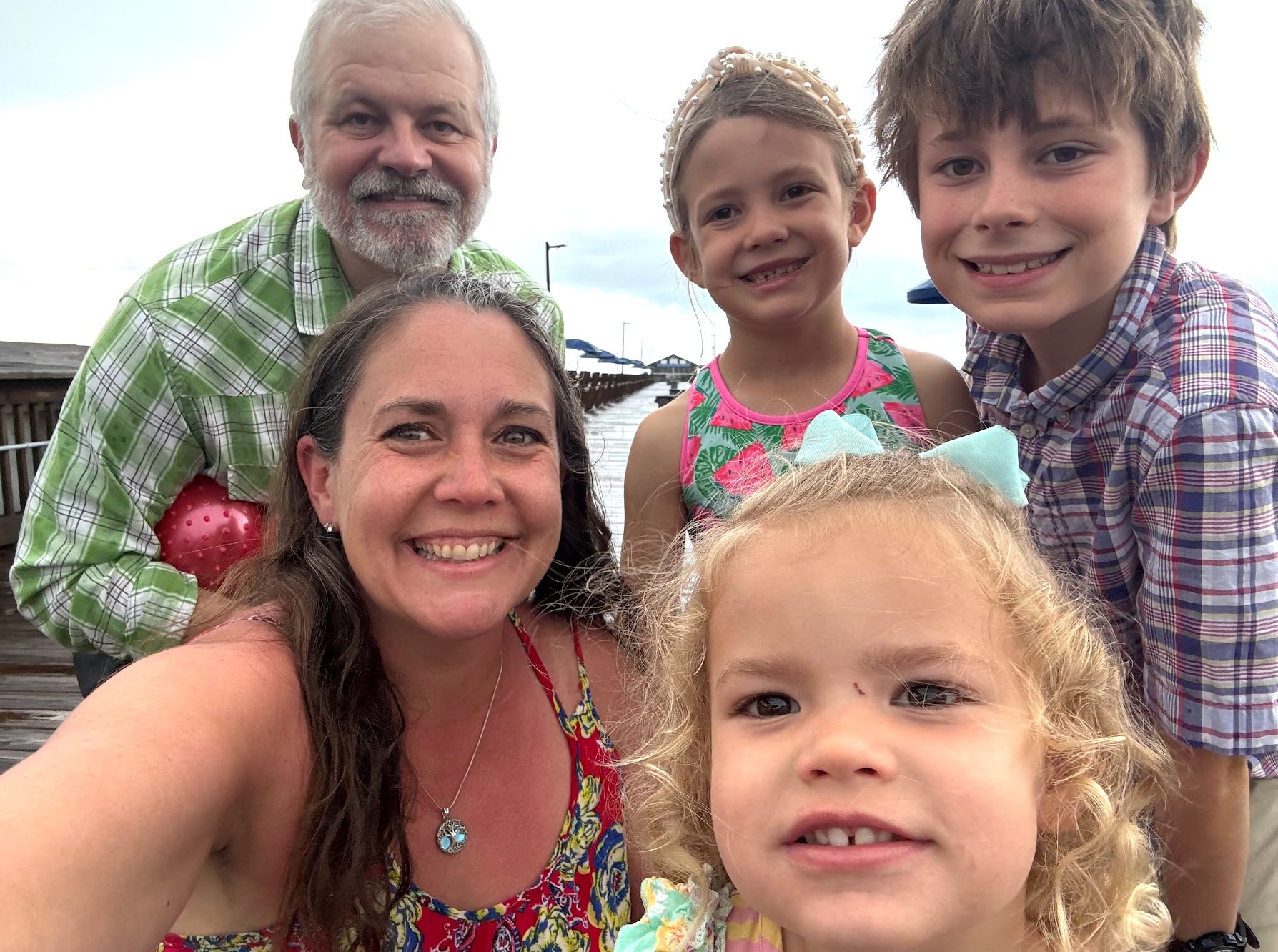
My children typically understand a place like Myrtle Beach before I do when we arrive. That is probably true of most places we visit with children, especially places with sand and water and the strange, temporary freedom that comes from being away from home. Adults usually arrive somewhere carrying the categories of the place with us. Myrtle Beach, for many of us in South Carolina, already has a name (and varying degrees of reputation) before we get there. It’s a place for a vacation. It’s the Memorial Day “beach traffic.” It’s seafood in Murrells Inlet, mini golf, beach stores, and towers of hotels facing the Atlantic. Myrtle Beach is also a place many of us have known since childhood, even if our memories of it are patchy and sunburned and mixed with the smell of sunscreen, vinyl car seats, damp towels, and fried food after a long day in the water. Growing up in Mullins, Myrtle Beach was the closest “big city” with a McDonald’s, a movie theater, AND a mall.
But as I’ve noticed in my last two decades of parenthood, I’ve concluded that children arrive differently at places like Myrtle Beach.
For them, the beach is not first a symbol, an economy, or a memory. It’s sand under the feet and the shock of a wave coming faster than expected. The place is a shell that must be shown to someone immediately and curated into their intentional collection. Myrtle Beach is also a horizon that can’t be reached (harkening back to one of my favorite poems because of a poster I memorized on my high school French teacher’s wall that she gave me upon graduation, and I lovingly displayed it on all of my classroom walls through the years). Myrtle is the thrill of sleeping somewhere different (bunk beds!), eating differently, moving differently, and letting the body discover that a week does not have to follow the same architecture as home.
After the last few years in Spartanburg, with our familiar rooms, routes to school, and routines on the Rail Trail, Myrtle Beach opens another field of attention for my children. They didn’t need to explain it out loud, but entered it into their own mindsets. Merianna preached at a dear friend’s funeral on Sunday in Columbia on our journey beachward. Even with that interregnum with our car full of bathing suits and beach toys, and folding chairs, I could see the look of anticipation in their eyes as we saw old friends and paid our respects to an amazing person who helped shape our family’s future and held our children in her arms many times when they were younger.

That realization has been something of a revelation (“you want a revolution, I want a revelation!” as Eliza says) with me since we got back a couple of days ago, partly because I am reading and studying Edith Stein’s Potency and Act for my comprehensive exams in my PhD work this summer. Stein has been on the front of my mind more than usual (which I thought was not possible), so even ordinary family scenes have started to take on metaphysical weight.
That can sound abstract, but I don’t think it is. If anything, Stein helps me see why the ordinary is never just ordinary. A child with a bucket at the edge of the Atlantic is already involved in questions of form, possibility, matter, relation, attention, and becoming. The beach presents and/or gives itself differently depending on how it is approached. The same sand that sticks to legs and inevitably gets tracked by the bucket load into our car also becomes a castle, a road, a wall, a burial mound for feet, a writing surface, a small ecology of shells and fragments, the glass screen on our phones, and ghost crab holes. The same ocean that adults watch from a chair becomes, for a child, a force to test, fear, chase, resist, and trust.
That is one of the gifts of Stein’s language of potency and act. Potency is often treated as if it simply means “not yet,” as if possibility were only an empty space waiting to become real later. But Stein is working with a much richer inheritance. She is thinking through being as something that cannot be reduced to static presence. A thing is what it is, but what it is includes capacities, tendencies, limits, receptivities, and relations. To say that something has potency is not to say that it is unreal. Rather, a thing with potency indicates that reality itself is deeper than what appears at first glance. A being carries within itself possible forms of becoming, and those forms come into act through encounter.
The beach makes this almost embarrassingly clear to me at 47, as I thought I understood metaphysics so well at 37.
Sand isn’t passive in children's hands. Sand receives shape, but not any shape whatsoever. Sand resists, collapses, and dries too quickly. It holds better when wet, as my children each learn in their own due time after practicing the scientific method at an expert level, even though they’d never call it that. Sand teaches through failure as much as success. “Failure is the key to success!” was the slogan we adopted when I taught 7th-grade science and Math at Carolina Day School in Asheville. My students and I had a tough time seeing eye to eye on that mantra, as with all good mantras.
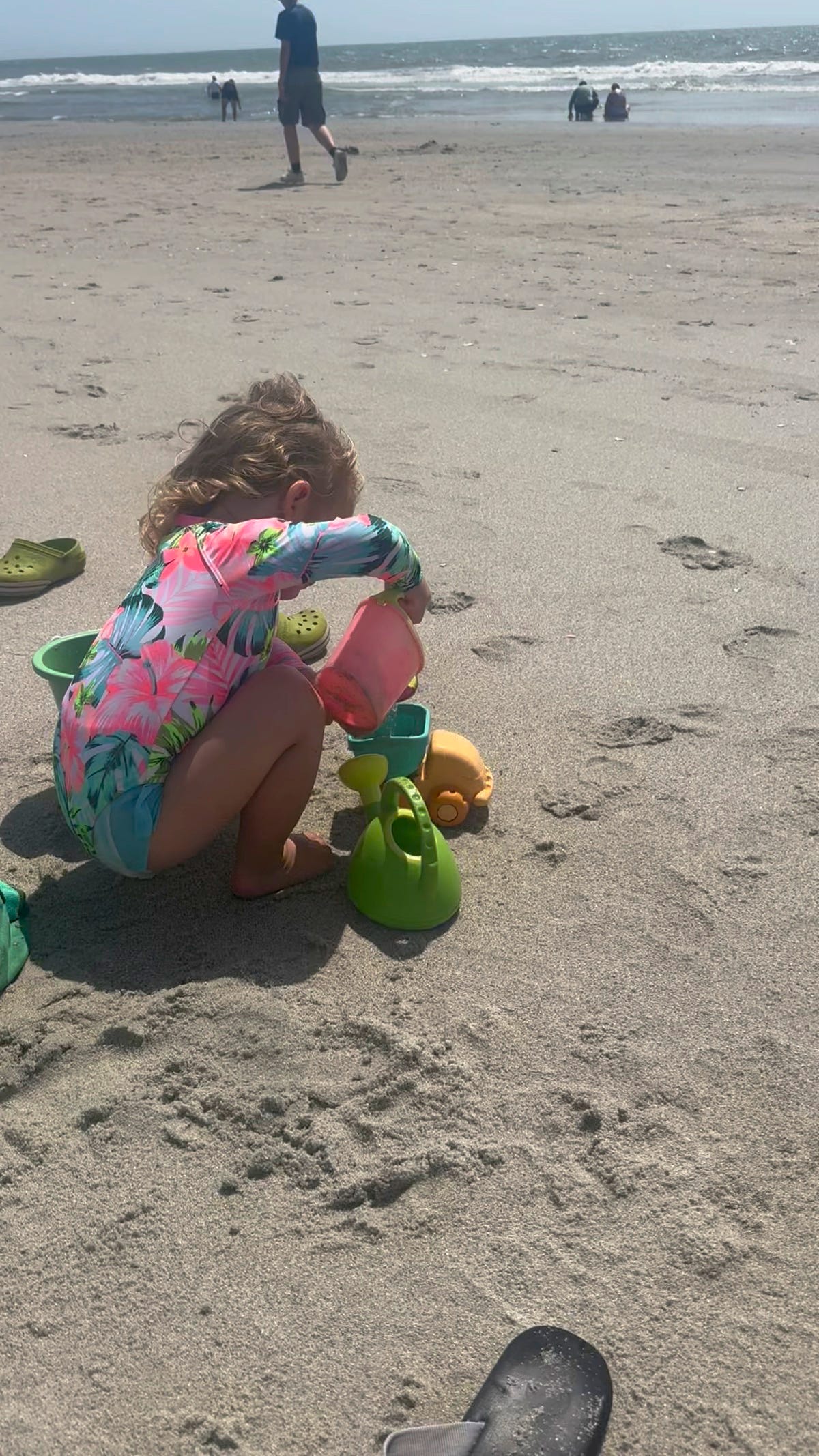
A sandcastle is not imposed on blank matter by a sovereign human mind. It comes about through an arrangement of hands, water, pressure, buckets, patience, and the sand’s own willingness to hold form for a little while. The castle is real, even if it will not last past the next tide in a few hours. Maybe especially because it will not last. A sandcastle’s temporality is not a defect, but belongs to what it is. “Castles made of sand fall/melt/slip into the sea… eventually” as Hendrix reminds us (one of my favs).
The shore itself also works this way. We call it a line, but it is not really a line but something we project onto it. A shore is a zone of exchange. Wave after wave revises it while tides move across it. Children run along it as if it were a border, but it behaves more like a conversation. Land and water meet on a shore without becoming the same thing. They shape one another constantly. The beach is always becoming beach again and always in motion. As with all things… panta rhei (everything flows)… thank you, Heraclitus (well, maybe not him, but close enough).
Myrtle Beach can be easy to dismiss as “that place” while we seek out “quieter” beaches and coastal vacation spots, especially for those of us who spend a lot of time thinking about ecology, attention, and place. It is not the quiet marsh. Myrtle is definitely not the protected maritime forest. It is certainly not the lonely barrier island reachable only by boat, with just golf carts on it, or the carefully interpreted preserve. Myrtle Beach is loud, commercial, and built up, a blend of Blade Runner and Idiocracy, and a slew of reality shows on some cable channel we don’t subscribe to. It is a place where the coast has been made to perform for vacation, real estate, leisure, golfers, and memory. There are stretches where the human imprint is so obvious that the place's older life can feel buried beneath concrete, signage, parking decks, and entertainment, except in the small places of memory that still exist, such as the wonderful Ingram Dunes (one of my favorite places in all of South Carolina).
But that judgment can become too simple if we let it. Myrtle Beach is still “shore.” The Atlantic has not become decorative simply because hotels face it, and their human builders have destroyed the once-imposing dunes and maritime forests. The gulls and pelicans have not become props because tourists notice them between meals, or because our 2-year-old learned to hide her goldfish in her swim jacket to avoid another disastrous encounter with them. The tide does not stop its work because someone has placed a chair too close to the water. Even in a heavily commercialized coastal landscape, the world exceeds the uses we assign to it.
That excess is what I kept noticing through my children. They were not naïve about the built environment, of course. Children love all of it. The pool, the elevators, the chlorine smell from indoor pools, snacks, beach ice cream stands, the bright lights on “the strip,” and all of the little rituals of being somewhere else. But they also moved through Myrtle Beach with a kind of ecological openness that we adults often have to relearn. A shell was not “just” a shell. A wave was not background noise. A crab hole was not a minor feature of the sand. The beach was not the scenery behind the vacation. It was the place acting upon them and inviting them into forms of attention that home does not always make available.
This is where Stein becomes helpful to me, not as an escape from the local but as a way of seeing the local more carefully. In Potency and Act, she is trying to think about being with enough patience to account for both form and becoming. The world is not a pile of objects. Nor is it only flux without a sense of stability. Beings have form, but form is not dead fixity as we observe when we attend to most anything. Everything flows, again. Form is alive in the sense that it gathers matter into meaning, capacity, direction, and relation. To perceive something well is to notice more than its surface availability to us.
A coast perceived as vacation property has been poorly received, leading to poor decisions that shape future ecologies. A beach perceived only as a recreational surface has been flattened. A shell perceived only as a keepsake has been removed from its longer story of life, death, calcium, ocean chemistry, and tide.
Stein’s metaphysics here gives me a way to say that things are not exhausted by their usefulness to human beings. Their being includes potencies we may never activate, capacities we may never understand, depths we may never name.
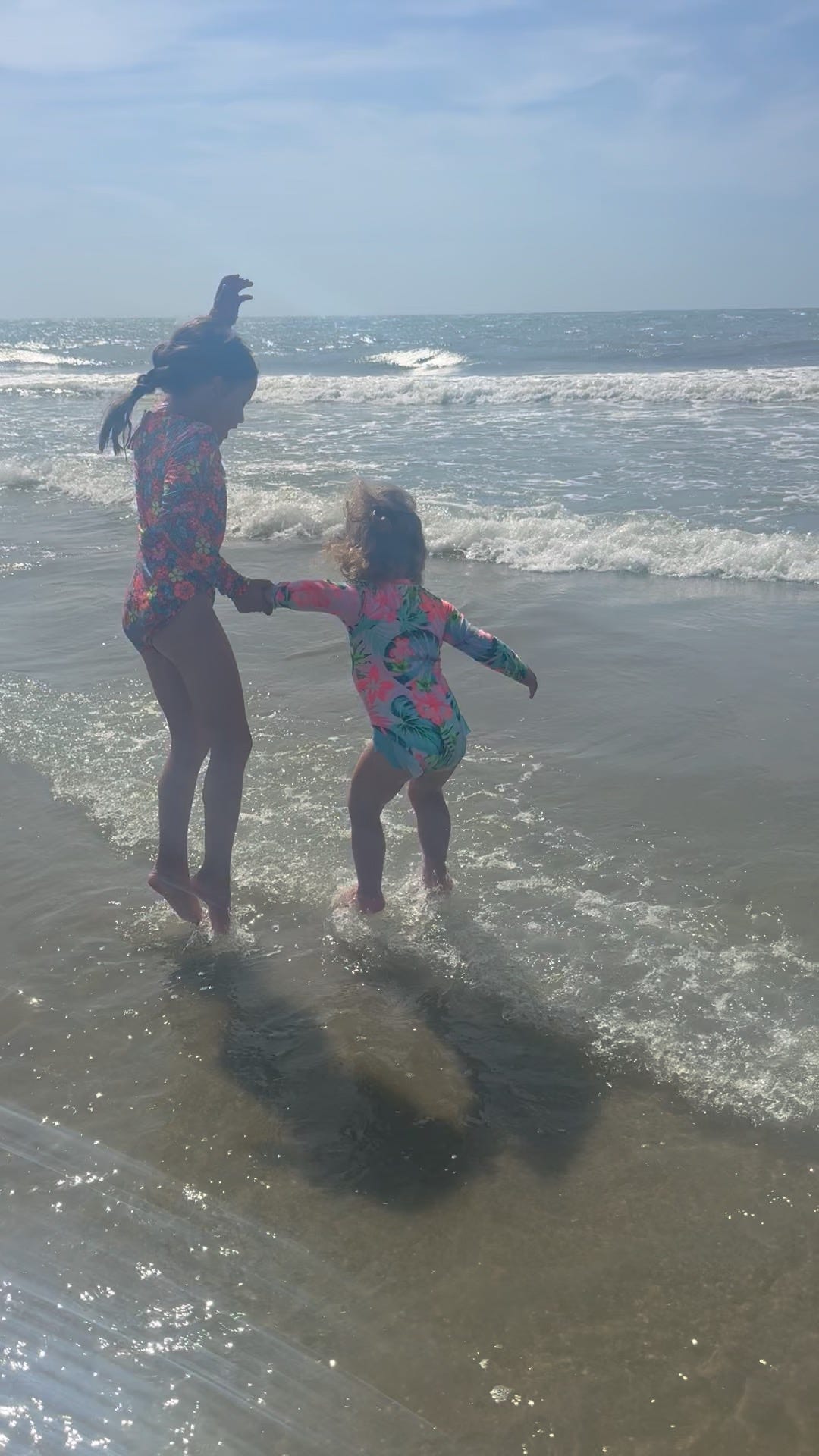
Children often live closer to this truth than adults do, whether through training, the “hardness” of a lived life, or the peculiar way our human brains help us process what we call reality as we get older. This isn’t because children are morally pure or spiritually superior (as a parent of 5, a middle and high school teacher for almost 20 years, and Dean of Students… I can testify to the opposite), but because they are less disciplined by utility. They can spend twenty minutes on a small patch of sand because the patch is still alive with possibility. They can make a world out of a bucket because the bucket has not yet been reduced to function. They can return to the waves again and again because repetition does not bore them when the world keeps arriving differently. The same wave is never the same wave. The same stretch of beach, in the morning and in the evening, is not quite the same place. “Not yet! Not yet!” was the familiar refrain of our almost 3-year-old when we told her it’s time to leave the beach and head back to the beach house.
Maybe this is one reason vacations with children are both exhausting and revealing. Adults often want rest, but children want transformation (or Eliza’s revelation). They want the furniture of the world rearranged. They want beds in different rooms, snacks at strange times, water before breakfast, sand after dinner, and permission to live bodily in a place without immediately translating it into productivity. Their joy is not always quiet or convenient. But it can become a form of instruction.
Watching them at Myrtle Beach, I kept thinking that potency is not a concept floating above the world. It is the world’s unfinishedness made visible. This is the capacity of a place to disclose itself differently when met with a different kind of attention. The beach that adults schedule becomes, for children, a teacher of impermanence, force, texture, and delight. The coast that developers sell as view and access remains a living threshold. The sand that seems like ground is made of histories. The ocean, which seems like a backdrop, is moving with planetary consequences, keeping us alive, fed, worried about sharks, and anxious about the hurricane season that starts in a few days.
That last phrase may sound heavy for a family beach trip, but the heaviness was there too, even if quietly. The Carolina coast carries the pressures of sea-level rise, storm intensification, erosion, development, insurance markets, tourism economies, and all the ways we keep pretending that shorelines are stable enough for our plans.
A place like Myrtle Beach depends on a kind of collective suspension of disbelief. We build close to an “edge” and then try to convince ourselves that the edge will behave. If it doesn’t, we’ll build sea walls and run for Governor! But the shore isn’t inert. A shore acts, receives, gives, erodes and deposits, shelters, and threatens. Its potencies include beauty and danger, memory and loss, play and destruction.
The children sensed some of this without needing the language. They knew the water could knock them down (and it did). They knew a castle and fort meticulously built with loving intentions would not survive the tide. They knew the sun could “burn” and the sand could become too hot. They knew, in their bodies, that delight and vulnerability are often braided together. That may be one of the deepest lessons of the coast… it doesn’t offer wonder without exposure.
For me, coming back inland to Spartanburg after a week at Myrtle Beach felt like returning with sand still somewhere in the seams of perception. The Piedmont has its own grammar of becoming, with its trees, red clay, creeks, heat, kudzu, old mill roads, and thunderstorms building in the late afternoon, as they are doing today. But the coast reveals something different. It teaches through edges and makes form temporary. The coast shows us how quickly the world can receive an imprint and how quickly it can erase it. It reminds us that being is not stillness.
That is what I hear in Stein right now as I read for my comps. Potency and act are not only scholastic categories to be mastered for an exam. These are ways of paying attention to a world that is always more than its current arrangement. A child is not only who they are in this moment, but neither are they merely a future adult. A beach isn’t a vacation site, but neither is it a pure wilderness untouched by human meaning. A shell isn’t only a remnant, but neither is it only a symbol. Each thing gathers what has been, what is, and what may yet come into view.
Our task, then (if you will), is not to force metaphysics onto the beach. The task is to let the beach correct our metaphysics.
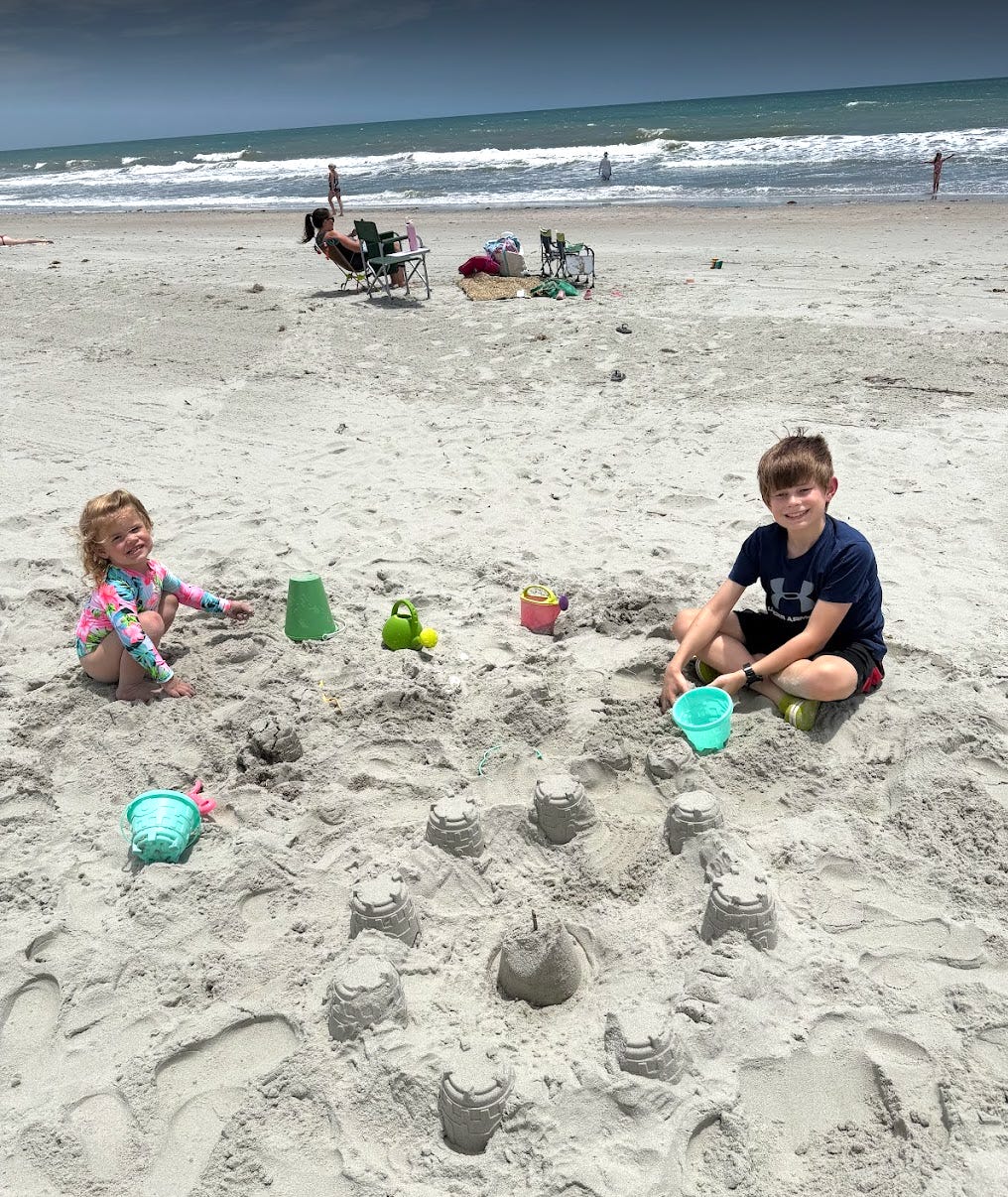
My children did that for me at Myrtle Beach this past week. They reminded me that places are not exhausted by adult naming and development. They reminded me that attention is often playful before it becomes analytical. They reminded me that the world’s capacities are disclosed through contact, not distance. Sand under fingernails, salt in hair, tired bodies in the backseat, sunburns, a shell carried home with great seriousness ... these are not interruptions to thought. They are thought returning to contact the world.
That’s why the shore stays with us after we leave it. It’s not because the shore gave us an escape from ordinary life, but because it quietly altered what ordinary life can hold. The beach acted on us. We acted on it. For a week, my children moved through a Carolina coast alive with potencies, some ancient and some newly discovered, some ecological and some familial, some already in act and some still waiting for the right form of attention.
The shore allowed all of that. And for a little while, we were able to notice.
Absolutely beautiful and poignant. Spot on. I'm remembering Ocracoke and the grands, their temporary beach friends, kids somehow join together for castle building and screaming at waves, never to meet again.
I am heading for the coast this week. It isa magical place. My father lives near Holdon Beach, NC.