


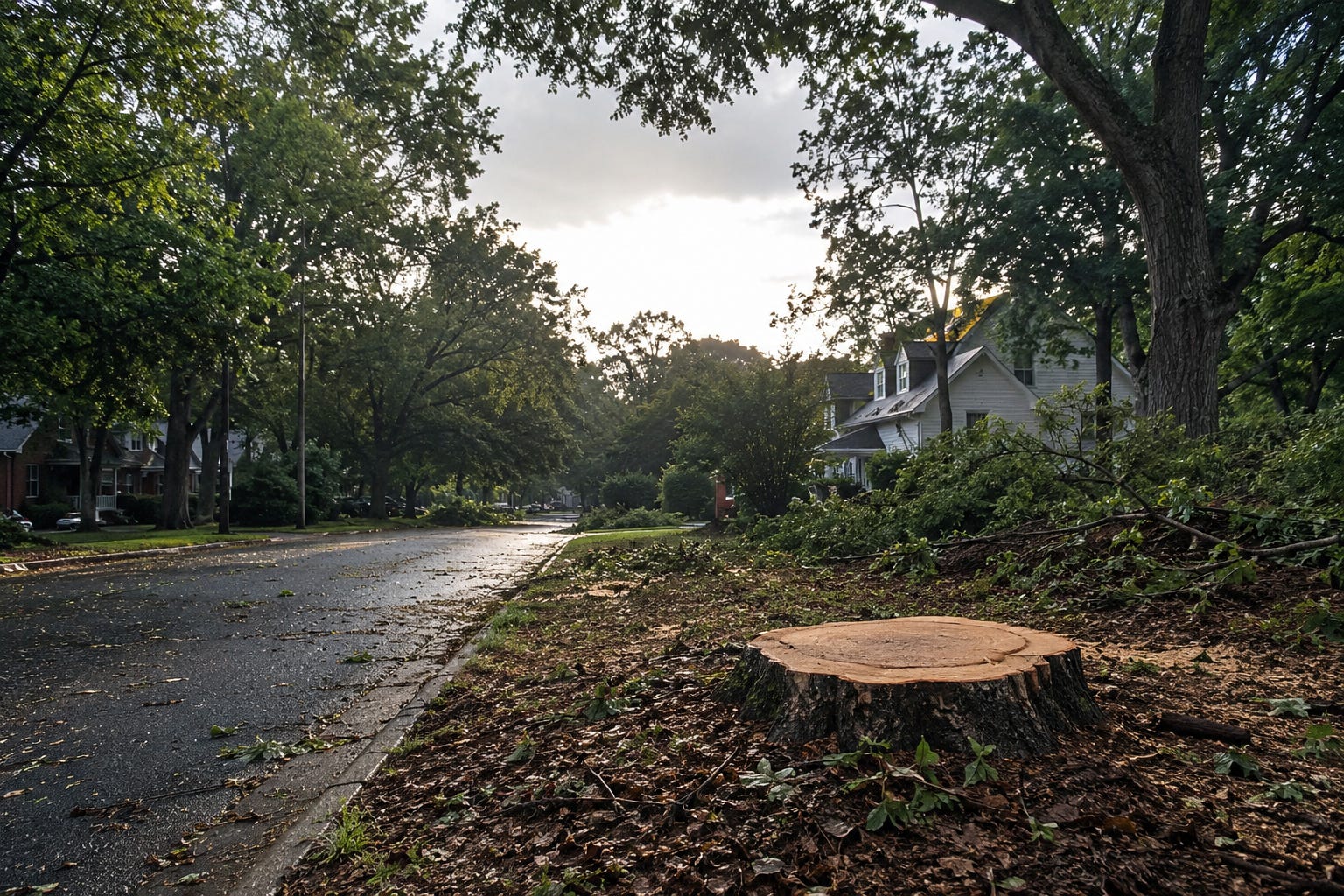
We live in a beautiful leafy neighborhood in Spartanburg. I can see the watershed of the creek we decided to dam in the 1930’s to create a lake out of my office window. When it’s raining, I can hear the water passing by. There’s a major half-marathon and 10k (Merianna is running!) going through the neighborhood this morning under the canopy of oaks, maples, walnuts, and cypresses that line the main street and side streets. I’ve cataloged well over 100 species of various birds, owls, hawks, ospreys, and geese over the past few seasons just in our yard alone (thanks to the incredible Merlin app from Cornell).
Our neighborhood was devastated by Hurricane Helene in the Fall of 2024. We lost countless trees, from solid oaks to the ever-present pines, as we took the main brunt of the storm early that September morning. Duncan Park looks different today than it did in May 2024. Houses are still being rebuilt and remodeled, and you’ll occasionally see a Lorax-like tree stump in someone’s yard as a reminder of that event.
Yet, we’ve bounced back as both humans and vegetal life in this little corner of Spartanburg, known for its shaded streets and great neighborhood vibes.
Still, there was something almost liturgical about the sound of chainsaws echoing across our street yesterday. The sound, vibration, and smell of fresh pine and oak death wasn’t sacred in any comforting sense, but ritualistic all the same. The grinding repetition began sometime after breakfast when I got home from taking our youngest to school and continued for hours into the late afternoon across the street from our house. One tree came down, then another, then another. Limbs crashed against the earth with that strange combination of violence and finality that only accompanies the falling of something that has been alive longer than many of the people watching it.
And I found myself asking a question I suspect many people quietly carry but rarely voice aloud...
Why do we cut down trees in our yards?
Of course, there are practical answers. Some trees are “diseased.” Some threaten roofs or foundations. Some people fear storms after Helene. To my disdain, insurance companies often encourage removals. Developers prefer clean lines and open lots for efficiency’s sake. Our non-native but oddly prized green crabgrass and Bermuda grass grow more easily in uninterrupted sunlight. Leaves clog gutters while roots “disturb” sidewalks.
Trees are messy in the same way human life is.
But standing there yesterday listening to chainsaws tear through our neighborhood canopy, I realized the practical explanations only explain part of the story.
What struck me most was how normal it all seemed.
No one gathered in mourning. There wasn’t any paused traffic as we do for human funeral processions here in the Carolinas. No one seemed to lower their voice. The removals happened with the ordinary efficiency of suburban maintenance. By dinner, the trunks were already sectioned into neat cylinders. The canopy that had filtered afternoon light onto that street for decades was simply... gone.
And perhaps that is the deeper question beneath the ecological one. Not merely why we cut down trees, but why we have become so accustomed to their disappearance.
Obviously, I have been thinking a great deal lately about attention as an ecological practice with my PhD work. About perception itself as a moral and spiritual act. Thomas Berry often wrote that the ecological crisis is fundamentally a crisis of relationship. I increasingly think it is also a crisis of perception. We do not destroy what we genuinely perceive as alive within the horizon of our own existence. We destroy what has become background.
A mature oak becomes “shade,” while a maple becomes “yard debris.” A stand of pines becomes “property value” or timber assets to eventually “harvest” and sell. The tree ceases to appear as a living participant in the world and instead becomes an object, obstacle, or commodity within a human-centered landscape.
This is not usually cruelty. That would almost be easier to confront. It is something quieter, perhaps more unsettling... indifference produced by habit.
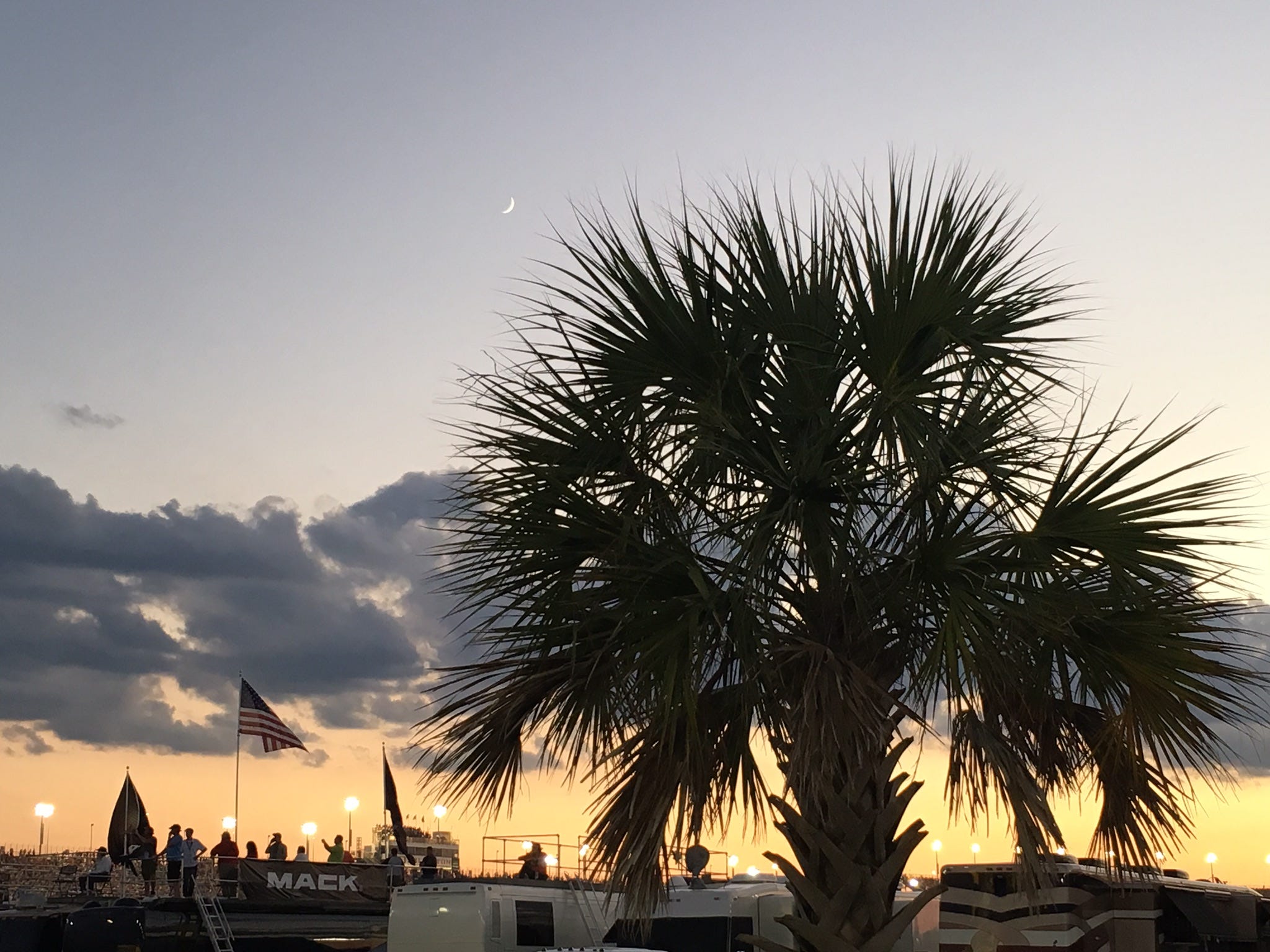
Growing up in South Carolina, trees have always been there as part of my history and perception. Longleaf pines along interstates and highways, and dirt roads of Marion County. Water oaks leaning over parking lots in Hilton Head. Pecans in old yards all over Florence. Sweetgums dropping those impossible spiked balls that turn into great pretend objects, from grenades to baseballs for children growing up in Latta every autumn. The ubiquitous Sabal Palm is on our state flag and lines our Atlantic coast (and a few yards here in Spartanburg). Trees formed the architecture of memory itself. You measured neighborhoods by them and summers by them. Their shade altered entire emotional geographies. Even now, when I think about childhood, I often remember trees before I remember buildings or even fellow humans.
I can see the Sweetgum in my grandparents’ backyard in Temperance Hill in my mind.
Yesterday’s chainsaw chorus and dirge also reminded me how physically visceral tree removal feels. The sound really bypasses abstraction. You feel it in your chest. The vibrations travel through walls and windows with an alarming thud when a solid and alive oak lands suddenly. It unsettles birds, and dogs bark differently. Even the light changes almost immediately once a canopy disappears. A yard that felt sheltered in the morning suddenly feels exposed by afternoon.
There is a phenomenology to tree loss that environmental discourse often misses. We talk about carbon sequestration, heat islands, runoff mitigation, biodiversity, and property values. All of those matter, obviously. But there is also the immediate lived experience of absence. A street feels different when older trees disappear. The scale of things changes. Time itself feels altered. Older trees bring a sense of temporal depth to neighborhoods. They silently witness generations.
Edith Stein’s work on empathy comes to mind, especially her insistence that perception is never neutral. To perceive another being as alive requires a kind of openness that exceeds utility. Perhaps ecological intentionality begins precisely there... in learning again how to perceive the more-than-human world not as scenery or resource but as neighbor.
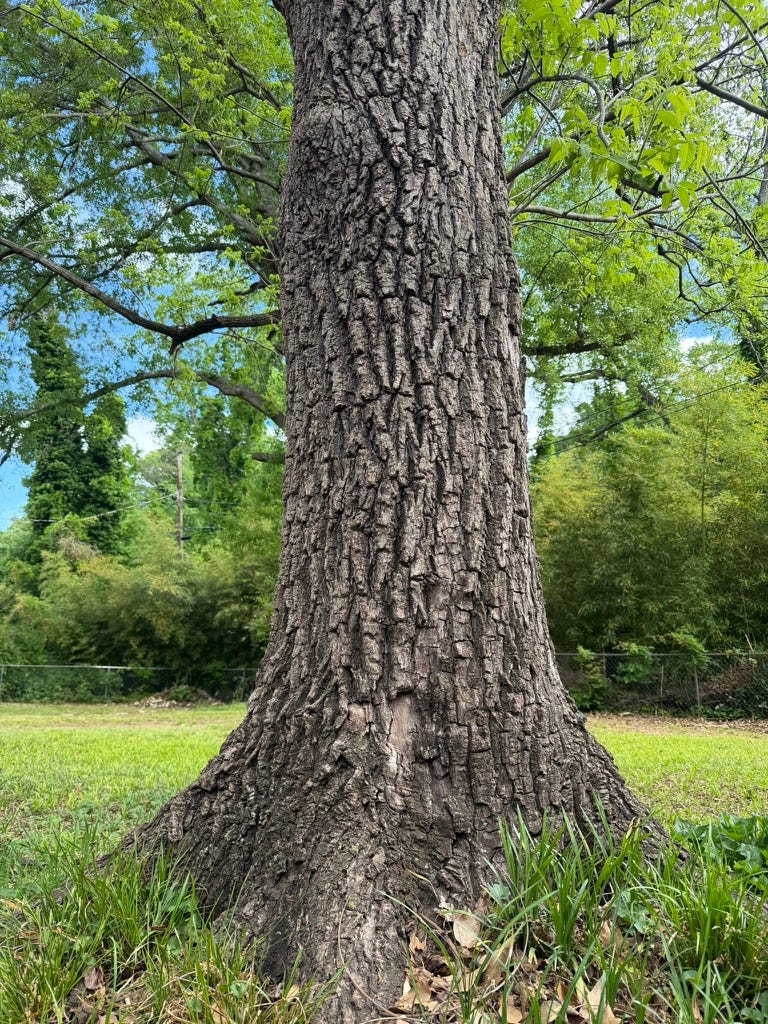
That sounds overly romantic to some, I know. And yet anyone who has sat quietly beneath a mature tree shortly before a Carolina summer thunderstorm probably already understands this intuitively. Trees shape consciousness. They alter acoustics, humidity, imagination, memory, and even prayer. They are not passive decorations around human life. They participate in the worlds we inhabit.
Which returns me to yesterday.
I do not know why those particular trees were cut down. Maybe there were entirely legitimate reasons (the house was recently purchased, and I haven’t met our incoming neighbors yet). Maybe the owners had worried about storm damage, roots, or decay. I’m not interested in condemning neighbors from across the street by any means.
But I do think the question matters.
Because every removed tree reveals something about how we imagine our relationship to place. Whether a yard is merely owned space or a shared habitat. Whether shade is an inconvenience or a gift. Whether we understand ourselves as managers, stewards of landscapes, or participants in living ecologies.
Late yesterday evening (after the chainsaws finally stopped), the street became strangely quiet. Too quiet. The birds had relocated somewhere else for the night. The remaining trees stood at odd new angles against the sky because the canopy had been interrupted. I walked outside after dinner and instinctively looked toward the gap where branches had been that morning.
And for a moment, Duncan Park felt just a little less alive.
I'm always heartbroken when trees are cut down. I live in a neighborhood that was developed from farmland in the 1950s and many of the trees planted by the original developers, mostly maples and locusts, are being cut down and nothing planted in their place. The neighborhood has much less shade. I haven't heard owls calling at night in a few years and they used to call all the time. There was an undeveloped tract behind the houses across the street from us that had a marshy area and a vernal pool and the spring peepers used to sing there. The trees were all cut down and a new street paved and new houses are going up and the peepers are silent. We are all so sad.
When I was 9 years old, living in North Georgia, there was an ice storm that was catastrophic for the trees. I remember lying in bed, probably in tears, as I listened to the pines in the thicket breaking one after the other from the load of ice. That pine thicket had been my favorite place on the farm.
But your observation made me think about what old established oaks represent in Chattanooga. I think that established trees go along with wealth, clearly not all the time there are plenty of established trees in poor neighborhoods. But as we make way for new housing, especially for affordable housing (because we are pushing people out of the inner city that is being gentrified), a lack of old trees is a given, often a lack of ANY trees at all is common. When I think about driving up into North Chattanooga to the richest area that we have, there are so many old established trees it's really quite amazing. Or up on Missionary Ridge, which is my favorite part of town. Not just established trees, but what feels like a rooted-deep forest.
I also thought of the truth that you explore here that losing trees feels like losing history and grounding. A couple houses down from us, I don't remember exactly what happened, maybe a lightning strike, maybe it was hit by a car, but this old oak went down and the landscape of the street is forever changed. But as you have observed here, in time we will forget all about it.
Actually, before I read your post, I was thinking about trees, thinking about the "Lone Tree" in a pasture somewhere, the lone tree that flourishes all by itself. Maybe because it doesn't have other trees around it. Maybe it isn't lonely at all, maybe it feels quite privileged to have all of that sunlight for itself. I was wondering what it would feel like, to live on a pasture all by myself.
Trees represent stability and stability represents a kind of wealth I cannot aspire to, at least in my town. But there is an old, impossibly tall tree in my backyard. It needs to be taken down. It is choked with ivy. But the squirrels frolic up there, birds rest there from time to time.
I guess I'm waiting for it to fall. But not on my house. Let it fall on someone else's house. Let it have its own way. How selfish is that? Am I that selfish?
But we've lived here for over thirty years. So far, so good.
Which brings me to the selfishness of trees. Behind our house there's a small ridge and there are two trees that have outdone all the other trees and grown very tall, sucking up more than their fair share of sunlight. I don't know much about trees. The very sad dogwood trees in my front yard are evidence of this. But I wonder how greedy trees like the ones on the ridge behind my house will eventually affect the little woods up there. And how it would feel to live here with no woods on that ridge, nothing but a few greedy trees.
(btw, I grew up on Temperance Hall Road)