


Rain falls on our roof here in Spartanburg, runs off the eaves, crosses our beloved yard where the black walnut is already darkening its fruit in early August, and makes its way to Lawson’s Fork, then the Pacolet, then the Broad, and at last to the Atlantic. Every house in Spartanburg County sits on a slope of some sort (ours especially, as I constantly realize when mowing with my late 40’s physique), and the slopes decide where the water goes. We spend a great deal of our lives thinking about home as a house, a hometown, a deed, a mortgage, a set of keys, a line on a map that says this is ours and that is theirs. But while home can mean those things, it’s more of a slope down which the rain runs in this part of what we call the United States. The water knew the shape of this ground long before the county drew a single boundary across it, and it will keep knowing that shape long after we take literally Prospero’s incantation about the sleep that comes after our little lives.
I’ve been learning this slowly since we moved back to Spartanburg a couple of years ago, and mostly by just sitting still. Most mornings, I take my regular but not regularly washed titanium coffee cup (I say it’s growing a patina) out under the walnut before the day organizes itself into my errands and emails and the ordinary noise of a house with young children in it. Nothing all that dramatic happens. A squirrel argues overhead. A cardinal couple cuts across the yard. Black ants keep their bright roads through the red clay and inspect my feet. A walnut falls, then another, with that small wooden knock against the day’s closed door. Given one such morning, this is nothing. Given enough mornings, the tree becomes a kind of tutor. It receives weather, injury, drought, birds, and time without hurry, and it teaches me that attention is a discipline rather than a mood, no more summoned by wanting it than sleep is. I go out to learn what the world is saying before I ask it to mean something for me. Getting the order backward is when things typically start to go wrong.
Some of this I’ll be saying aloud. The Unitarian Universalists here in Spartanburg have given me their pulpit for two Sundays in August, the 16th and the 23rd, under the heading Home Ground, and I wanted to share a little of those messages here as well. The first Sunday is a reflection on the yard and the creek that I look at from my office window. The second follows the water outward into the harder questions of what a place asks of us in common.
What the walnut has been teaching, in its patient and wordless way, is that I didn’t make this home so much as it has been making me. The Hebrew of the second creation account in Genesis keeps the joke close to the surface: the human, אָדָם (adam), is drawn up out of the ground, אֲדָמָה (adamah), earthling from Earth (little Bowie-esque, isn’t it?), and set in the garden to serve it and keep it. The pun doesn’t survive the trip into Greek, where adam becomes the generic ἄνθρωπος (anthropos or human), and the ground flattens into γῆ. I think something of the meaning gets lost in translation. To be from a place, in the older and stranger sense, is to have been formed by it. Ask where you live, and you’ll name a street. Ask the water, and it’ll give you a different address entirely: you are downstream of your neighbor to the north and upstream of your neighbor to the south (unless you’re on the Nile), and the rain that crosses your roof is already on its way to someone else’s well or town.
Edith Stein’s account of empathy begins in an unexpected place, and her word for it, Einfühlung, or feeling-into, points to it. My own body, she says, is always the null point of orientation, the Nullpunkt der Orientierung in that wonderful German, the here around which every there arranges itself. I can’t get outside it. The world comes to me arranged from where I stand, and left to itself, that arrangement presents its own appearance of things as though the appearance were simply the world. What breaks the spell is another person or more-than-human. In empathy, I grasp that the other carries a world of their own, ordered from a center that’s not mine, and that their picture is just as valid as my own. Only then do I come to see my own standpoint as one standpoint among many, rather than the measure of what is real. The genuinely shared world is never given from a single vantage, despite what our current influencer culture wants us to believe. It’s constituted across all of them together, or it isn’t constituted at all. A self that takes its own orientation as the standard hasn’t yet reached the world. It’s reached only its picture of the world, and mistaken the two.
I dwell on Stein here and in my academic work because I think perception has to come before ethics, and empathy is where the two meet. You can’t love a neighbor you haven’t first perceived as a center of their own life rather than a feature of yours. And what’s true of persons turns out to be true of places, and of the water that binds a place together. The watershed is the physical fact that answers to Stein’s philosophical one. It’s the shape of the home that won’t stay private. Water crosses property lines without asking, joining the well and the wastewater, the creek and the reservoir, the data center and the subdivision, and the forest into a single body that no one owns and everyone’s inside of. To live in a watershed means living in a shared world, whether or not we’ve consented to it, whether or not we’ve noticed.
Which brings me to the harder half of this, and to why I’ve been writing about data centers all summer in this space that is mostly about a tree.
A single large data center of the kind now proposed across the Carolinas can draw hundreds of thousands of gallons of water a day. The NorthMark project on South Pine Street here in Spartanburg County, a 457-megawatt facility, has been projected at something near 460,000 gallons a day, and a good deal of what a center like that takes in for cooling leaves again as evaporated water vapor. That water doesn’t come back down the creek. There’s a real engineering difference between a closed-loop system that recirculates its water and an evaporative one that consumes it, and that difference is the kind of thing that gets decided in rooms most of us never enter or are invited to attend. Permits are public, and comment periods are open, and then they close. The Southern Environmental Law Center has sued Spartanburg County over how this one was permitted, arguing that a single large development was waved through as two minor land developments rather than one major one, each parcel small enough on its own to slip beneath the threshold that would have triggered real scrutiny. The county’s defense, roughly in my own take, is that industrial parks have always involved more than one parcel. You can hear in that exchange two different accounts of what a place is.
In Stein’s terms, this comes across more clearly than the usual language of “sides” allows. A permit application knows the Körper, the body, as a measurable thing, so many parcels, so many acres, so many gallons, so many megawatts. It doesn’t know the Leib, the lived body, the creek as a neighbor rather than a resource, the watershed as a home rather than a site. Neither of those is a sentimental addition to the facts, but they are the facts perceived from the standpoint of the people and the more-than-human lives that actually live downstream. The deep question a data center puts to a county isn’t only how many gallons. It’s whose orientation gets to count as the standard, and who is expected to live with a world constituted entirely from someone else’s zero point. A hearing that the affected are informed of only after the decision is made isn’t a bad decision. It’s a world built from a single vantage and mistaken for the world.
Scripture, when it turns to this, doesn’t really make this any more palatable for the non-empathizers. Jeremiah writes to exiles who didn’t choose their city and tells them to build houses there, to plant gardens and eat what they grow, and to seek the welfare of the place, its שָׁלוֹם (shalom), the Septuagint’s εἰρήνη, because in its welfare they will find their own. It’s a startling instruction, in my opinion. Seek the flourishing of a home you hold in common with people whose experience of it differs sharply from yours, and understand that your good is bound up with theirs, whether you like it or not.
And Amos, closing the circle, gives us the image everyone sort of half remembers from historic speeches: let justice roll down like waters, and righteousness like an ever-flowing stream. The Hebrew there is נַחַל אֵיתָן (nachal eitan), a wadi that runs year-round, or a perennial creek. The Septuagint renders it χειμάρρους ἄβατος, an impassable winter torrent, the kind of dry bed that fills after the rain and then sweeps everything before it like a wild river when the snow melts in the Sierras. A perennial stream and a flash flood are two different theologies of justice, the steady and the sudden.
We live in a watershed that does both. Some of the work of a place is slow, the widening ring, the hidden labor of root and rain. Some of it arrives all at once, reorganizing the ground. My college mentor, Larry T. McGehee (himself a great writer of this type of piece under his Southern Scene banner in the local Spartanburg Herald Journal), once told me that I had too much “righteous indignation” while we had burgers at Ike’s, and I was complaining about a local politician. He told me to see the work of the place and observe the great turning. He wasn’t wrong, as I learned 26 years later from Joanna Macy. Big and small. Slow and fast. You and me. Dualities are the key.
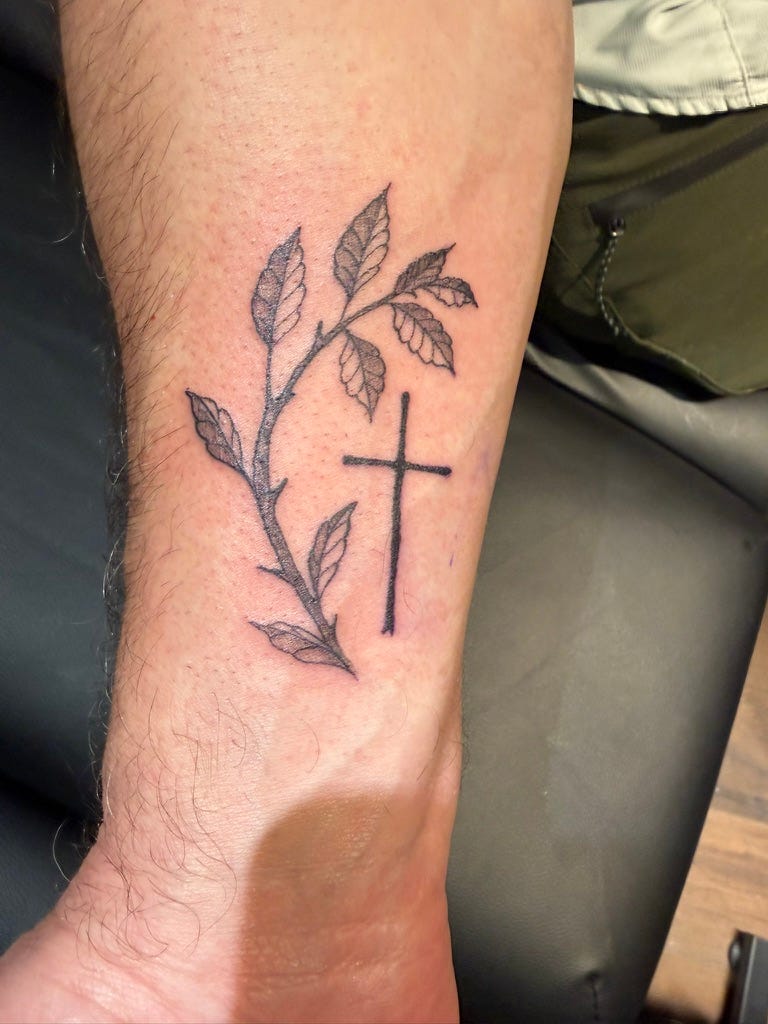
I keep returning, at the end, to the same rough crown of limbs at the top of the black walnut in our yard. The cross, before it was doctrine or ornament, was wood. It was a tree before it was a theology, sap and leaf and a body eating light from the same sun that warms my hands on an ordinary Carolina morning. If grace is anything, I’ve come to think it is less a rescue arriving from elsewhere than something greening up through what has already been given (thanks, Hildegard): this soil, this water, these children growing louder and more opinionated, this creek that is also, inconveniently and gracefully, my neighbor’s. A walnut falls. The sound is small, almost comic, and always startles me since I’ve learned not to wear AirPods when visiting the walnut. And still I hear it as an invitation, the same one the watershed has been extending all along. Pay attention. Nothing here is only here. Even the bruised fruit splitting in the grass is busy becoming food, and stain, and shadow, and prayer, and part of the long common life we have been given to keep.
Love this essay. Thank you.