


For the last several years, one of the most important places in my academic work has been a black walnut tree behind our house in Spartanburg, South Carolina. I sit beneath it, photograph it, record myself talking while I watch it, notice when the walnuts begin to fall, when leaves yellow, where branches have been damaged, how the canopy moves in the wind, and how exposed roots disappear beneath violets and grass. Sometimes I bring a philosophical question. Sometimes the tree gives me a different question before I get very far with the first one (most often the case).
What began as a practice within my doctoral coursework in Religion and Ecology at CIIS has gradually become one of the places where I test my larger project, ecological intentionality. That word “test” has become increasingly important because I do not want the black walnut to illustrate a philosophy I have already figured out is true. I want the encounter to show me where the philosophy fails.
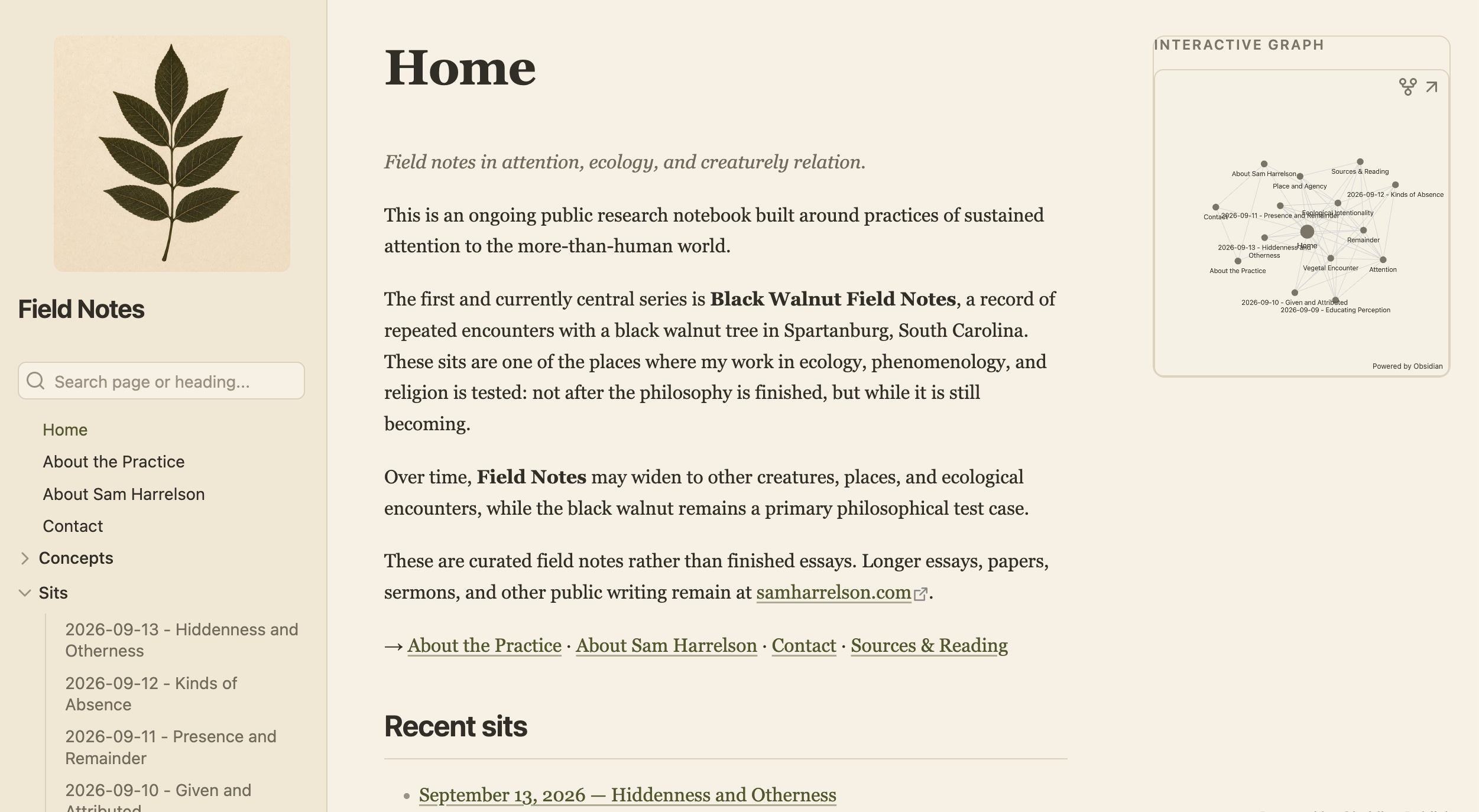
That is why I recently built a new public layer of this work at ecologicalintentionality.org. I’m calling the larger project Field Notes, and its first and currently central series is Black Walnut Field Notes. The site is not a dissertation draft, and it’s definitely not a public dump of my private research notebook. It sits somewhere in between as a curated record of encounters in which a philosophical argument can be seen taking shape, becoming more precise, and sometimes being forced to retreat.
That distinction between the private and public layers is important to me. My private field journal is intentionally messy, containing audio transcripts, photographs, half-formed thoughts, bibliographic questions, mistakes, conceptual leaps, drawings, and moments when I realize I have described something as though I perceived it when, in fact, I inferred it. That mess is useful because it preserves the actual movement of the encounter rather than retrospectively making everything look more orderly than it was.
The public Field Notes here are different. After a sit, I return to the raw record and ask what actually changed in the encounter each day… what became visible, what assumption failed, what question became harder, and what deserves to be carried forward.
That resulting workflow looks something like sit → private field note → philosophical analysis → research integration → curated public field note. The public note is, therefore, not simply a shortened version of the private one; it is an editorial act.
Over the last week, I have watched that distinction begin to produce something I’d hoped for but couldn’t really plan for. The field notes are becoming an argument in themselves. The first recent note is called “Educating Perception.” I had been thinking about whether sustained attention changes what becomes perceptually salient, especially after years of sitting with this particular tree and learning to notice growth, repair, orientation, damage, relation, and seasonal transformation in ways I hadn't initially noticed.
But that immediately raised a problem. Am I actually perceiving those things, or am I applying concepts I have learned? The following day last week therefore became “Given and Attributed.” I tried to remain as close as possible to what was sensibly present: leaves moving, bark texture, shadows, exposed roots, sound. And I began catching myself crossing boundaries.
The leaves “eat the sunlight.” A branch “reaches.” The tree “responds.” These descriptions may not be wrong, but neither are they identical to what appears directly to perception. That sit produced a question that has stayed with me: Can the tree appear as a living center without me having to imaginatively occupy its life?
The next note became “Presence and Remainder.” The more carefully I attended, the more the walnut seemed both present and incomplete. From where I sat, one side of the trunk appeared while the other remained hidden. Some leaves were visible head-on, some edgewise, others obscured behind branches. A few roots emerged above the soil while most of the root system remained invisible.
Greater attention did not make the tree fully available. Instead, it made the character of its unavailability more precise, and that gave me one of the lines I suspect will remain important for the larger project: The more determinately the walnut appears, the more determinate its excess over its appearance becomes. But the next sit over the weekend complicated even that. What exactly do I mean by “excess”?
The unseen back of a tree trunk exceeds what I presently perceive, but I can stand up and walk around the tree. What was hidden becomes visible. That is very different from saying that the walnut possesses an interiority that I cannot enter, so the next field note became “Kinds of Absence.”
Some absence is perspectival. Some is temporal. Some belongs to memory, anticipation, biological knowledge, or inference, and perhaps some otherness is irreducible. But perhaps not.
That distinction forced me to write down a methodological warning that I keep on an index card when I do my sits: living ≠ interiority ≠ subjectivity ≠ empathically accessible other.
Those terms are easy to slide between, obviously. The fact that the black walnut is alive does not by itself establish an experiential interiority. Biological organization is not automatically subjectivity. And even if some form of vegetal experience can be philosophically defended, that does not establish that I encounter it through something analogous to the empathy Edith Stein describes between human subjects.
The most recent sit from this morning before church, “Hiddenness and Otherness,” brought the problem into sharper focus. I found myself distinguishing two sentences: “Hidden from me because of position; other to me as another being.” The first is comparatively easy. My body occupies one place, and the tree occupies another, and its opacity prevents every profile from appearing simultaneously. Movement changes what I can see, and phenomenology has very good language for this.
The second sentence is much more difficult. What would warrant my saying that the walnut remains other to me not merely because I lack a certain perspective, but because it is another center of life whose mode of being cannot become mine? That is currently an open question, and keeping it open is becoming one of the project's most important disciplines.
My comprehensive examination work this fall is forcing me to test ecological intentionality against Edmund Husserl’s phenomenology much more rigorously than I previously had. Maybe I do not need a new philosophical category. Husserl already gives an extraordinarily sophisticated account of embodied perception, profiles, horizons, memory, anticipation, passive synthesis, constitution, and the way an object can remain identical while appearing differently from different positions. If those resources adequately describe what is happening beneath the walnut, then I need to say so.
Likewise, Edith Stein’s phenomenology of empathy gives me a powerful way to think about another being as genuinely given, even as its experience never becomes primordial for me. But extending that account from another human subject to a plant cannot simply be assumed. The walnut has to be capable of saying no, not literally, of course, but philosophically. It has to be able to resist the concepts I bring to it.
That may be the deepest reason I wanted to make these field notes public. Academic writing normally presents arguments after much of the uncertainty has been removed. We encounter the finished article, chapter, dissertation, or book, while the false starts and abandoned categories disappear into the archive. There are good reasons for that, but ecological thinking may benefit from leaving a little more scaffolding visible.
It matters that a concept that seemed compelling on Tuesday looked less secure beneath a black walnut on Saturday. It matters that I sometimes say more than perception warrants, and it matters that repeated attention changes both what I notice and what I realize I do not know. The black walnut is therefore not merely material upon which philosophy operates. It is a recurring resistance within the work.
That resistance is also why I have come to enjoy the graph that accompanies the Field Notes site. Each sit is connected only to concepts that actually became important during that encounter: Attention, Remainder, Ecological Intentionality, Vegetal Encounter, Place and Agency. As the archive grows, those connections become visible, and the graph is already beginning to show something that a conventional table of contents cannot.
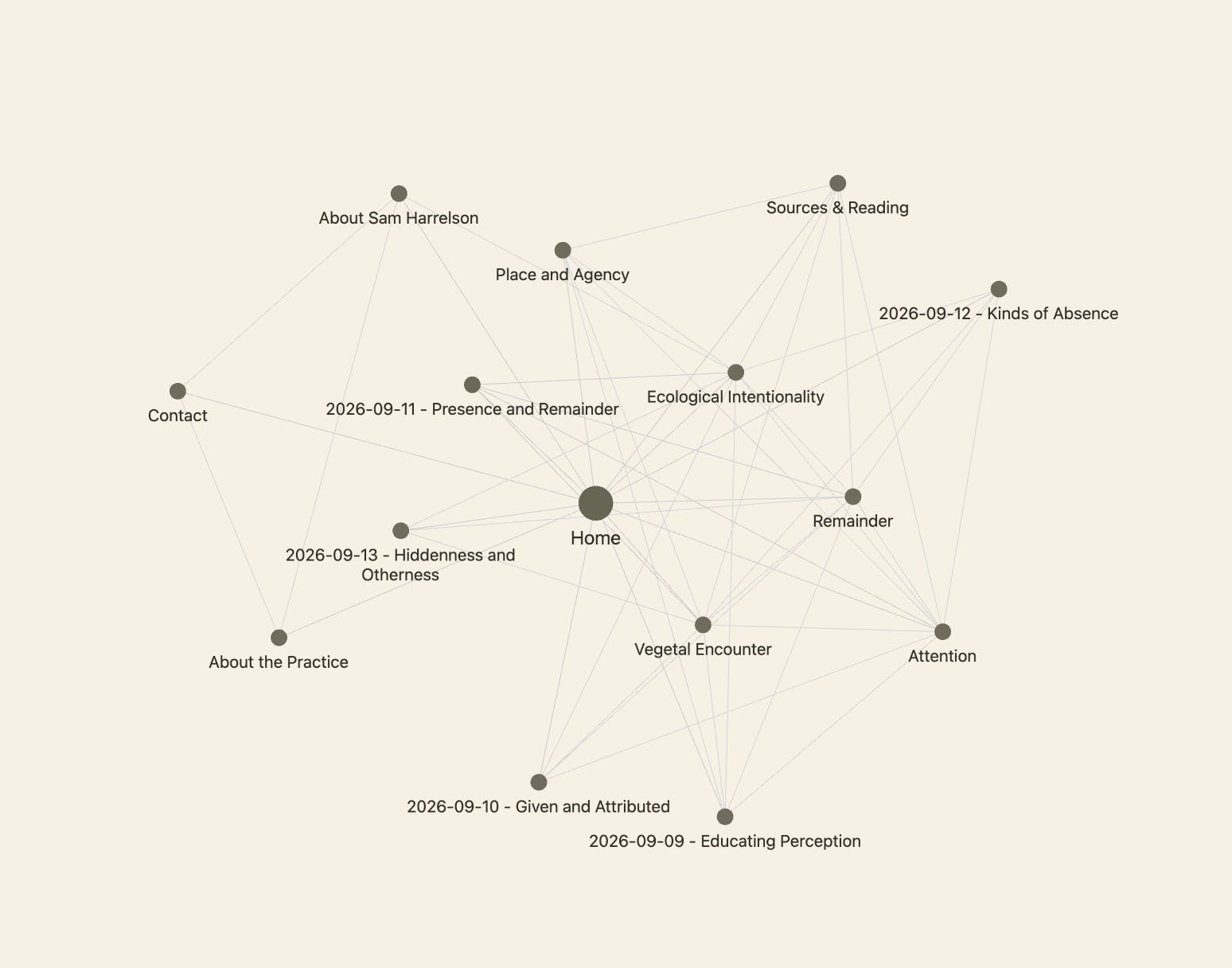
The fieldwork isn’t moving in a straight line, as nothing really should (as the more-than-human world teaches us and Wendell Berry pointed out). Questions return, concepts gather around particular encounters, and some themes become unexpectedly central while others remain peripheral. I don’t know what that graph will look like six months from now, and that is part of the experiment. I also don’t yet know what ecological intentionality will finally mean, even at this stage.
It may turn out to name a distinctive phenomenological structure. It may instead name a disciplined configuration of already familiar intentional structures, or it may eventually make more sense as a hermeneutical, metaphysical, or theological term than as a strictly phenomenological one. Those possibilities remain open. What I know with much greater confidence is that repeatedly returning to one living being has changed the question's quality.
There is something different about having to ask a concept to survive twenty minutes beneath a particular tree. For now, that is what the Black Walnut Field Notes are for. They aren’t meant to prove ecological intentionality, make a tree speak in a human voice, or transform every encounter into an argument. They are meant to help me return, attend, distinguish what is given from what I bring with me, notice where inference begins, leave some things unresolved, and let the philosophy become answerable to the encounter.