


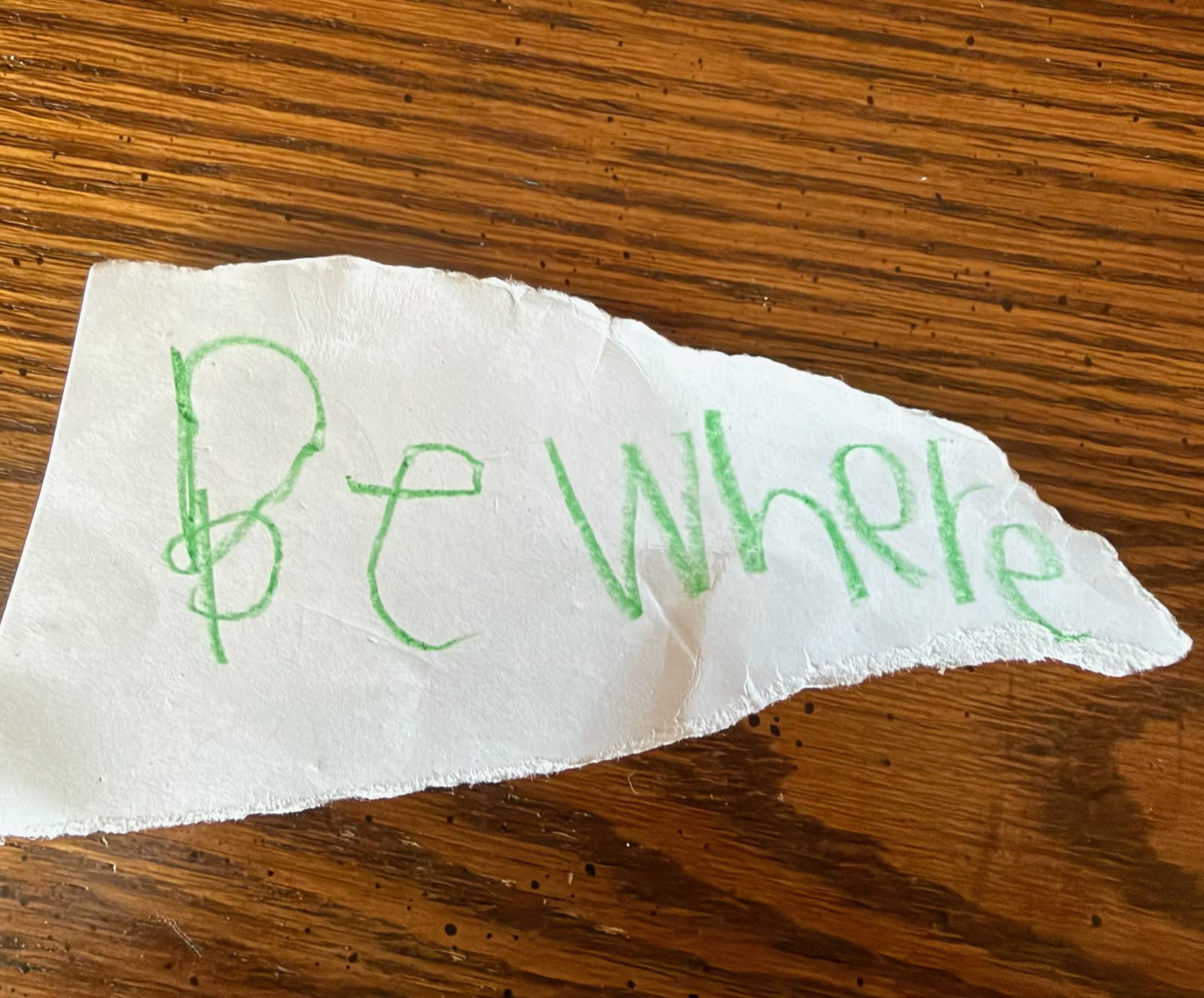
Sometime last week, our daughter taped a sign to her door, about the height of a four-foot-tall person. It’s a strip torn off the long edge of a sheet (she makes lots of these ostraca), with the tear feathered where the fibers gave. Seven letters running down the length of the strip instead of across it, so that anyone in the hallway has to tilt their head to take it in.
Bewhere.
I asked her about it, and she laughed the way she does when I’ve missed something obvious, and said she meant beware, like a sign. “Beware of what?” I asked. She said that was the point of a sign like that. Beware!
I’ve thought a good deal about the spelling in little free moments while preparing to give a Meditation series at the Spartanburg UU yesterday and this coming Sunday under the wider theme of “Home.” It’s a better instruction than she knows in some ways. Her admonition is also closer to the inside of the word than the correct spelling is.
If you haven’t gathered from my previous writings, I’m a language nerd (mostly after taking a course on the 14th-century poem Piers Plowman while a seminary student at Yale Divinity after taking 3 years of Greek in undergrad at Wofford College), so beware yourself, dear reader. But it’s worth the background, I think!
Beware is what we call a compression. In Middle English, it’s be war, from the Old English adjective wær: prudent, watchful, on guard. The same root gives us aware, wary, warn, ward, warden, and, by way of Frankish into Old French, guard. Etymologists trace the original root back to the mysterious (and incredibly cool concept) Proto-Indo-European *wer-, to watch, to perceive, to look out for. The Attic Greek (a language itself with something of an enigma of origins) ὁράω (to see) to that same root, along with οὖρος, a watcher set over something. This means a warning of “beware!” is a demand for perception rather than a demand for fear. Beware doesn’t tell you what to do, but tells you to look.
The Koine Greek of the New Testament preserves some of this in a fascinating way, theologically as well as just historically. Where our translations say beware, Matthew has προσέχετε (lexical form προσέχω): προσέχετε ἀπὸ τῶν ψευδοπροφητῶν, beware of false prophets. The verb is πρός plus ἔχω, to hold toward. Classical usage from sources outside the NT gives us more insight into the term's usage, as in Matthew’s: hold your mind toward. Nothing in the word says danger. It says direction, an act with an address, a mind aimed. Mark’s version of the same imperative is βλέπετε (βλέπω), look, followed by ἀγρυπνεῖτε, stay wakeful. Watchfulness, again, is the whole content of the warning. Big difference for those passages that we so easily read over in the Christian tradition(s).
And then Luke, in the twelfth chapter, sets two verbs side by side: ὁρᾶτε καὶ φυλάσσεσθε ἀπὸ πάσης πλεονεξίας. See, and guard yourselves, from every greed. That second verb, φυλάσσω, is the one the Greek Septuagint translation of the Hebrew Scriptures (which itself was used by authors of the New Testament and deutero-canonical books that didn’t make it into the official canon) uses in Genesis 2:15 for the work the human being is put in the garden to do: ἐργάζεσθαι αὐτὸν καὶ φυλάσσειν, in the Hebrew לְעָבְדָהּ וּלְשָׁמְרָהּ, to till it and to keep it.
The verb for beware and the verb for keeping a garden are one verb! Warning and husbandry are the same posture held at different distances.
Every posture has a location. This is where my daughter’s spelling made me stop, laugh, and shake my head at the wisdom of our young people.
Edith Stein, working through the structure of empathy in 1916 in German, gives the body an essential aspect: the Nullpunkt der Orientierung, or the zero point of orientation. My living body is the here from which every there gets measured. Distance, direction, near and far, all of it is reckoned from a point I can’t step out of, and empathy is the act in which I take up someone else’s here without vacating my own. Rather than being a survey from above, perception happens from a spot on the ground.
So a warning with no location isn’t a warning. It’s noise. To be warned is to be told that the place you’re standing in has become consequential.
There’s a warning in my backyard that nobody wrote about in ancient Greek or Hebrew or Old English (that I’ve come across, at least). The black walnut produces juglone, a compound concentrated in the roots and the green hulls, and the tomatoes I’ve tried to grow within its reach yellow from the bottom up and quit by July. Blueberries won’t hold. Apples decline (the crabapple tree I planted across the yard early this year is doing quite well, though!). There’s an edge to this warning. It’s true inside the root zone and mostly false outside of it, and on a mature tree those roots run well past the drip line, fifty to eighty feet out from the trunk, an irregular circle that no one has marked and many gardeners here in Spartanburg and the Piedmont learn by loss. That circle is the entire content of the warning. Take the chemistry out of the radius, and there’s nothing left to say. The walnut’s beware is a where.
That's also what I keep failing to explain in my writings about things like data centers here.
Most of what I’ve written this year has come back to a single failure of location. A 457-megawatt data center gets permitted on South Pine Street as two minor land developments instead of one major one, and the defense offered is that industrial parks involve more than one parcel. The parcel lines are real on paper. However, water isn’t distributed by parcel lines. 460,000 gallons a day of evaporative loss (estimated) doesn’t consult the plat. Heat doesn’t stop at a property boundary, and neither does the sound of the cooling. When the where gets dissolved into acreage, the warnings stop working, because a warning attached to no particular ground can be satisfied by moving a line on a map. That’s what a variance is, most of the time: a place talked out of being a place.
Ecology has this argument built into its own name. Οἶκος, the household, the dwelling. Rather than a systematic approach in the abstract, this implies the particular arrangement of a particular house: its doors and its thresholds, who comes in, and by what route. A seven-year-old taping a strip of paper to her door is doing ecological work in that sense. She’s declaring an edge just like the black walnut. The Carolina Wren on the fence line does it every morning from the same post. The black walnut does it chemically, through the soil, and has been doing it well before we moved to our home. An edge announced is an invitation to arrive correctly, and the sign on the door is only half a fortification. The other half is an address, so that anyone coming down the hall knows there’s someone in here to be met.
Beware. Be where.
I’ve stopped correcting the spelling in my own head when I see her sign on her door. The hulls from the black walnut started falling a few weeks ago (a little early… I believe it’s drought stress) and rolling under my shoes in the dark, and the ground under that tree already smells like turpentine and citrus when I take my coffee out to say good morning to my good friend. None of that is available anywhere except there, at the end of the hall and out the back door, one hundred feet from where she’s sleeping. Attention has an address. So does grace, as far as I can tell. It shows up where you are, which is the only place it’s ever had to work with.