


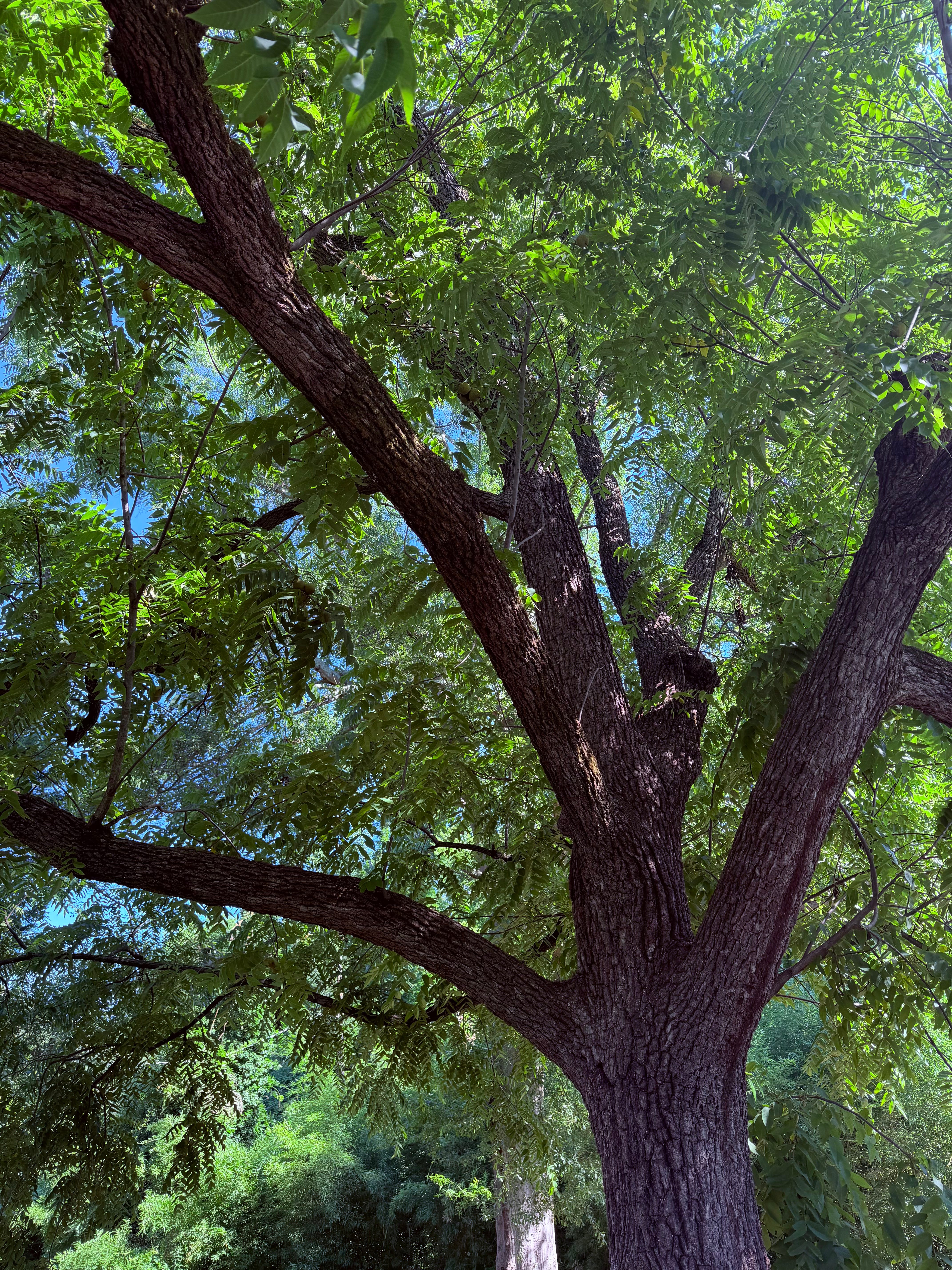
The black walnut in the backyard has started to drop a few hard green fruits this last week, well before the leaves have even thought about turning from green to brown. I go out most mornings before the heat and stand underneath it. There’s really nothing for me to do there. The tree doesn’t need me. Whatever I know about juglone in the soil, about the way this tree conditions the ground beneath it to keep its own kind close, about the Carolina Piedmont clay and the water moving somewhere under Lawson’s Fork... all of that comes later, and none of it is why I go out. I go out to look. And I have come to believe, slowly, over about two decades of teaching and now these last couple of years of PhD study, that the looking is the whole thing. The looking is where ecology begins, and where the Cross is waiting.
People who know me from the church side of my life sometimes ask how I ended up here, wading through air permits and monitoring wells and matplotlib figures of groundwater data, when I was trained to read Greek (classical and koine) and Biblical Hebrew and stand in a pulpit. And people who know me from the science side ask the opposite... what a Carmelite mystic or a French philosopher of form has to do with a data center’s permit. The answer I keep coming back to, the one I have worked toward for years, is that I do not experience these as two rooms with a hallway between them. I experience them as one room. And the name of that room is perception. It’s not always easy to explain, and I fumble the attempt too often while sharing a coffee or beer with someone at Fretwell or a Council meeting.
Let me tell it the way it happened, which is also the way I would preach it.
It begins, for me, in Genesis (and not where you would expect). Not in the command itself. The first thing God does with the world, in this account, is not use it and not even bless it. The first thing God does is see it. Again and again the refrain comes: וַיַּרְא אֱלֹהִים כִּי־טוֹב, and in the Greek my eye learned to read, καὶ εἶδεν ὁ θεὸς ὅτι καλόν... “and God saw that it was good.“ The verb in Hebrew is ראה, appearing here as וַיַּרְא; in the Septuagint’s Greek it’s ὁράω, appearing as εἶδεν. God sees.
The important term here is καλόν. The Greek does not say ἀγαθόν, or good-as-useful, good-for-something. It says καλόν, which is good and beautiful at once (I wish English could hold both senses in one word the way Greek does... but alas we have to work with the tools we’re given), the good that is seen and found lovely. Before the world is put to work, before the human is anywhere in the story, there is a seeing that finds the world beautiful. Perception comes first, and the blessing follows the beholding.
And when the human does at last arrive, the charge isn’t to master or subdue or pull out weeds in the Garden. The human is placed in the Garden לְעָבְדָהּ וּלְשָׁמְרָהּ, in the Greek ἐργάζεσθαι καὶ φυλάσσειν... to serve it and to keep it, to work and to guard. There’s the ethic.
But notice the order of the whole. The keeping comes at the end. First, the Earth is told to bring forth, βλαστησάτω ἡ γῆ, let the Earth put out green from itself. Then God sees that it is good. Only then, late, is a human told to keep anything.
I’ve come to think and realize that nearly every failure of what we now call ecology is a failure to keep this order. We reach for the keeping, the management, the stewardship, the policy, before we have done the seeing. We try to be responsible for a world we have not yet troubled to behold. And a keeping that has not first been a seeing hardens into control.
So the question underneath all of my work, the theological question and the ecological question at once, turns out to be a question about the eye. What would it mean to see the way that first seeing sees... to find the world καλόν (good and beautiful at once) before finding it useful?
I spent twenty years in Middle and High School classrooms across the Carolinas, teaching AP Environmental Science, AP Physics, Earth Science, Life Science, and Physical Science, and for a long time, I thought I was teaching students facts about systems... carbon, water, nitrogen, energy... the great cycles. I was (I hope), and those facts and understandings do matter. But what I was actually trying to do, what the good days were about, was teaching attention.
Getting a sixteen-year-old to look at the creek behind the school, at the particular creek, this one in this community, with its particular silt and its particular light, until the abstraction “watershed” became a thing they had stood beside. Ecology, I finally began to understand, is not first a body of knowledge. It is a training of perception. It is the discipline of noticing that nothing is alone, that the walnut and the clay and the juglone and the water and I are already bound together before I’ve decided anything about any of it.
Which is where the old voices started to find me. Hildegard of Bingen, the twelfth-century abbess on the Rhine, had a Latin word for what she saw pressing up through the whole created order: viriditas, greenness, greening, the moist living freshness by which God keeps the world from going dry. For Hildegard, in all of her wildness and wisdom, the green of a leaf was not a symbol pointing away to God. It was the very showing of God’s aliveness in the thing itself. When I stand under the walnut, and the light comes green through the compound leaves, I’m not being handed a lesson about God. I am, if I have the eyes for it, seeing viriditas... the world’s aliveness given directly, in this leaf, this morning. Hildegard taught me that perception could be worship, and that the two might actually be the same act.
Then Edith Stein, whom I keep close throughout this whole season of study. She began as a phenomenologist, a student of Edmund Husserl, and her first great work was on empathy, Einfühlung... the question of how I come to know that the other in front of me has an inner life of their own, a center that isn’t mine. Her answer was that I neither infer it nor project it. I perceive it. The other’s interiority is given to me in the encounter, a presence I meet and cannot manufacture. Late in her life, a Carmelite by then with the name St. Teresa Benedicta of the Cross, she carried that phenomenology all the way down into the ground of being itself, into the Latin term from St. Thomas Aquinas and the Scholastics, esse (Endliches und ewiges Sein in her native German), being as the act by which anything at all stands forth from nothing and holds itself in existence. And then she wrote the book she did not finish, Kreuzeswissenschaft, The Science of the Cross.
Stein handed me the thread I most needed in my own perception and work. If empathy is the perception of another’s interiority, then to encounter any living thing rightly is to grant that it has an inside, a center of its own being, that it is present to itself and not simply present to me. The walnut isn’t an object lying in my visual field. It is a form holding itself in being, and my seeing of it is a meeting of sorts (maybe a Sort of Homecoming to borrow U2’s language).
This is where the philosophers of form came in... allow me to be strange for a moment. Raymond Ruyer, whom almost no one reads (sadly), spent his life on a single stubborn intuition he called survol, self-survey, the way a living form is present to itself all at once, without standing back from itself, without a little inner eye watching from a distance. A visual field, he pointed out, is present to itself whole, immediately, with no homunculus reviewing it. So is an embryo.
So, Ruyer thought, is any true form. Life isn’t a machine assembled from outside. Life is a self-presence, an inside that surveys itself in a single act. And Gilles Deleuze, alongside him, taught me to trust difference itself and to stop treating the endless particularity of the world as noise cluttering up the general categories, to see instead that the particular... this walnut, this clay, this fracture in the rock under Spartanburg County... is the real thing, and the concept is the thin abstraction laid over it. Between them, Ruyer and Deleuze gave me permission to take the singular seriously, to believe that the form in front of me is present to itself and worth the whole weight of my attention.
Merleau-Ponty, whom I’ve studied the last two years intently, and now, in my comprehensive exams this summer, ties together so much of this. In his last unfinished work, he kept returning to a French word, la chair, the flesh. His claim, the one I haven’t gotten over since I first read his work just two short years ago, is that the one who sees and the thing that is seen are cut from the same cloth. That’s mind-blowing.
My looking at the walnut is possible only because I, too, am a visible thing, a body in the world, of the same cloth as the tree. Seeing is not a beam I aim at inert “stuff.” Seeing is a reversibility, a chiasm in the Greek, my flesh and the world’s flesh folding into each other so that in touching the bark I am also touched, in seeing I am also seen. Perception is participation. To perceive is already to be inside the relation, already implicated, already bound. There’s no neutral looking from outside, because there is no outside to stand in.
Now put all of that together, and you can perhaps see why I call my dissertation the Ecology of the Cross.
The Cross is... a tree. We forget this because we have made it a shape, a piece of jewelry, a bumper sticker, and a logo on a steeple. But it was a tree, wood, ξύλον, the same word the Greek scriptures use for the tree of life and for the Cross alike. And what happens on that tree is that a form pours itself out, gives its own being away, and in the giving does not vanish but is returned, raised, kept. The word the church reached for was kenosis, κένωσις, from κενόω, to empty... he emptied himself, ἐκένωσεν ἑαυτόν. The form that is most fully present to itself, most alive, is the form that can give itself away without ceasing to be.
I look at the walnut, and I see this. The tree spends itself constantly... leaves let down, fruit dropped early onto the clay, sugars poured underground into fungal networks it will never account for, the whole slow self-giving of a life that keeps itself by not clinging to itself. The juglone paradox (which fascinates me), the tree conditioning its own ground against its neighbors, belongs here too, the Strange Currencies (to borrow the language of R.E.M. and their video about perception here) of a form that shapes a whole world around its self-giving and its self-keeping at once. The Ecology of the Cross is the recognition that this pattern... form given away and returned, self-emptying that is also self-presence... runs through the whole created order and is disclosed most sharply on a particular Palestinian / Roman tree on a particular afternoon. The Cross does not interrupt ecology. The Cross reveals ecology.
This is why perception has to come before ethics, not after. I’m famous and annoying at my school for repeating “empathy before ethics” in our class discussions. If I begin with the command, with keeping, with stewardship, management, and policy, I begin as a manager standing outside of a system I have been made responsible for. But if I begin with the seeing, with καλόν, with viriditas, with the meeting of a form that is present to itself, with the flesh that binds my looking to the thing looked at, then I am already inside. I am already kin. The ethic does not have to be imposed from outside, because the seeing has already dissolved the outside.
To perceive the walnut rightly, as a form holding itself in being, present to itself, giving itself away, is to have already been drawn into the keeping. The keeping was never a duty bolted on afterward. It’s what the seeing became.
This is why, when people ask how ecology is related to the study of religion, or to Genesis, or to a mystic on the Rhine, or to a data center’s air permit, I want to say that they are not related at all. They are one thing, seen from different sides. Ecology is the discipline of perceiving that nothing is alone. The Cross is the disclosure of what such perceiving costs and what it gives. And Genesis was right from the first chapter: before the keeping, the seeing. Before the ethic, the eye. Before we are asked to serve and to guard, we are asked simply to behold, and to find it good, καλόν, beautiful and good and given.
The walnut doesn’t need me this morning. It’s letting its fruit down onto the red clay whether I come out or not. But I go out anyway with my coffee, and I stand there, and I look. That standing and looking isn’t the preparation for the work. It is the work. It is the first and hardest discipline, and everything else, the permits and the poems and the paper due at the end of this month, comes out of it or comes to nothing.
First, the seeing. Then, and only then, the keeping.
As a poet, I often practice the "seeing" as a means of "keeping," though your essay has offered a new (and beautiful) perspective that I will carry closely.
Thank you for this. I deeply appreciate your perspective and acknowledgement of the interconnectivity of these "two" realms.
Like many others' experiences, growing up, teachers in my faith used the Scriptures to advocate for, bluntly, the domination and exploitation of the natural world, even going so far as to say that some aspects of ecology are idolatrous. There was more than a small portion of "It's all going to burn anyway!" thrown in there, too. I have since come to a new perspective - heard other voices like yours - that such is not the case and is, in fact, a perversion of both our role as humans on Earth and the Scriptures themselves. Faith can impel people to see and steward.
I think a person of faith presenting scientific information and ecological advocacy is important for cultivating perception and caring within largely-religious communities (or communities that hold on to religious identities and ideas even if they are non-practicing), such as in the South.
Also, I appreciate your highlighting of the range of Hildegard von Bingen's work. I have only been previously acquainted with her by way of her awesome musical compositions.