


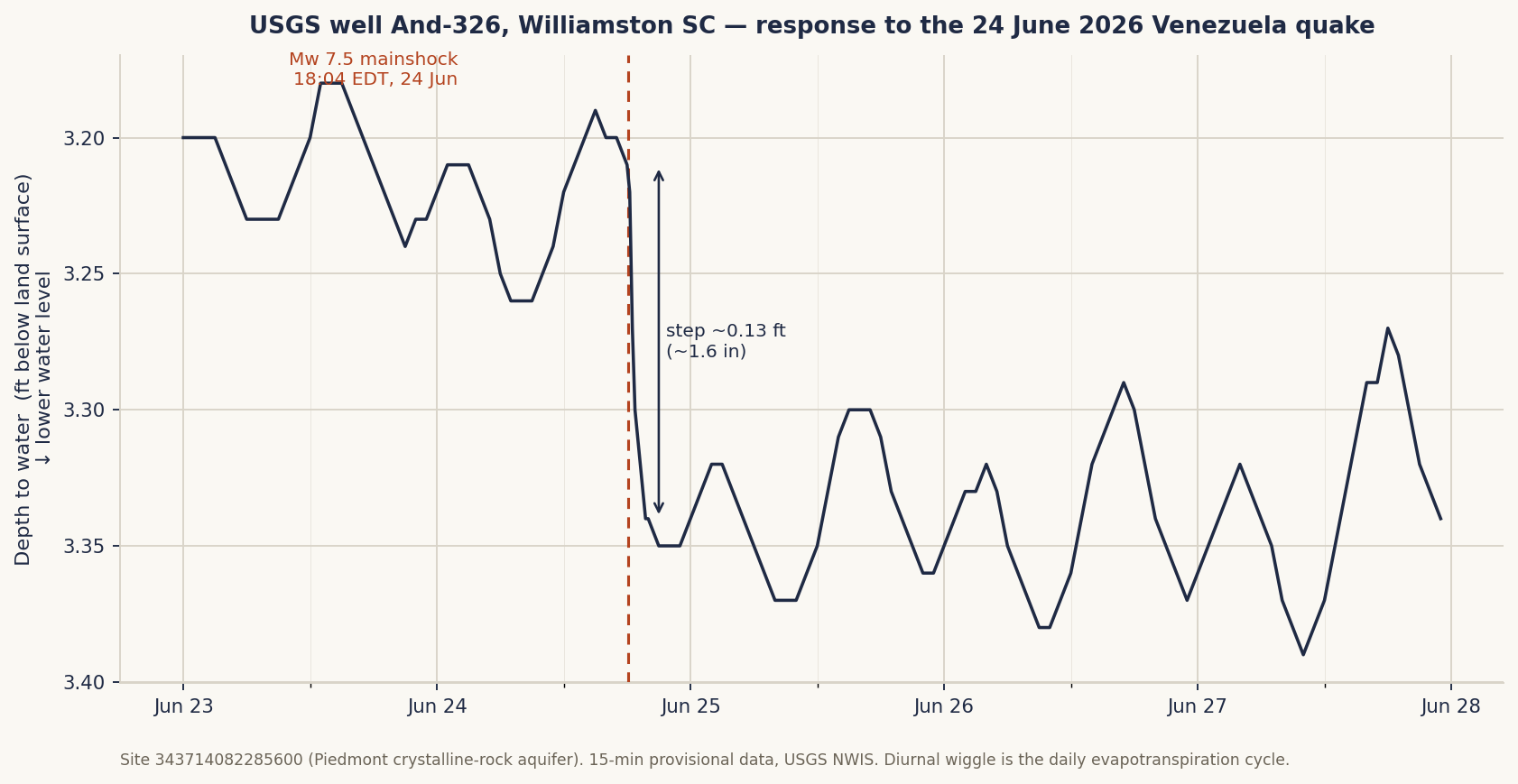
Williamston, SC (Anderson County), has a pipe in the ground where the Upstate begins to run out of foothills, and the land begins its long tilt toward the Atlantic across ancient seashores. A column of water inside the pipe is a little more than three feet below the grass, held in the cracked crystalline rock that is the Piedmont’s true body under its skin of red clay. A sensor lowered into that water takes a reading every fifteen minutes, day and night, and has done so without much ceremony for years. What it records, most of the time, is “breathing.” Through the heat of each afternoon in Anderson County, the water sinks a fraction of an inch as the trees and grasses pull moisture up and out into the air, and through the cool of each night, it eases back. The daily wave is usually small (less than an inch from crest to trough). It’s the respiration of a water table going about the ordinary business of being a place, and there are lots of other shallow pipes across our country doing the same sensing.
On the evening of June 24th, around four minutes past 6 o’clock, the floor of that breathing dropped.
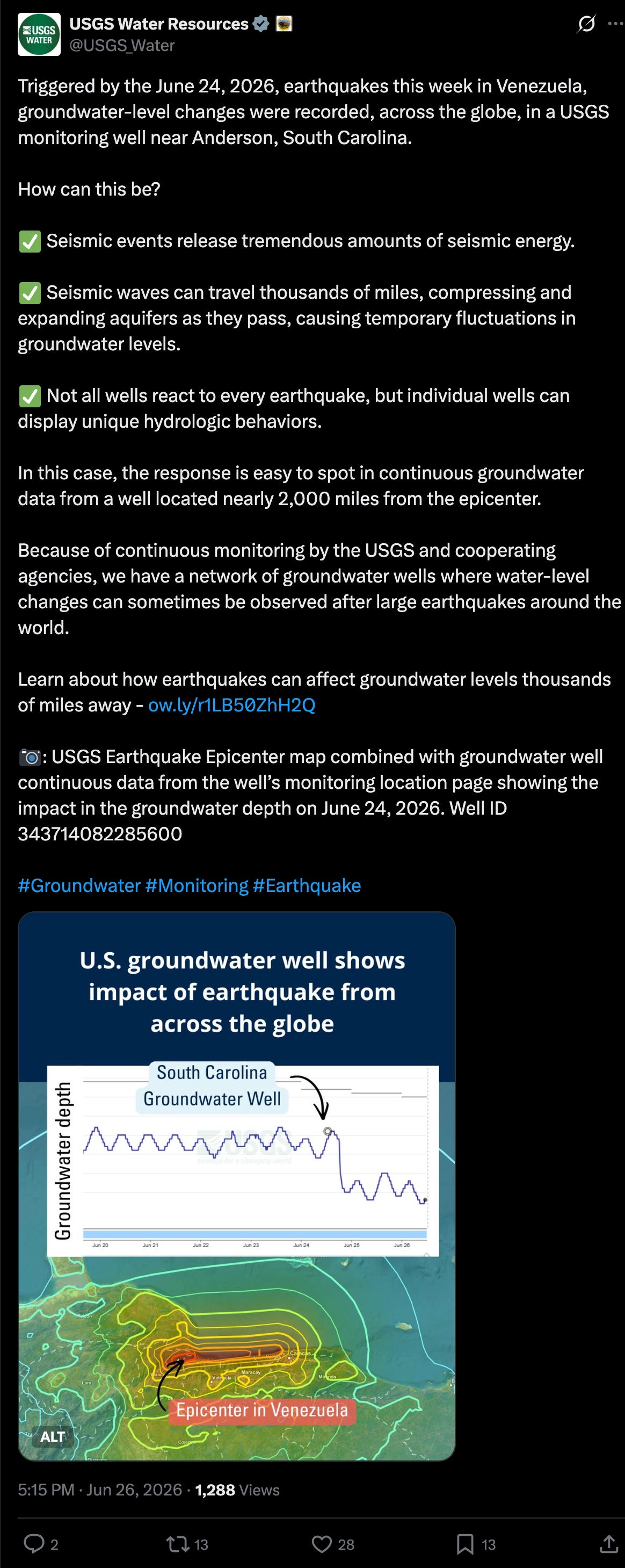
Nearly two thousand miles to the south, beneath the state of Yaracuy in Venezuela, the San Sebastián fault slipped. The Caribbean Plate and the South American Plate, which have been grinding past one another for eons, slipped by a meter or more along a seam in the crust of the planet, and the ground there shook hard enough to take down a third of some cities and to kill, in the first countings, more people than a town the size of Williamston usually holds. The energy released from the slip didn’t stay in Venezuela. It spread outward through the rock of the Earth as a wave, the way a struck bell sends a note through the air, and some fourteen minutes later... about the time a surface wave needs to cross that distance through the crust... it reached the cracked rock under Anderson County.
The water in the pipe “felt the squeeze,” if you will. By half past six, the sensor had logged a drop of roughly an eighth of a foot (about the width of a finger)... something like an inch and a half. And then, having dropped, the water didn’t climb back. The daily breathing resumed at once in the next sensor measurement, unbothered, as it had always been, the same small wave. However, it has now risen and fallen around a new, lower floor, and through the rest of last week, the floor has seemed to hold. The fracture had taken a set even here in the Carolinas, much like the way a green branch bent too far keeps a little of the bend. Here’s the full data set from the USGS sensor.
The first thing this asks of us is wonder at the plain fact of connection. For the length of a pressure wave, the Earth is one body. A column of water in South Carolina is in direct physical contact, through nothing but stone and energy waves, with a fault on the far side of the Caribbean. We’re joined to places we will never see and to griefs we will never witness by the ground we are standing on, and that joining isn’t a clever figure of speech. It’s measurable to the hundredth of a foot. There is a kind of comfort in this, and a kind of terror, and the two aren’t easy to pull apart when you give your ontology its own breathing room to consider and process.
The water registered the event, but it didn’t attend to it. It received the brute strain of the wave and passed it along, and it knew nothing whatever of Venezuela, nothing of the fault or the dead, injured, or displaced. The water wasn’t aware of the distance and velocity of the energy wave in any human sense. Aristotle gives us the language for the gap. To perceive, he says in the De Anima, is to receive the sensible form, the εἶδος (eidos), without the matter, the way wax takes the shape of a signet ring but not the gold (De Anima 424a). The water took the gold and the push of the matter, rather than the form of the thing that pushed it. So, in that sense, the water in the pipe in Anderson County didn’t perceive at all. It’s what Aristotle would call pure δύναμις (dynamis), potency, capacity, a thing acted upon, and it never crosses over into ἐνέργεια (energeia), into being-at-work, into the actuality that perceiving and living in fact are. It has no ἐντελέχεια (entelecheia), no form it holds itself toward, no end it enacts. It is partes extra partes, parts lying outside of parts, a heap of water in a heap of rock, and nothing in it gathers the heap into a “self” as Aristotle here would qualify it.
However, Henri Bergson saw the same thing from the other direction. In Matter and Memory (must read if you’re so inclined), he describes matter as the great aggregate that transmits everything and holds back nothing, while perception, living perception, is subtraction... the body standing in the flux as a center of indetermination, carving out of the total motion of the world only the slender portion that bears on what it might do next. The water table is the aggregate in Bergson’s sense. It transmits the whole planet’s tremors with perfect indifference, the Venezuelan one as readily as the log truck on US 20 that passes through Williamston. To perceive is to choose, and the water chooses nothing.
Likewise, Raymond Ruyer would say it has no survol, no self-survey, none of the way a living form is present to itself all at once without having to climb outside itself to look. The water is all outside. There is no inside there for the wave to reach.
I keep, in my own yard in Spartanburg (about an hour or so drive from Williamston), a thing that does what the water in a pipe underground can’t. The black walnut in the back leans into the light, times the unfurling of its leaves to the lengthening of the days, drops its fruit on a schedule older than the county, and lays down juglone in the soil beneath it to thin the competition that would crowd its roots.
Michael Marder has spent years arguing that this counts, that the vegetal reaching toward light and the timing and the chemistry are the rudiments of intentionality, a directedness, (a δύναμις) that is for something in a way the water’s emphatically is not. The walnut and the well sit only a few counties apart, and the distance between them is the distance my whole work is trying to understand.
Intentionality is not a property the universe adds to certain bodies from the outside; it is a structural feature of living form, present wherever there is form holding itself in act, and absent from the water (no matter how faithfully the water passes the tremor on). The microorganisms in the water are a different story.
Which means the well’s dropped line is a parable about us, and not about water. The registration sits there on the graph above, marked provisional and subject to revision, until a human comes and attends to it... until someone stands at the threshold and reads the lowered floor as the near edge of a far grief, and lets the eighth of a foot open onto 1/3 of a fallen city and the count of the dead, injured, and displaced. That translation, from bare registration into meaning, from strain into significance, is the work of attention.
Teachers and ministers of the spiritual life had a word for it well before the ministries of Jesus and Paul, προσοχή (prosochē), the watchfulness they took to be the beginning of any real interior life. They were right that it has to be practiced, that it does not come for free, that the natural drift of a mind is toward the heap and away from the form.
It’s the same poverty John of the Cross would later call a kind of night, a willed unknowing that empties the senses of their clamor so that something true has room to arrive. This is why I have come to think the ecological crisis is a crisis of attention before it is a crisis of carbon, policy, or machines.
The data center approved in secret council meetings and legal documents, the algal bloom in the Reflecting Pool, the clover renamed a weed so we could be sold a poison... each is a failure to attend, a treating of a living place as though it were only the well, only an aggregate to be transmitted through and drawn from and never once perceived.
Owen Barfield called the older way of knowing original participation, the sense, mostly lost to us, of mind and world as one continuous fabric rather than two strangers. He thought the task of our age was to find that participation again on the far side of our separation, with our eyes open this time. To attend to the well is a small instance of that finding. The water can’t reach back across the distance to Venezuela in any way that means anything. We can.
We are the ones in whom the bare continuity of the rock becomes a felt nearness, the ones who can hold a stranger’s grief in the reading of a line, and this capacity is no burden laid on us from outside; it is the very shape of what we are, form in act, made to perceive. The fracture in the Earth’s crust kept the lowered level like a memory with no one home to remember it. We are the ones at home. The discipline is only to be there, awake, when the wave arrives, and to let it find in us the inside it could not find in the water.
Notes and Further Reading
The event and the data
USGS NWIS monitoring well 343714082285600 (”And-326”), Williamston, SC. Continuous depth-to-water record. https://waterdata.usgs.gov/monitoring-location/USGS-343714082285600/
Mark Price, “Massive quakes in Venezuela impacted groundwater levels in Carolinas, USGS learns,” The State, June 27, 2026. https://apple.news/Aiv-GzEp3QViLRShZ95a8fg
“2026 Venezuela earthquakes,” Wikipedia (event overview, San Felipe / Yaracuy, Boconó–San Sebastián–El Pilar fault system). https://en.wikipedia.org/wiki/2026_Venezuela_earthquakes
Why a well in the Carolinas feels a fault in Venezuela
USGS, “Groundwater Effects from Earthquakes” (Evelyn Roeloffs). The plain-language primary: oscillations, sustained offsets, and why a recorded step can be “instantaneous” only to the resolution of the sampling interval. https://www.usgs.gov/programs/earthquake-hazards/groundwater-effects-earthquakes
Brodsky, E. E., Roeloffs, E., Woodcock, D., Gall, I., & Manga, M. (2003). A mechanism for sustained groundwater pressure changes induced by distant earthquakes. Journal of Geophysical Research: Solid Earth, 108(B8), 2390. The paper behind the part that matters most here, that the step holds rather than recovers, with a model of seismic waves clearing a clogged fracture. https://doi.org/10.1029/2002JB002321 (free copy: https://pubs.usgs.gov/publication/70025130)
Roeloffs, E. (1998). Persistent water level changes in a well near Parkfield, California, due to local and distant earthquakes. JGR: Solid Earth, 103(B1), 869–889. The persistence classic, including the one-meter step from Loma Prieta. https://doi.org/10.1029/97JB02335
Montgomery, D. R., & Manga, M. (2003). Streamflow and water well responses to earthquakes. Science, 300(5628), 2047–2049. https://doi.org/10.1126/science.1082980
Wang, C.-Y., & Manga, M. (2021). Water and Earthquakes. Springer (open access). Book-length treatment if you want the full hydroseismology. https://doi.org/10.1007/978-3-030-64308-9
Mentioned Readings and References:
Aristotle, De Anima, esp. II.1 (412a, first and second actuality, ἐντελέχεια) and II.12 (424a, perception as the reception of form without matter). Orientation: Stanford Encyclopedia of Philosophy, “Aristotle’s Psychology.” https://plato.stanford.edu/entries/aristotle-psychology/ (Greek with facing translation: Christopher Shields, trans., Clarendon Aristotle Series, Oxford, 2016.)
Aristotle, Metaphysics, Book Θ (IX), on the priority of ἐνέργεια to δύναμις (1049b). SEP, “Aristotle’s Metaphysics.” https://plato.stanford.edu/entries/aristotle-metaphysics/
Henri Bergson, Matter and Memory (1896). Matter as the aggregate that transmits all, perception as subtraction. SEP, “Henri Bergson.” https://plato.stanford.edu/entries/bergson/ (Standard English edition: Paul & Palmer, trans., Zone Books, 1991; the 1911 translation is public-domain and free at the Internet Archive.)
Raymond Ruyer, Neofinalism (1952), Alyosha Edlebi, trans. University of Minnesota Press, 2016. On survol, a living form’s self-presence without an external vantage. ISBN 978-0816676293.
Michael Marder, “Plant Intentionality and the Phenomenological Framework of Plant Intelligence.” Plant Signaling & Behavior, 7(11), 2012, 1365–1372 (open access). https://doi.org/10.4161/psb.21954
Michael Marder, “Plant Intelligence and Attention.” Plant Signaling & Behavior, 8(5), 2013, e23902. The companion essay, directly on attention. https://doi.org/10.4161/psb.23902
Michael Marder, Plant-Thinking: A Philosophy of Vegetal Life. Columbia University Press, 2013. ISBN 978-0231161251.
John of the Cross, The Ascent of Mount Carmel and The Dark Night. The Collected Works of St. John of the Cross, Kavanaugh & Rodriguez, trans. ICS Publications. https://icspublications.org (public-domain Allison Peers translations free at the Christian Classics Ethereal Library, https://www.ccel.org
Owen Barfield, Saving the Appearances: A Study in Idolatry (1957). On original participation. Owen Barfield Literary Estate. https://owenbarfield.org
Mark Vernon, A Secret History of Christianity: Jesus, the Last Inkling, and the Evolution of Consciousness. Christian Alternative, 2019. The Barfieldian lineage and the cruciform reading of participation. https://www.markvernon.com
Pierre Hadot, Philosophy as a Way of Life, Michael Chase, trans. Blackwell, 1995. On προσοχή (prosochē), attention as a practiced spiritual exercise. ISBN 978-0631180333.