


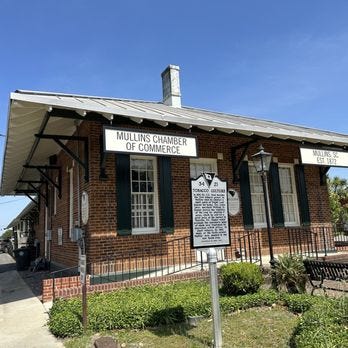
I grew up in Mullins, South Carolina, in Marion County, which means I grew up in the Pee Dee even before I had any real sense of what that meant. As a child, “Pee Dee” was one of those names that was everywhere and nowhere at once. Pee Dee Academy is the name of the independent school between Mullins and our county seat of Marion. It also included businesses, news stations (WPDE), school regions, weather forecasts, sports alignments, and the broad eastern part of the state that seemed to stretch from the Midlands Sandhills around Columbia and Camden down toward the coast. Pee Dee was a name I heard constantly, but not one I was taught to inhabit historically. Like many regional names in South Carolina, it carried more meaning than it might seem to.
“Located in northeastern South Carolina, Marion County is shaped like a knobby sweet potato, with its skinny southern end approximately fifteen miles from the Atlantic Ocean.”
https://www.scencyclopedia.org/sce/entries/marion-county/

My alma mater, Mullins High School, has the mascot “Auctioneer” (shortened to Aucs), which I always found interesting without giving it much thought. We used a representation of an Indigenous Chief as the school's icon (complete with a larger-than-life-sized wooden “Cigar store Indian” at the school's front door). Our rival in the county, Marion High School, is the “Swamp Foxes,” which I was taught not to like but always secretly envied… because what a great mascot!
Mullins itself taught history indirectly as well. There were tobacco warehouses (which I have depictions of on our dining room walls today), old brick buildings, family names, churches, ball fields, sandy roads that I loved exploring with my restored 1989 Jeep with no doors while listening to The Beatles and Fleetwood Mac on my Walkman’s headphones, and the peculiar atmosphere of a small agricultural town after its main crop had begun to recede from view. Harrelson itself is a very common surname there, and our ancestors who headed west to Arkansas in the 19th century would establish their own Mullins, Marion, and Conway’s there (which also led to Woody Harrelson’s family). The land felt flat, practical, hot, humid, and “ordinary” in that weird sense of homeland. Place forms us before we know how to ponder what that really means. We inherit the roads, names, soils, silences, and rituals of place, and we learn where we are before we understand what has happened there.
The Watershed Beneath the Name
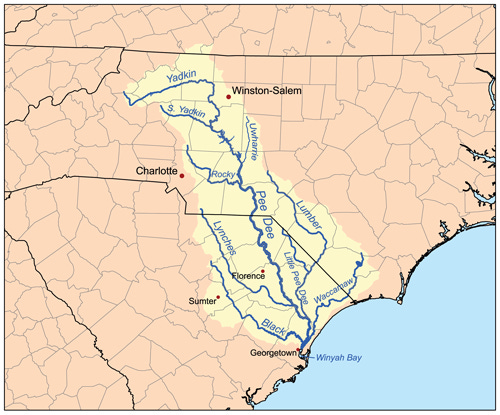
The Pee Dee is not simply a region on a South Carolina map. It’s a watershed in the most literal sense of that term. The Great Pee Dee River begins farther north as the Yadkin River in North Carolina and eventually flows through northeastern South Carolina toward Winyah Bay, where my ancestors settled in and around Georgetown after coming from Denmark and Norway. The Little Pee Dee, Lynches River, Black River, Waccamaw, and countless swamps, creeks, and bottomlands form a broader hydrological world of the Pee Dee. The people of the Pee Dee have always lived in relation to water, even when the dominant story has been told through crops, counties, railroads, or towns. The watershed wasn’t the background. It was route, food source, boundary, refuge, danger, market, memory, and field of consequence.
Before the Pee Dee was a “region,” it was the homeland and movement-space of Indigenous peoples. The very name Pee Dee comes from Native people whose history colonial records only partially (and often poorly) preserve. Today, Pee Dee tribal communities continue to identify with the river and northeastern South Carolina, a reminder that Indigenous presence is not only a matter of prehistory or archaeology but of continuing life. Archaeologists and historians also use the term “Pee Dee” to refer to older cultural worlds along the river system, including the Town Creek site in what is now North Carolina, downstream of which the river becomes the Great Pee Dee as it crosses into South Carolina.
One of the errors or control systems (if you will) of colonial and later regional history is the habit of turning living peoples into place names, then treating those names as if they belong more to roads and rivers than to the people themselves. South Carolina is full of such names. Catawba, Santee, Waccamaw, Edisto, Combahee, Wateree, Congaree, Pee Dee, Salkehatchie. These names remain on maps, but maps can be dangerous forms of memory and are often used as colonialist or propagandist mechanisms to define and circumscribe memory or perception. They can preserve a word on a two-dimensional surface while obscuring the third dimension of life that gave it meaning, and make displacement look like geography without the fourth dimension of time (whether you side with Bergson or Einstein on that, I’ll leave to you).
So any honest history of the Pee Dee has to begin before Marion or Liberty County, before Mullins, before tobacco, before cotton, before rice plantations, before enslaved voices, before the railroad, before English land grants. It has to begin with the river as a lived world full of its dimensions and concrescence. It has to begin with Indigenous presence and with the humility to acknowledge that the surviving written archive is partial, often colonial, and often structured by outsiders' perceptions.
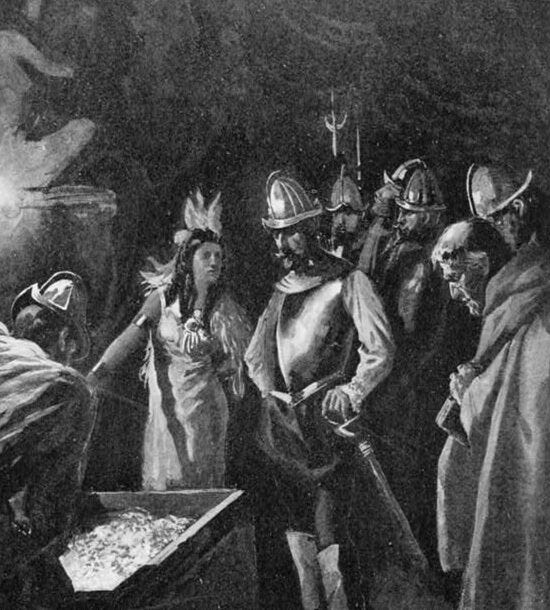
European contact brought naming, violence, disease, trade, enslavement, surveying, and land hunger into the region for all of its benefits as well. Spanish expeditions entered the larger Pee Dee world in the sixteenth century (with De Soto and his band traversing parts of the Pee Dee and near what we now call the Great Pee Dee River in their search for gold. English settlers later moved inland from the coast during the eighteenth century. The South Carolina Encyclopedia’s entry on the Pee Dee River points out that English settlement pushed into the Pee Dee from Winyah Bay and upriver to places such as the now-named area of Cheraw (now with a mascot of “Braves” after the Cheraw tribe there), reshaping the region through trade, agriculture, and, eventually, plantation economies.
This history of European settlement also represents a deep reordering of the world, as all colonialist programs do, whether tacitly or implicitly. Land that had been inhabited, traveled, burned, planted, hunted, remembered, and storied within Indigenous systems of relation became land to be granted, surveyed, owned, mortgaged, inherited, taxed, and sold in our modern context. The river became an infrastructure and a resource, supporting logging floats and the shipment of supplies back to European markets. Forests metamorphosed into naval stores while the swamps and mysterious Carolina Bays of the Pee Dee became rice fields with the labor of enslaved people bought and sold via the slave trade and viewed as resources, property, and collateral themselves.
The early colonial Pee Dee economy depended on the extraction of both land and people. The Florence County Museum’s work on African American rice growers at Mars Bluff, on the border between present-day Florence and Marion Counties, notes that rice expanded rapidly in the Pee Dee during the early eighteenth century and that climate, geography, and the forced migration of enslaved West Africans made the region central to rice cultivation. The Smithsonian’s National Museum of African American History and Culture also emphasizes that enslaved Africans and African Americans didn’t provide just labor for rice plantations, but brought knowledge of rice agriculture and engineered complex systems of dikes, floodgates, ditches, and drains across the coastal South through what it calls the rice fields of the Lowcountry (which some communities in the Pee Dee still maintain).
That is one of the central moral facts of Pee Dee history. The region’s soils were fertile, and its rivers navigable, but the area was “profitable” because enslaved people knew how to work, read, endure, and transform difficult landscapes under sometimes violent conditions. Their knowledge was ecological, technical, bodily, seasonal, and spiritual. They knew heat, water, mud, insects, illness, planting, harvest, and the demands of survival. Yet the dominant archive usually names owners before workers, plantations before quarters, and crops before hands. Much like the namesake of my hometown, Mullins, who was a Colonel in the Confederacy.
The Pee Dee was also a place where swamp and river complicated power. Marion County is named for Francis Marion, the Revolutionary War figure known as the “Swamp Fox.” The county’s earlier forms included Queensboro Township, Liberty County, and then Marion District before later county boundaries took shape. The town of Marion developed around the courthouse, and the arrival of the Wilmington and Manchester Railroad in 1854 helped create new towns and stations, including the Mullins Railway Station that became the nucleus of Mullins, while areas like Floydville became the town of Nichols nearby because of the new railroad. That railroad line disrupted many of my morning trips to high school (often running late).
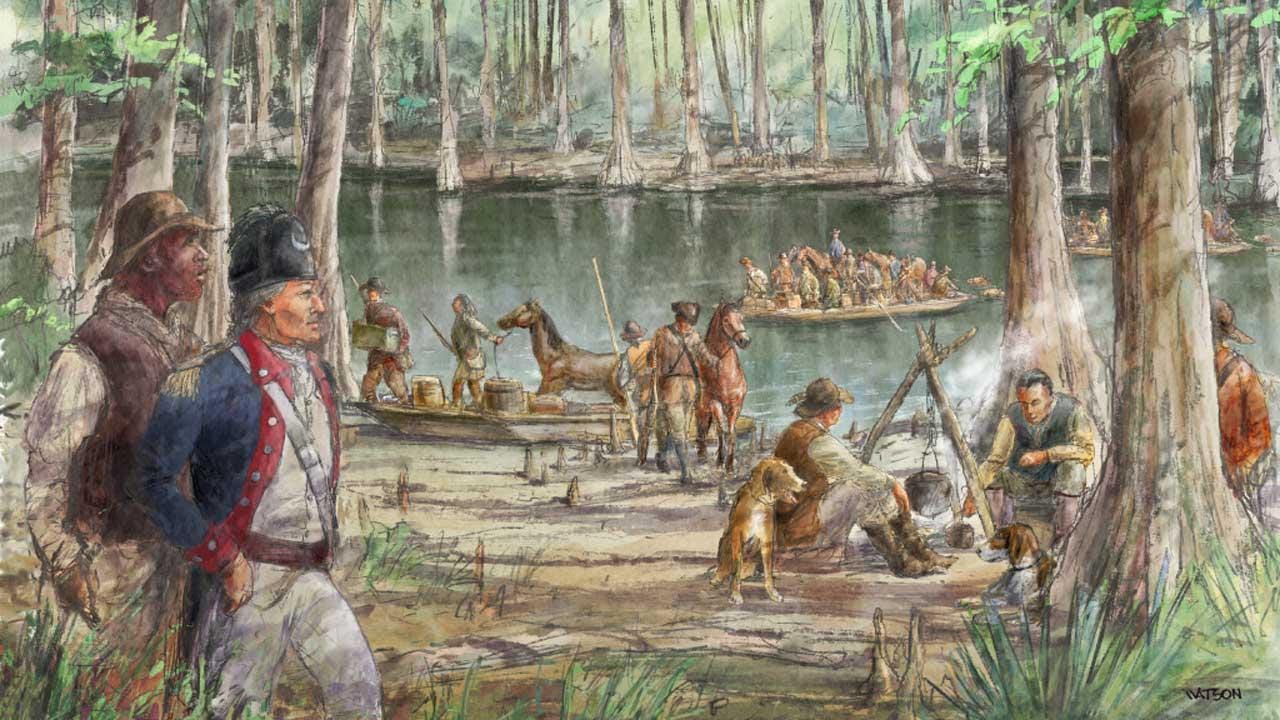
The Francis Marion story of his band of savvy guerrilla fighters camped at Snow Island (an interesting read here on the site's archaeology) is familiar in South Carolina, but I find myself more interested now in the landscape behind the legend. The swamp becomes heroic when it hides a patriot fighter like Robin Hood. It becomes marginal when it shelters the poor, the fugitive, the tenant, the displaced, or the nonhuman, such as enslaved people daring enough to escape their situation. That tells us something about how memory and perception work. The same wetland can become a shrine to clever resistance or a symbol of backwardness, depending on whose story is being told. The swamp did not change, but the attention did.
By the nineteenth century, cotton transformed the Pee Dee backcountry. Flatboats carried cotton bales downriver toward Georgetown and brought goods back upriver. The cotton gin, expanding markets, and enslaved labor reorganized the region again. Then the railroad shifted its movement from river landings to stations and towns. Infrastructure changed what counted as a center. A place did not simply “grow.” It was drawn into new networks of labor, credit, commerce, extraction, and imagination, much like we face today with an economy in transition and clever marketing programs meant to abstract data centers into “clouds” and “grids” instead of ecological mechanisms.
Tobacco Time
Mullins emerged from that railroad world. The town was formally established in 1872, when it was still small, with only a few streets and stores. The city’s history describes how tobacco, introduced in the 1890s, transformed Mullins into South Carolina’s “Tobacco Capital,” with barns and warehouses rising throughout the community. The South Carolina Encyclopedia’s entry on Mullins writes that Dr. C. T. Ford planted an experimental tobacco crop in 1891, that Planter’s Warehouse was completed in 1894, and that auction sales began that same year.
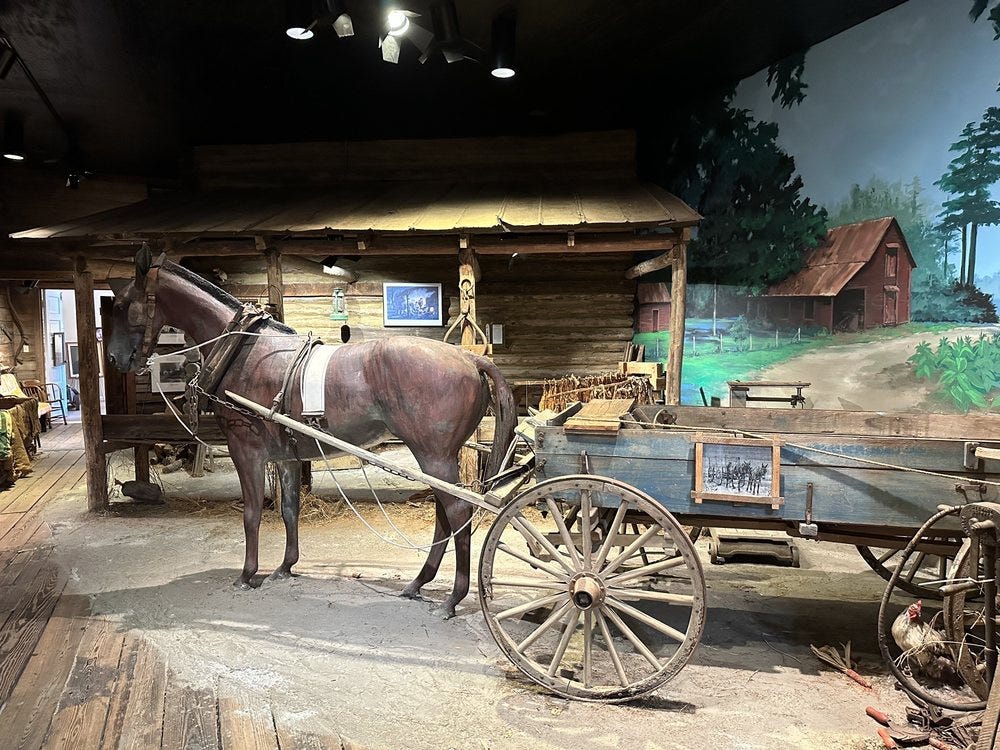
That is the Mullins I inherited, though mostly after the height of its old agricultural confidence. Tobacco was no abstraction there, even in my childhood, when the fall auctions were still held in person and were quite the spectacle, with rows and rows of sweet-curing tobacco wrapped in burlap sacks whose smell permeated the entire town in August and September. Tobacco structured the dimension of time. It gave the town a smell, a rhythm, a market, a class system, and a seasonal intensity. It shaped barns, warehouses, banks, stores, roads, labor arrangements, and family economies. The South Carolina Tobacco Museum now preserves part of that world in the old Mullins Depot, but museums also tell us that a world has passed far enough away to require interpretation to guide our perceptions.
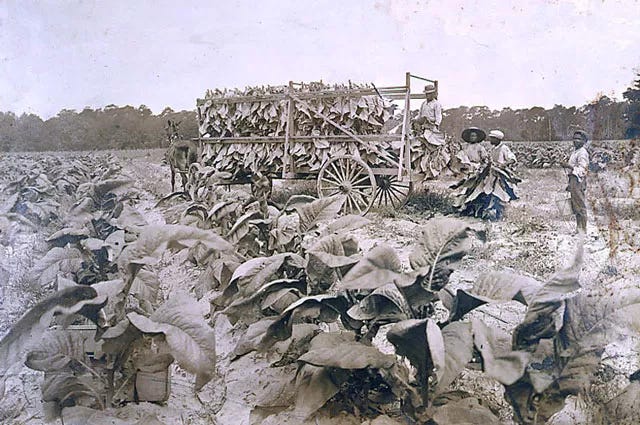
The tobacco story is complicated because it isn’t a story of economic pride as a trajectory. It is also a story of tenant labor, racial inequality, health consequences, federal policy, market dependence, and rural vulnerability. Tobacco made Mullins visible, but it also tied the town to a fragile agricultural economy over which many people did not have control. When the tobacco markets declined in the 1990’s, it was not just a crop that disappeared. A calendar disappeared, and an entire social rhythm disappeared, even though Mullins still celebrates the Golden Leaf Festival and parade in the Fall, and many of us Mullins-born still have a framed tobacco leaf on our walls, even if we don’t live there anymore.
The decline in the 80s and 90s was dramatic, however. The South Carolina Encyclopedia’s entry on tobacco asserts that between 1974 and 1992, the number of tobacco farms in South Carolina declined by 70%, as farms became fewer and larger and the older agrarian culture of the Pee Dee faded from view. SCETV’s materials on The Last Auction describe Mullins as South Carolina’s major tobacco market for more than a century, while also noting the later pressures of shrinking allotments, textile decline, and economic change.
But the people of the Pee Dee were never only tobacco people. Regional history often gets reduced to the crop that outsiders can identify most easily. Rice. Cotton. Tobacco. Indigo for the South Carolina history textbooks I read. But, people are not crops. People are not economies. People live inside economies (often painfully) but they also pray, sing, cook, resist, remember, bury their dead, raise children, repair porches, teach school, preach sermons, play ball, hold reunions, eat at Fred’s, and tell stories in parking lots long after official meetings or school are over.
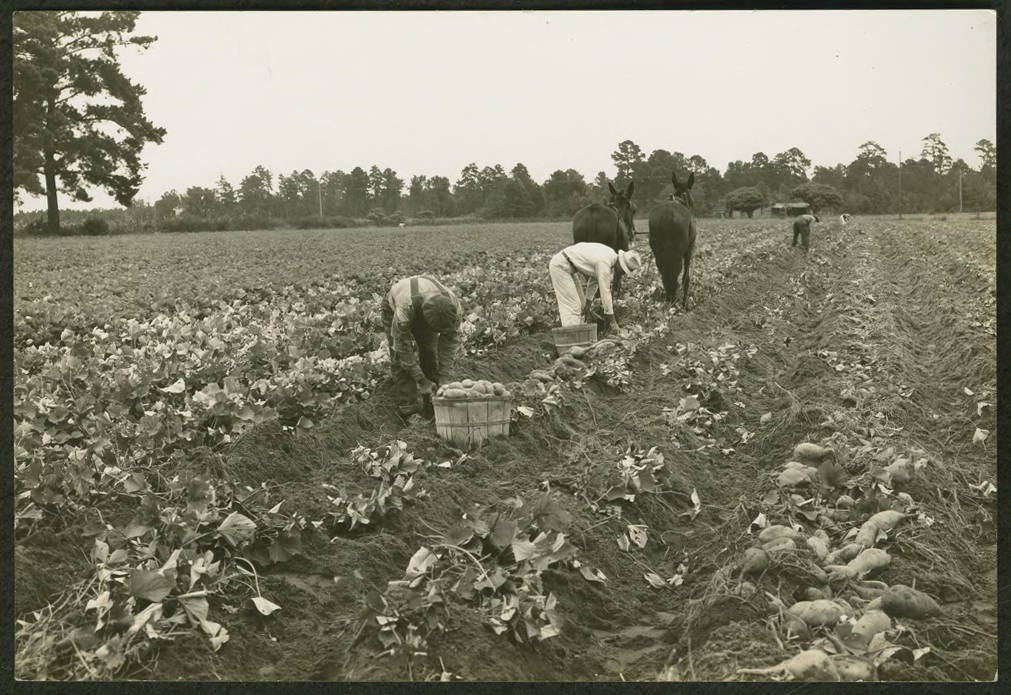
A history of the people of the Pee Dee has to include Black churches, Native communities, tenant houses, schoolhouses, cemeteries, tobacco warehouses, rice fields, courthouse squares, railroad depots, small farms, family land, and the long migrations out and back. It has to include the people who left for better jobs in Columbia, Charleston, Charlotte, Atlanta, New York, Philadelphia, Washington, or Spartanburg and came home for funerals, holidays, and reunions. It has to include those who stayed, and staying is its own kind of historical act, though I wasn’t brave enough to do so.
It also has to include memory that survives outside the official archive. In rural South Carolina, history is not first encountered in books. Instead, history is often encountered through names. Road, church, cemetery and family names tell histories and shape memories starting at a very early age. Names are spoken with affection, suspicion, reverence, or warning. Names carry old debts and old kindnesses. Names tell you where you are allowed to go, where you belong, where you do not, and what stories you are expected to already know. It’s a vocabulary of developing consciousness.
Learning to See Home Again
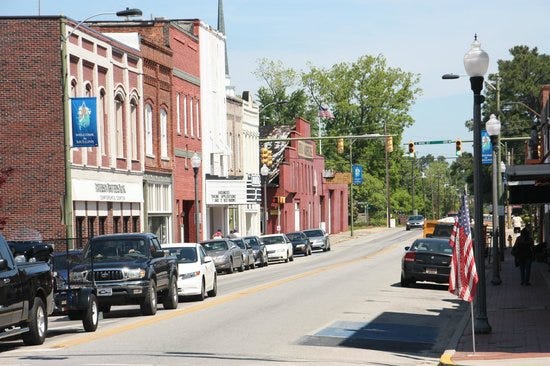
This is where the Pee Dee becomes more than regional history for me. It becomes a question of perception. What did I see growing up in Mullins? What did I fail to see? What was hidden in plain sight by familiarity? The old tobacco warehouses were not just old buildings. The fields were not just fields with their careful rows of cultivated tobacco, corn, and soybeans surrounded by the liminal spaces of the edge of fields between human cultivation and “wildness.” The river names were not just names of rivers. The churches were not just churches. The landscape was already speaking, but I had not yet learned how to listen to it.
That’s not a confession meant to produce guilt in my own perception or memory. Rather, it’s a practice of attention and intentionality. To come back to a place historically is not to solve it or issue judgment. We must let the place become strange enough to be seen again. This is especially true for those of us formed by rural towns that are easily dismissed as poor, flat, backward, or politically simple. The Pee Dee is not simple. It is layered with Indigenous memory, colonial violence, African skill, enslaved labor, Black endurance, white agricultural ambition, tenant farming, churches, railroads, tobacco markets, ecological change, and the grief of economic (and political) abandonment. There’s a reason it’s called “The Corridor of Shame” in national news stories.

The region also asks us to think differently about ecology. Ecology is not only wilderness, wetlands, species, forests, and rivers, though it is certainly all of those. Ecology is also the history of relations by which people and land shape one another over time. The Pee Dee is an ecological region because water, soil, labor, plants, markets, and memory have never been separate there. Rice requires water engineering, while cotton required soil exhaustion and enslaved labor. Tobacco required barns, curing, credit, auctions, allotments, and bodies. Railroads required timber, grading, capital, and stations. Churches required gathering. Cemeteries required ground held in memory if they were to survive, which many Black and Indigenous places of burial did not due to development and agriculture.
To write the history of the people of the Pee Dee, then, is to refuse the idea that rural places are marginal to the larger story, like the liminal edge of a cultivated field of row crops. The Pee Dee is one of the places where South Carolina’s deepest patterns become visible in Indigenous displacement, plantation wealth, racial hierarchy, agricultural extraction, Black survival, rural faith, environmental transformation, and the constant question of who gets to belong to a place.
I keep coming back to Mullins in my mind because it gives me a way into that larger field. I don’t want to necessarily romanticize it, though it’s hard for a young Gen X’er / Old Millennial with memories of riding bikes with friends in our neighborhood until the streetlights came on, while playing baseball in Smith’s Lot every day during the summer, all while not being tethered to a mobile phone and parent-tracking device.

I don’t want to condemn Mullins or the Pee Dee from a distance either (as is so often done). I want to pay attention to Mullins and ask what kind of history lives in a tobacco warehouse after the auctions are over (the few that remain, memorialized in a print on our dining room wall in Spartanburg). I want to ask what a railroad town remembers once the train and the capitalistic vocabulary of trade no longer feel like destiny. I want to ask how a region named for Native people can remember Indigenous presence as more than a map label. I want to ask how the labor of enslaved Africans and their descendants remains present in fields, drainage systems, foodways, churches, and family memory, even when official plaques are few.
The Pee Dee is not a forgotten place. It’s a place many people have often chosen not to remember or perceive carefully.
That may be the beginning of a different kind of regional history. Rather than a grand or nostalgic story or myth, more like a history of attention. A history that starts with the land and then listens for the people. A history that recognizes that rivers remember even when towns and their settled humans forget. This is a history that sees Mullins not as a small town outside the main current of South Carolina history, but as one of the places where that current comes close enough to touch.
To grow up in Mullins was to grow up inside of a history that rarely attended itself as history. But, history and memory were there in the soil, the warehouses, the churches, the fields, the roads, the cemeteries, and the name Pee Dee itself. What people said and what people did not say shaped that history. The old agricultural confidence and the quieter uncertainty that followed shifting economic conditions molded that history in the modern context. That history is in recognizing that “home” is never only where we are from, but also what we are responsible for learning to see.
I live in Georgetown County. I grew up in a small rural community called Plantersville. Thank you for writing this!
This was a thought provoking piece, thank you! Notes of Doreen Massey coming through for me in places. I wonder too about the other side of that unhistorical view we have in childhood, what it's potential might be for connecting with the land without the influence of colonial history.