


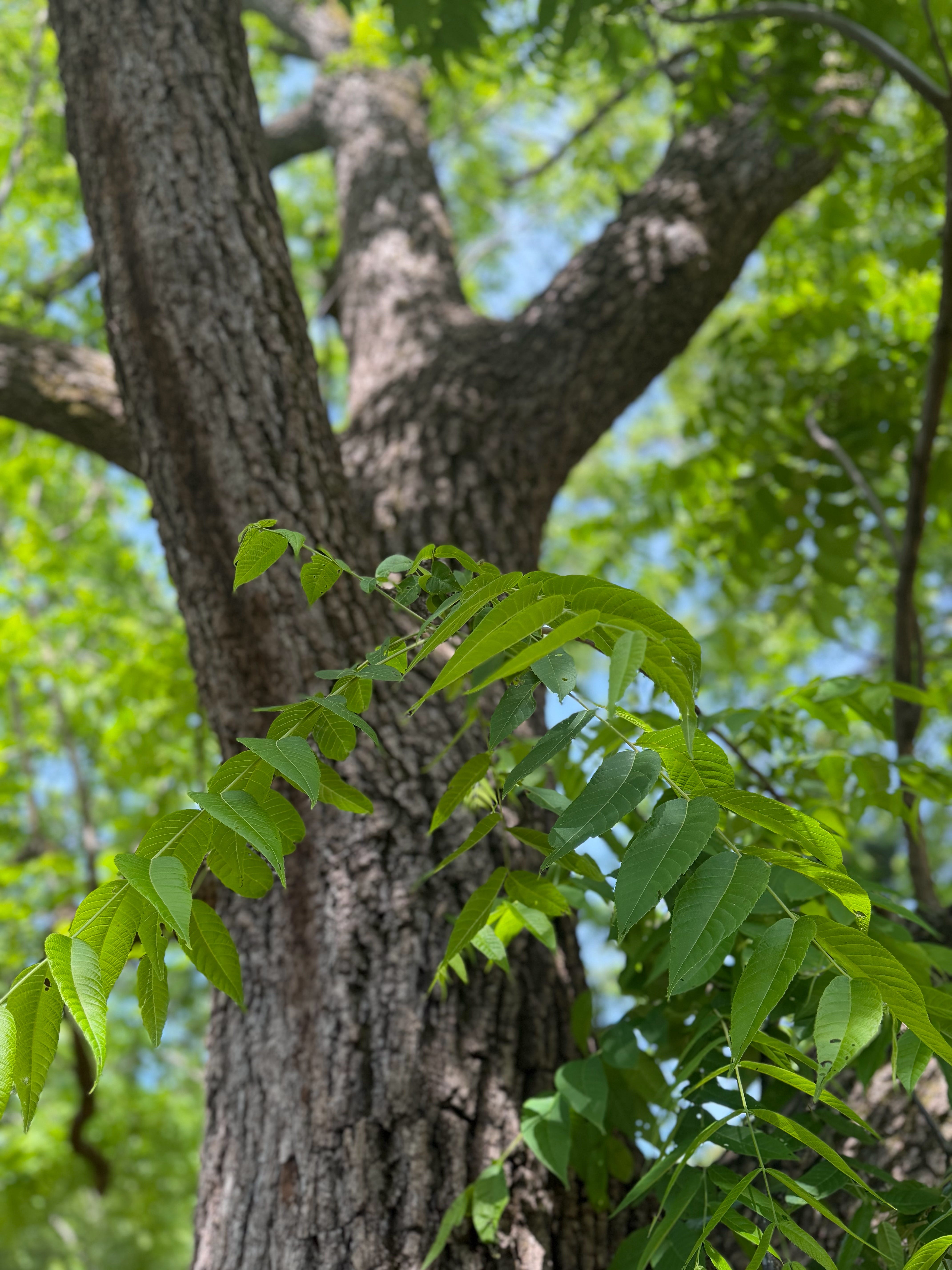
For weeks, the black walnut in the backyard had not leafed out. Everything else had started to erupt in leaves, with the oaks coming first, then the dogwoods, the red maples, the tulip poplars climbing the slope behind the fence. The cedars in our yard shed their winter coat (lots of sweeping of our porches attest to this). Even the vile Bradford pears planted in earnest around Spartanburg by do-gooders and lawn contractors supplied from Lowe’s bloomed and lost their bloom (thankfully). The redbuds made their brief argument. But the walnut stood in its own calendar (like our youngest daughter), unbothered by what the rest of the yard was doing, and if you didn’t know better, you might have thought it wasn’t going to bloom again.
This is one of the things the Upstate of South Carolina teaches me every year that I’ve lived here (if you live here long enough to pay the kind of attention it asks for, you’ll know). The season doesn’t move as a single event. It moves in layers, and the layers don’t agree with each other. April here is not the arrival of spring so much as the negotiation of it... a warm week followed by a cold one, the redbuds catching a late frost, the insects starting up and then going quiet. Leaves still piled up by those of us not barbaric enough to rake. And underneath all of that, the black walnut was doing its own calculation, holding its own new leaves in reserve while the rest of the canopy committed. It had reasons, I suppose. The last frost date in the Piedmont is a moving target, and the walnut has been tracking it for longer than any of us has been alive.
There is a particular quality to May light in the Upstate that I keep trying to describe and keep getting wrong. Growing up in the Pee Dee region, I learned a different light entirely... coastal plain light, which carries its heavy humidity visibly, which softens edges and holds the morning in a kind of suspension. In the Lowcountry, the air is a presence in itself and plays a key role in how you perceive the day and night. It thickens over the blackwater rivers, hangs in the long leaf pine stands, wraps the Spanish moss until the moss seems to be breathing. You don’t so much see the Pee Dee landscape as you receive it through a medium that is always slightly opaque, always slightly (or very) warm, the way you might perceive something through water that is almost but not quite clear. The fog that settles over the mysterious Carolina bays surrounding my hometown before dawn is not merely weather. It is a condition of perception, a way the landscape announces that looking here requires patience with obscurity.
The Upstate doesn’t offer such a cushion. This light has angles, as I realized as a freshman at Wofford College, with a dorm room window facing east. It comes over the Blue Ridge foothills with a directness that the piedmont clay seems to answer... that red-orange earth, dense and iron-laden in a way the sandy Pee Dee soils and heavy top soil never are, holds the morning light differently, gives it back warm and specific. The Pee Dee soils are pale and acid, leached by rain that moves quickly through sand toward a water table that is never far below your feet. You can dig two feet almost anywhere in the Lowcountry and find moisture. The land there is in constant negotiation with water, which is why the bald cypress and the tupelo grow with their feet submerged, why the pocosins hold their dark water for months, and why the whole ecology is organized around the premise that water is close and the ground is only provisionally dry. In the Upstate, the red clay holds its structure differently. It is stubborn, slow to drain, and prone to cracking in August when the rain stops. This spring has been much drier than usual, with a drought settling into Spartanburg County in a quiet march that the recent rains only partially addressed. The things that grow here have to push through something denser, which may be part of why they arrive later, why the walnut in particular takes its time.
In the early mornings, the May light falls through the gap in the trees along the back fence with a clarity that feels like attention rather than illumination. You notice things in it that you don’t notice in summer, when the canopy closes, and the air thickens and the whole landscape retreats into a kind of green privacy. The Pee Dee’s summer is a disappearance into humidity. You stop seeing the landscape clearly and start moving through it by texture, heat, and proximity to finding shade or shelter from afternoon thunderstorms. The Upstate’s summer is a different kind of concealment… almost more architectural... the hardwood canopy simply closes over everything and the filtered light underneath loses its angles and goes green and general. May in the Upstate is also the last month in which the landscape is still visibly organized, still showing you how it works, before the heat covers everything and you have to take it on faith.
What I notice in May here that I didn’t have to notice growing up is the sourwood beginning to distinguish itself from the other understory trees by its particular leaf shape, narrow and finely toothed, and the way the chestnut oaks on the rocky slopes are slower than the willow oaks in the low places. The fireflies of my youth in the Pee Dee came in enormous, synchronizing pulses, a coastal plain phenomenon tied to flat terrain and thick, humid air, a display so total it reorganized your sense of what a corn, tobacco, or peanut field was. The fireflies in the Upstate are more individual but still present, scattered across a hillier darkness, blinking in patterns that don’t resolve into the same collective rhythm. It is a different kind of attention the Upstate asks for at night... not the overwhelm of the Pee Dee’s simultaneous pulse, but something more patient, more like tracking or following a single light, then another, and then losing both in the treeline.
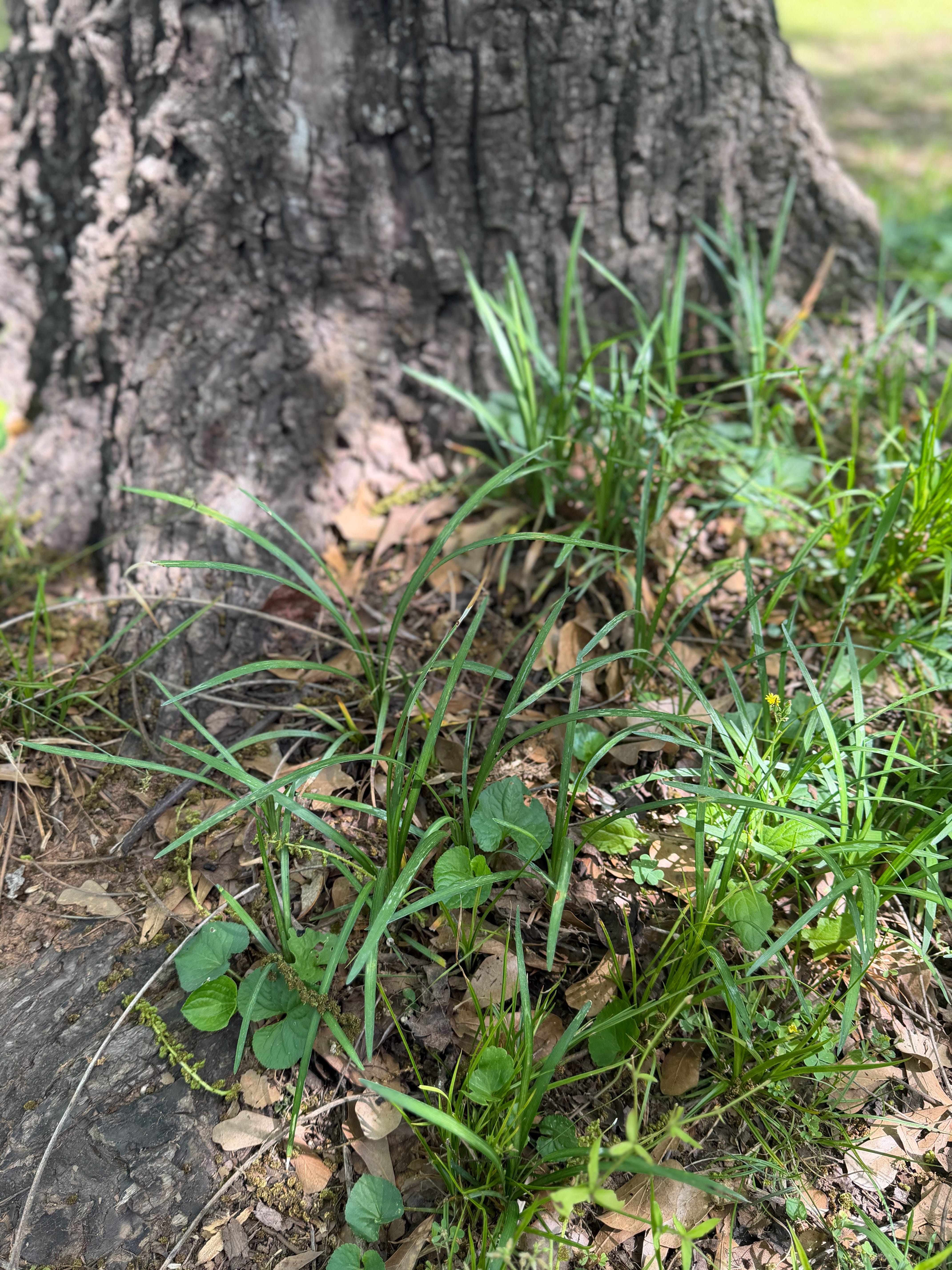
For weeks, I could see the shape of the walnut clearly... the architecture of the branching, the slight asymmetry, the branch that reaches further south than the others, as though it had learned something about sunlight that the other branches hadn’t yet. I knew the structure would eventually be hidden. The leaves would come in waves, the compound fronds opening outward from each bud in sequence, and by July, nothing would be visible but canopy. But while the “skeleton” as may be considered (perhaps unwisely) was still exposed, the light that fell through it onto the ground was detailed in a way it won’t be again until November.
What the walnut was also doing, below the surface, is more difficult to see but no less organized. The roots extend well past the dripline, releasing juglone into the soil... a compound that inhibits the germination and growth of a long list of plants that would otherwise compete for light and moisture. This is sometimes described as allelopathy, as though it were a kind of aggression, but I’m not sure that framing serves the tree or any tree doing similar things. The walnut is reorganizing the terms of its neighborhood, slowly and continuously, without announcement, in a way that reflects a long series of calculations about what kind of community it can thrive in, much like I tend our gardens. Those calculations include droughts like this one, and storms worse than drought... Hurricane Helene came through in 2024, and the walnut stood through it, the way it has stood through every wet and dry season this particular slope has offered, adjusting its chemistry, canopy, and root spread to whatever the year required. The plants that grow near a walnut have either adapted to juglone or learned to give it space. The soil remembers the tree’s decisions. What the tree remembers is harder to say, but I don’t think the question is as strange as it sounds.
The French philosopher Raymond Ruyer called this kind of self-organizing purposiveness “neofinalism”... the idea that living forms are not merely subject to chemical processes but are in some genuine sense the authors of them, that an organism surveys its own form from the inside in a way that has no spatial equivalent, no outside perspective from which to observe itself. The walnut releasing juglone, timing its leafing to the last reliable frost, shedding bark in the drought... these are not mechanisms running on the tree but expressions of what the tree, in Ruyer’s sense, already knows about itself and its situation. A wonderful distinction, and I think Ruyer is right. A mechanism can be interrupted. What the walnut is doing is more like memory made active, a long argument with its own conditions that nothing from the outside fully determines.
The Upstate is not a landscape that announces itself. The mountains that shape the region’s weather, light, and micro-climate are just over the line into North Carolina... you can clearly see the Blue Ridge from certain areas here in Spartanburg on clear days, as I do when I take our children to school on Union Street, but they don’t necessarily dominate the view. The rivers here run brown with tannins from the piedmont clay, and they move through terrain that is neither flat nor dramatically elevated, just undulating in a way that conceals its own organization from anyone moving through it quickly. You have to slow down. You have to develop the kind of attention the walnut practices... patient, cumulative, tracking the long-term pattern of temperature, soil chemistry, and available light rather than any single dramatic event.
Maurice Merleau-Ponty argued that perception is not something we do to the world but something we do with it... that the body and its environment are caught up in each other in ways that precede any deliberate act of looking. I think about this in May in the Upstate, when the light is doing something particular and the whole landscape is in a state of visible process rather than settled appearance. Perception here is a matter of learning the calendar the landscape is keeping, which is a different calendar than the one on the wall and which has as much to do with juglone concentration, frost probability, and the angle of morning light as it does with dates. I grew up learning one version of that calendar. I am still, after years in the Piedmont, learning another. Quarter 2 isn’t so scary anymore.
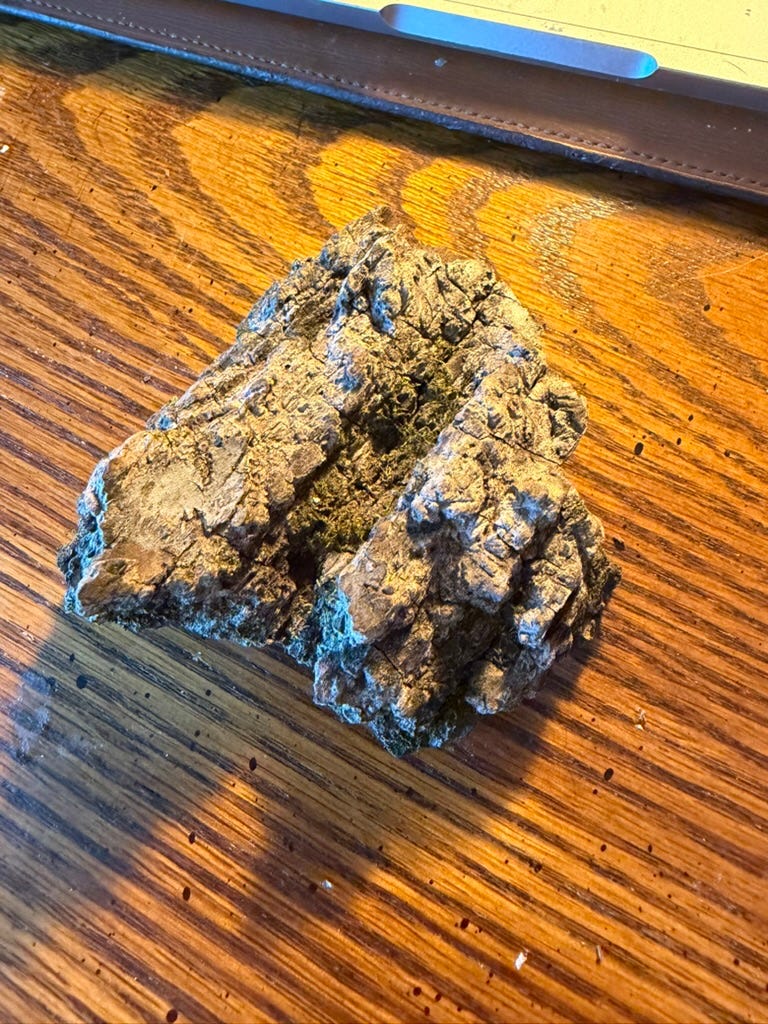
The leaves did come. I was sitting beside the walnut on this Tuesday morning in early May, upper sixties, blue sky, low humidity, the kind of weather we say we love because it fits our idea of what a morning should feel like, and the compound fronds had opened... bright green, almost translucent in the direct light, the leaflets still soft enough that they moved individually in the breeze coming through the yard. The honeybees had found the privet blooming along the fence and were working through it with their characteristic single-mindedness, indifferent to drought or season or the particular quality of the light. And there, at the base of the trunk where I usually sit and visit and attend (and be attended by) the walnut, was a piece of bark. A substantial piece, deeply furrowed, gray-brown, with a little lichen beginning its slow work on one edge. I don’t know when it fell or what loosened it... whether it was the wind, or the drought contracting the outer layers, or simply the tree’s ongoing process of shedding what it no longer needs. I picked it up and held it for a while, the way you hold something you weren’t expecting to receive. The texture was almost geological, more like a piece of eroded ridge than something that had been alive. Layers much like my beloved archaeological digs at Dura Europos or Nineveh. And I thought about what the tree had gone through to produce that texture, what decades of weather and drought and storm had compressed into that particular surface, and what it meant that the tree had left it there in my sitting spot on a morning when I happened to be paying attention. I don’t want to make too much of it. But I don’t want to make too little of it either. That is, I think, what the walnut keeps teaching... that perception requires us to stay in the register of what is actually happening, which is always more than our categories for it, and to receive what is offered without insisting on knowing in advance what it means.
That gift from the walnut now has a sacred place on my desk, and I just smiled as I stole a glance at it while typing this.
Further Reading
Raymond Ruyer, Neofinalism (1952; translated by Anika Skuli Reuter, University of Minnesota Press, 2016). The source of the “neofinalism” argument in my post here... can be very dense for a lay audience, but it’s worth your effort, especially the chapters on organic surveys and the inside of form.
Maurice Merleau-Ponty, Phenomenology of Perception (1945; translated by Donald Landes, Routledge, 2012). The philosophical ground beneath everything here is about bodies, environments, and the priority of perception.
Robin Wall Kimmerer, Braiding Sweetgrass (Milkweed Editions, 2013). The best existing model for writing about plant intelligence in an incredible way that neither oversimplifies nor overclaims.
David Abram, The Spell of the Sensuous (Pantheon, 1996). On perception, landscape, and what it costs us to stop attending to the more-than-human world.
Henri Bergson, Creative Evolution (1907; translated by Arthur Mitchell, Dover, 1998). For the argument about duration and living form that runs underneath Ruyer (which it inspired, as it does my own work).
Henri Bergson, Matter and Memory (1896; translated by Nancy Margaret Paul and W. Scott Palmer, Zone Books, 1988). Bergson on memory as something the body carries rather than the mind stores... relevant to what the walnut “remembers.”
Robert Tulecke, “Juglone: Autotoxin of Black Walnut,” Phytochemistry (various editions). For the actual chemistry behind the allelopathy claims, if you want to go further down that particular root.
Douglas W. Tallamy, Bringing Nature Home: How Native Plants Sustain Wildlife in Our Gardens (Timber Press, 2007). Practical and perceptual at once... good on the community logic of native trees, including walnut, in Piedmont landscapes.
Beautiful. I am learning a lot from your essays.